

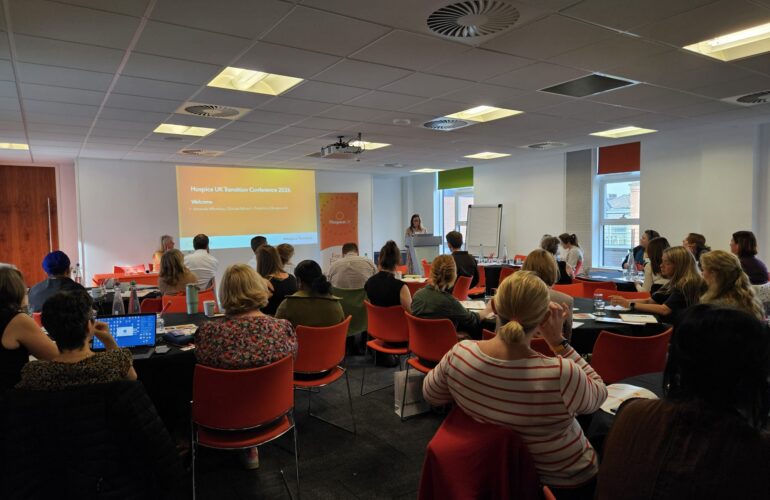
On 9th September delegates gathered in Manchester in the UK for a conference on transition, part of Hospice UK’s national transition programme. In the conference programme Amanda Whateley, Hospice UK’s Clinical Advisor for Transition, states that the aim of their programme is to ‘make transition the norm, not the exception’ – a powerful call to action for everyone working with young people as they move from children’s to adult palliative care services.
Presentations were wide-ranging, kicking off with Dr Andrew Fletcher from St Catherine’s Hospice, an adult hospice, and Dr Debbie Box from Martin House Children’s Hospice sharing models of joined-up working that featured early joint planning for patients, collaborative working, personalised care, workforce development and system leadership – all critical success factors for a good transition experience for young people.
Ben Troke, a health and social care lawyer, gave a fascinating overview of the legal framework in the UK for decision-making for young adults. He explained how the complicated legal jigsaw means that young people and their families have to pick their way through law pertaining to responsibilities of children and parents/carers, deputyship, mental capacity and deprivation of liberty. Ben highlighted My Adult still My Child – a useful resource that can help navigate the legal system for young adults with serious illness going through transition in England and Wales.
Sheila Brill, a bereaved parent and ‘unintentional campaigner for safer childbirth’, spoke of her experiences of caring for her daughter Josephine who was starved of oxygen during birth, leading to a catastrophic brain injury. Josephine died in 2017, aged 23. Sheila highlighted the critical importance of sensitive and honest communication with parents. Sheila has written a book about her experiences Can I Speak to Josephine Please
Dr Angela Brunn from Kingston University in London shared insights from the DAPPLE project which explores the development of effective service models for adult palliative and end-of-life care for people with a learning disability. Dr Brunn shared a case study of a young adult who took part in this ethnographic study.
After lunch, two parallel sessions provided an opportunity for interaction. One explored symptom management led by children’s palliative care consultant, Dr Megumi Baba, and adult palliative care consultant, Dr Emma Husbands, with a special focus on movement disorders and gastrointestinal symptoms. The other session, led by two members of the Acorns Children’s Hospice Team (Gemma Deely and Elizabeth Morgan-Williams) presented case studies to illustrate the wider social issues that impact young people with palliative care needs as they become adults.
Professor Sarah Earle from Nottingham Trent University and Sharon Warner from Rainbows Hospice facilitated a lively session ‘I’d rather talk about death than sex’ on some of the challenges that young people with life-limiting conditions face as they navigate relationships, intimacy and their developing sense of self. They encouraged delegates to think about their own values and the barriers to open conversations with young people about sex and sexuality. You can find resources developed by the Sexuality Alliance led by Professor Earle on their website: The Sexuality Alliance | Nottingham Trent University
The final session featured Dr Michael Tatterton from the University of Bradford and Dr Alison Rodriguez from the University of Leeds who spoke about the importance of a dignity-centred approach to meeting the needs of young people, listening to their voices and supporting person-centred planning for transition.
The day was a celebration of all that is being achieved for young adults with life-limiting illness. There is still a way to go, but it was especially heartening to see Hospice UK, the national body for hospices in the UK and Together for Short Lives, the national body for children’s hospice and palliative care working to bring adults and children’s care providers together for this programme.
By Lizzie Chambers, Programme Manager, ICPCN.


Leave a Reply