

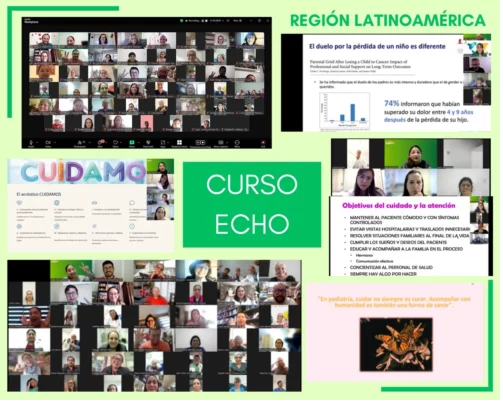
Testimonials from the ECHO Latin America Course – Introduction to Pediatric Palliative Care
Written by Gabriela García-Durán and Alex Daniels, ICPCN
Introduction
In Latin America, pediatric palliative care (PPC) faces persistent challenges: limited specialized training, restricted access, and insufficient collaborative networks. These challenges, however, also represent opportunities to transform care through systematic and collective education (Pastrana et al., 2021; ADAPT, 2023).
The acrostic REDES—Spanish for networks—articulates five key dimensions in which the teaching of PPC can catalyze sustainable change. In English, networking refers to the process of creating and sustaining meaningful professional connections to share knowledge, experiences, and support—an essential element of high-quality palliative care.
To illustrate these opportunities, we highlight the voices of healthcare professionals who participated in the Introduction to Pediatric Palliative Care – ECHO Latin America course, an initiative led by ICPCN in collaboration with Two Worlds Cancer Collaboration (TWCC). This course not only disseminates knowledge but also builds supportive professional networks, promotes practical guidance, and facilitates ongoing interdisciplinary training.
R – Reinforcement of Professional Competencies
Training in PPC strengthens clinical, communication, and ethical skills to provide comprehensive care for patients and families. In Latin America, fewer than 25% of healthcare providers have received specialized training in PPC (Bonilla, 2021; Pastrana et al., 2021).
“I found it very important to take the Palliative Care course, as it offered a comprehensive approach to patients in terminal situations. It addressed physical, psychological, social, and family aspects, providing an enriching and interdisciplinary learning space. I think including real case analysis as part of the sessions is an excellent idea. I congratulate the organizers and hope to continue participating in future events.”
Thanatologist María Eugenia Elizalde Velázquez, Instituto Nacional de Pediatría, Mexico
E – Empowerment of Professionals to Lead Change
Training empowers professionals to promote institutional best practices, advocate for inclusive public policies, and guide local initiatives that expand access and quality of care (Downing et al., 2018; Perez Cruz et al., 2016; Bonilla, 2021).
“Participating in the Certified PPC Course for Latin America ECHO 2025, from Margarita Island, Venezuela, was a wonderful journey—sharing experiences and knowledge through each topic, case, and material provided. It was truly a splendid and enriching space. That opportunity, from the other side of the screen, allowed me to envision a time when all countries, with the help of education and initiatives like this—combined with a shift in vision and action—will give Pediatric and Perinatal Palliative Care the same visibility and meaning.”
Dr. Rosalía Mercedes Romero Jurgensen Hospital Dr. Luís Ortega, Venezuela
D – Development of Communities of Practice
The ECHO model strengthens virtual communities where professionals exchange clinical experiences, build networks of support, and overcome geographic isolation (PAHO/OPS, 2021; Perez Cruz et al., 2016; Downing et al., 2018).
“This course was a great learning experience. The importance of the topics and how they were addressed made it even more enriching. Being able to share the perspectives of all our colleagues across Latin America allowed us to build networks.”
Dr. Maite Rosas Paetz, Pediatrician
Hospital San Juan de Dios, Chile
E – Educational Strategies to Improve Quality of Care
Active methodologies—such as real case analysis, clinical simulations, and collaborative learning—enhance symptom management, communication with families, and ethical decision-making (Downing et al., 2018; Perez Cruz et al., 2016; PAHO/OPS, 2021).
“Taking the Introduction to Pediatric Palliative Care course provided by ICPCN has given me the opportunity to improve the quality of medical care I provide to children and their families—especially to enhance the quality of life of children and adolescents living with incurable and life-threatening illnesses. I thank the organizing committee for the thoughtful selection of topics and congratulate each of the instructors for the valuable information shared during the course. Personally, all the topics were relevant, but without a doubt, the session on communication with families was an essential tool for my professional practice.
I hope these types of courses continue and that more healthcare professionals join and apply what they learn in daily practice.”
Dr. Carlos Benítez Pineda, Pediatrician Hospital Infantil de Especialidades de Chihuahua and Hospital General Dr. Salvador Zubirán Anchondo, Chihuahua, Mexico
S – Solidarity Among Specialists to Promote Well-being
Professional collaboration and transnational networking are essential to ensure dignified palliative care, even in resource-limited settings (Bonilla, 2021; Perez Cruz et al., 2016; Downing et al., 2018).
Conclusion The learning of PPC in Latin America is grounded in REDES:
• Reinforcement of competencies
• Empowerment of professionals
• Development of communities of practice
• Educational strategies
• Solidarity across regions
The role of ICPCN, TWCC, and the ECHO model is vital and strategic for building knowledge, creating practical guidelines, fostering collaborative networks, and strengthening collective leadership in pediatric palliative care. Education is not merely an academic pursuit, but an ethical commitment to the well-being of children.
In a region where thousands of children and adolescents with life-limiting or life-threatening conditions still face barriers to access, neglect, or lack of awareness, investing in education and collaboration is not a privilege, it is a human and professional duty.
Transforming pediatric palliative care is not the responsibility of a few, but a collective call to action. As a wise African proverb reminds us: “If you want to go fast, go alone. If you want to go far, go together.”
Connect with our community in Latin America! 🌎
Would you like to learn more about this course, future editions, other courses, webinars and educational resources in paediatric palliative care? Join our WhatsApp community and stay up to date with new learning opportunities across Latin America.
👉 Join us here: https://chat.whatsapp.com/BuUDxoEVRnY1CUoQ4uegBh
For further information, please contact:
Gabriela García-Durán
Education Officer, ICPCN
References
• Bonilla, P. (2021). Palliative care in Latin America. Revista de Nutrición Clínica y Metabolismo, 4(2), 4–13. https://www.redalyc.org/pdf/7182/718279904002.pdf
• Downing, J., Namisango, E., & Harding, R. (2018). Outcome measurement in paediatric palliative care: lessons from the past and future developments. Annals of Palliative Medicine, 7(Suppl 3), S151–S163. https://apm.amegroups.org/article/view/19946
• Pan American Health Organization (PAHO)/Organización Panamericana de la Salud (OPS). (2021). Palliative care in Latin America – ECHO. https://global.stjude.org/content/dam/global/en-us/documents/adapt-reports/latin-america/es/Spa-ADAPT-Mexico.pdf
• Pastrana, T., Lima, L., & Sánchez Cárdenas, M., et al. (2021). Atlas of Palliative Care in Latin America 2020 (2nd ed.). ALCP. https://cuidadospaliativos.org/uploads/2021/8/Atlas%20de%20Cuidados%20Paliativos%20en%20Latinoamerica%202020.pdf
• Perez Cruz, P. E., Rodríguez Núñez, A., & Leng, M. (2016). Challenges in Palliative Care Postgraduate Education in Latin America – Time for Collaboration. Indian Journal of Palliative Care, 22(3), 278–282. https://www.ncbi.nlm.nih.gov/pmc/articles/PMC4973439/


Leave a Reply