

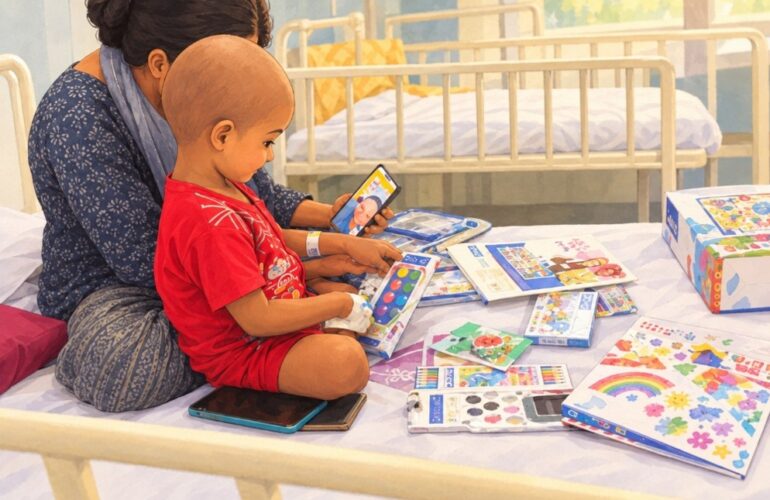
Before her cancer diagnosis, her mother described her as a joyful and playful three-year-old. She loved to smile, interact with her family, and play with other children.
After treatment began, however, her parents noticed a gradual change. She became increasingly withdrawn, rarely smiled, and showed little interest in interacting with those around her. Her illness seemed to be affecting not only her physical health, but also her ability to experience and express the simple joys of childhood.
During a routine psychosocial visit, social worker found her sitting quietly, turning away and showing little interest in engaging.
That afternoon, Golden Butterflies Children’s Palliative Care Foundation was distributing art kits as part of our ward-based psychosocial support programme. When the child received her kit, her mother shared that colouring had always been one of her favourite activities.
As she began exploring the colours and crayons, something changed. The child who had been withdrawn began to engage with the activity. Then, in a moment that stayed with us, she called out to her father.
For several weeks, she had barely interacted with him. Now, she wanted to show him the colours, the crayons, and the pages in her kit.
For her parents, seeing their daughter smile and reconnect with them was deeply meaningful.
More Than an Activity
In paediatric palliative care, creative activities can offer much more than a way to pass time. For children who may find it difficult to communicate fear, distress, boredom, or uncertainty, art can provide another language for expression.
It can also give children something that illness and hospitalisation often take away: choice and control.
A child can choose a colour, decide what to draw, and participate at their own pace. These simple choices can help preserve a sense of autonomy and identity during a period when much of their daily life is determined by treatment and hospital routines.
Most importantly, creative activities can create opportunities for children to experience themselves as children—not only as patients.
Preserving Childhood
Paediatric palliative care is not limited to managing symptoms. It also involves supporting quality of life, relationships, emotional wellbeing, dignity, and the child’s sense of self.
A drawing can become a conversation. A colouring activity can become shared time with a parent. A simple art kit can create an opportunity for connection.
For this child, the crayons did not change her diagnosis or treatment. But they created a bridge—a bridge between silence and communication, between withdrawal and connection, and between a child and her parents.
The experience at Golden Butterflies has reinforced an important lesson: meaningful psychosocial care does not always require complex interventions. Sometimes, small and familiar activities can create significant moments of connection.
When caring for children with serious illness, we must look beyond what the illness has taken away and ask what we can still help them enjoy, choose, create, and share.
Because paediatric palliative care is not only about adding days to life. It is also about ensuring that those days still contain moments of play, connection, dignity, and childhood.
And sometimes, that can begin with something as simple as a few crayons.
David Davey paediatric medical and psychiatric social worker and Manager of the Multidisciplinary Team (MDT) at Golden Butterflies Children’s Palliative Care Foundation, Chennai, India. His work focuses on psychosocial care, family-centred support, bereavement care, and multidisciplinary support for children with life-limiting illnesses and their families.




Leave a Reply