

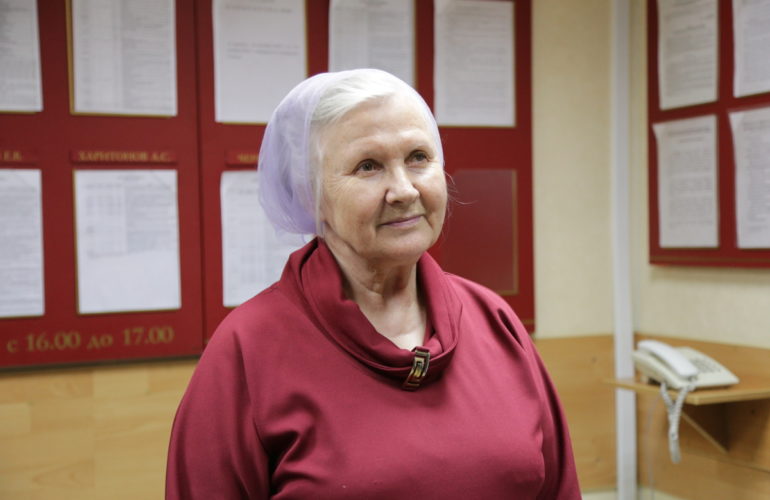
Writing to ehospice about the acquittal, Dr Khorinyak said: “When I heard the verdict, I felt the happiness of freedom, but I am still not fully aware of that, because for three and a half years I felt aggrieved and needed to control myself and I could not express my emotions. It is wonderful that the second judge was able to take a fair decision.”
The two women were charged in 2011, after they helped to obtain Tramadol for Victor Sechin, a family friend who was in the final stages of testicular cancer. Dr Khorinyak wrote the prescription, while Ms Tabarintseva purchased the medication.
Legal barriers to patient care
Under Russian law, only a patient’s own doctor can write a prescription for these medications. Overly restrictive laws regulating the prescription of opioids make most doctors reluctant to do so.
Writing to ehospice, Dr Khorinyak said: “I think that currently our judges have become accustomed to condemning doctors for minor violations in prescriptions of opioids, because usually they do not resist. We have several doctors at our polyclinic who have criminal records for prescribing medication to patients in need.”
Mr Sechin was entitled to free medication from the State, but stocks of this had run out at his local clinic. He needed a prescription to purchase medication from a different pharmacy for a fee, but was unable to get this essential document.
“When I came to the Sechins, Victor was by then at the last stage of his cancer, having spent his eleventh day without pain killers,” said Dr Khorinyak in an interview with the Russian news source, ‘Lenta’. “He was suffering. He wasn’t moaning – he was screaming. He was crying.
“I wrote a prescription for the paid medication and my friend bought it with her own money. It cost 286 Roubles (about $6). That was the moment when I consciously violated the administrative order. Victor was not my clinic patient.
“I was ready to be told off for that, because to look at a human suffering, knowing that you can help and not do anything is just wrong. I am a doctor. I swore to help people. But I didn’t expect to become a criminal.”
The charges
In 2013, a case was opened, with Dr Khorinyak being charged under article 327 of the Russian Criminal Code: ‘Forgery of documents in order to facilitate the commission of another crime’, and under article 234: ‘Trafficking potent substances in large quantities by prior agreement with the intent to sell, an organized group’.
The case went to court and Dr Khorinyak was given a fine of 15,000 Roubles.
“The first trial was very showy, with the prosecutor recklessly accusing me and demanding eight years in jail,” she said. “When the story went public, my colleagues and patients from all over Russia called me. Some of them offered to pay the fine for me because similar situations have been happening in other regions.”
An appeals court decision on 3 September 2013 voided the previous guilty verdict but sent the two women for retrial and also banned their lawyer from representing them, putting them at a disadvantage.
Despite this, on 21 October 2014, the Oktyabrsky Court of Krasnoyarsk acquitted Dr Alevtina Khorinyak and Ms Tabarintseva of the charges.
Pain relief in Russia
Dr Khorinyak said the case has been watched closely by the medical profession with doctors now scared to prescribe any painkillers, even in obvious cases.
Russia has been notorious for obstructive laws and policies which make it difficult – and often illegal – for patients to get adequate pain medication. In some cases, people have chosen to take their own lives or the lives of loved ones to end unbearable suffering. The suicide of the retired Admiral, Vyacheslav Apanasenko, brought these issues into the public spotlight.
Dr Khorinyak said: “Currently Russian doctors have been intimidated, they are afraid even to say the words ‘narcotic analgesics’ and they discourage patients from taking them, because the belief is that they will immediately be addicted.
“(Agents of) the Federal Drug Control Service constantly monitor all prescriptions at the pharmacies and act like clinical pharmacologists (without the necessary education), questioning why the physicians prescribed them. As a result, patients with pain do not have access to needed medications.
“The suicide of Admiral Apanasenko shocked everyone, but many unknown patients lie in their homes without any help.”
Dr Khorinyak’s case was highlighted by Human Rights Watch in their 24th annual World Report, using it to illustrate the need for governments to: “ensure that anyone with a legitimate medical need for controlled medications (…) has access to them.”
Justice
“It has been a matter of principle to get justice for me,” said Dr Khorinyak, speaking to ‘Lenta’ about her determination to win this case. “How can a doctor be prosecuted for helping their patient? Have people lost their hearts?”
She later expanded on this comment, saying: “International support from palliative care professionals gave us strength and faith in our innocence. My lawyers informed the court about this support from the medical community and I think it had a serious impact on all: on the court, on patients, on their relatives and on the whole society.
“Patients are becoming more aware that they have a right for pain relief; the doctors understand that patients should be treated. My acquittal showed them the way that they should not give up, they must fight, must protect their patients and themselves. And most importantly; it’s possible!”
Find out more about the case:
Stop ’Russian Roulette’ for patients and physicians
Human Rights Watch World Report 2014 features palliative care
Update from Russia: Dr Khorinyak
Ordeal extended for Russian doctor
Call for support for Russian physician prosecuted for helping a patient in pain
Russia: More pain – less opioids
The Siberian Times: Doctor cleared after giving painkillers to dying friend


Leave a Reply