


The development of palliative care (PC) in the Democratic Republic of Congo (DRC) remains insufficient, particularly in rural areas and among indigenous populations such as the Pende. However, traditional Pende medicine has a long tradition of caring for terminally ill patients, aiming to relieve pain and improve quality of life.
This article advocates for coexistence and structured integration between traditional Pende medicine (TM) and biomedicine in order to offer more comprehensive and culturally appropriate care to this population. Despite their methodological differences, these two systems share a fundamental goal: to relieve suffering and ensure a dignified end of life.
Socio-Cultural Context: The Pende People and Healthcare
The Pende people (or Bapende) constitute a major Bantu ethnic group primarily established in the south-western Democratic Republic of Congo (DRC), notably in the Kwilu, Kwango, and Kasai provinces, as well as in Angola. This predominantly rural population often faces limited access to biomedical health infrastructures, a factor that severely challenges the deployment of modern palliative care services.
The traditional Pende understanding of health and illness is profoundly holistic and collectivist, principles that directly influence end-of-life management:
- Matrilineality and Social Cohesion: Social organization, traditionally based on matrilineality, places the community at the core of the illness experience. The extended family and neighbours collectively undertake daily care, vigils, and prayers, ensuring that the terminally ill patient is “never alone”. This empathetic support is deemed essential to ensure a dignified end of life.
- Integration of the Spiritual: The Pende approach encompasses the patient’s physical, social, emotional, and spiritual well-being. The nganga (traditional healer) is a central figure, employing divination, herbal remedies, and magico-religious rituals to calm the mind and prepare the soul for the passage to the afterlife.
These ancestral practices constitute a culturally aligned PC system that predates biomedicine. Adherence to values of dignity and a holistic approach establishes a fundamental point of convergence with contemporary palliative care principles. Nevertheless, the introduction of biomedical PC encounters significant challenges in this context, positioning the structured integration of the two systems as an ethical and clinical necessity to provide comprehensive and appropriate care for this population.
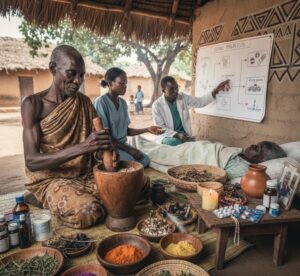
The traditional Pende approach to palliative care
Before the arrival of biomedicine, traditional medicine was the main source of healthcare among the Pende. Traditional Pende palliative care is characterised by a holistic approach that encompasses the physical, social, emotional and spiritual well-being of the patient.
Ancestral practices for relieving suffering and accompanying the end of life include:
- The use of medicinal plants: The Pende use a variety of plants, such as ‘mutaba’ for its analgesic and sedative properties, ‘mumbunze’ for digestive disorders, or ‘gakhonio’ for respiratory problems, prepared in the form of infusions, decoctions or ointments. The aim is to reduce pain and improve quality of life.
- Healing rituals: Led by traditional healers, known as ‘nganga’, these magical-religious rituals may include prayers, incantations and songs. They aim to calm the patient’s mind and prepare their soul for the passage to the afterlife.
- Community support: The supportive and empathetic Pende community plays a crucial role. Family and neighbours are involved in daily care, ensuring that the patient is never alone, and organising vigils and collective prayers. This essential support aims to ensure a dignified end of life.

The ‘nganga’ is a central figure, using divination, dialogue, and observation for diagnosis, preparing herbal remedies, and conducting rites of passage for the spiritual purification of the dying.
The Limitations of Tradition and the Challenges of Biomedicine
Despite its cultural alignment and accessibility, traditional Pende medicine has limitations, including:
- Management of severe pain: Medicinal plants are not always sufficient to relieve severe or complex pain.
- Lack of documentation: Knowledge is transmitted orally, without a fixed pattern, which can lead to poisoning or overdose.
- Lack of training: Healers lack formal training in the management of complex symptoms and modern care techniques.
For its part, the introduction of biomedicine in the DRC has brought significant advances in PC, including the use of powerful analgesics such as morphine for effective pain management and superior symptom control. It also includes professional care and psychological support.
However, its deployment in rural areas such as those of the Pende faces major challenges:
- Lack of resources: Inadequate health infrastructure and shortages of essential medicines.
- Shortage of trained personnel: Scarcity of professionals specifically trained in palliative care.
- Cultural mistrust: Cultural barriers and historical mistrust limit the acceptance of biomedicine by the Pende population.
Towards integration: A necessary coexistence
The integration of the two systems would overcome their respective limitations. The two approaches share important points of convergence: a common goal of alleviating suffering, a holistic approach (physical, emotional, spiritual), the importance of community support, and respect for patient dignity.
For successful coexistence, several key actions are recommended:
- Promote Training and Collaboration: Organise joint training workshops between nganga and health professionals to exchange knowledge on pain management and palliative care techniques. Set up joint consultations where biomedicine would contribute its expertise (blood pressure measurement, laboratory tests) to refine the traditional diagnosis.
- Training healers: Offer nganga training programmes on the basics of biomedical palliative care.
- Incorporating traditional remedies: Integrate effective traditional remedies into modern care protocols to complement biomedical treatments.
- Develop cultural education: Conduct culturally appropriate awareness campaigns to inform communities about the benefits of integrated care and reduce mistrust.
By combining the scientific rigour of biomedicine with the community support and holistic approach of traditional Pende medicine, it is possible to ensure better care and a dignified end of life for this population.


Un article riche et plein des saveurs scientifiques. Une telle étude nous plonge au cœur d’une dimension traditionnelle à considérer. Car la médecine traditionnelle porte des marques importantes et instructives dans la prise en soin des patients en fin de vie; bien qu’elle montre ses limites justement soulignées par l’auteur. Il reste à apprendre sur beaucoup de choses et démontrer avec le temps un mariage de complémentarité entre la médecin moderne et la médecine traditionnelle.