

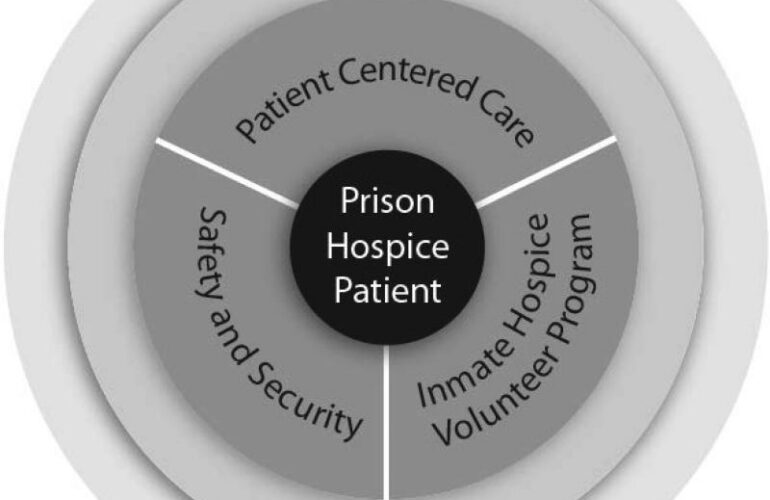
Following are selected articles, reports, etc., from the latest (September) posting. Access the monthly postings at: https://bit.ly/47sVCRU LAUNCHED IN 2024, THE END-OF-LIFE CARE BEHIND BARS WEBSITE fills a critical information and advocacy gap for a unique, often overlooked population. While general prison healthcare has gained attention, keeping pace with research on palliative care within correctional facilities remains a challenge for busy professionals.
As a dedicated advocacy, teaching, and research hub, this site streamlines access to essential knowledge. Users can find the latest developments, including curated reviews of articles and reports, in the monthly bulletins on the “Current Thinking” page, while the “Spotlight” page offers commentaries on several key issues. As this resource grows, it aims to foster a necessary shift in societal attitudes toward the care and dignity of incarcerated individuals at the end of life.
________________________________________________________________________________________________________
Care complexities: Progressing prison palliative care and compassionate release in Canada
THE MANITOBA LAW JOURNAL (Canada) | Online – Accessed 30 August 2026 – Prison populations continue to get older in Canada, and as aging levels increase, so do the complex health services that those held in custody require. Yet the intersection between the realities faced by older incarcerated persons and the structures for providing palliative care (PC) remains undertheorized and underdeveloped in Canadian law and policy. This article argues Canada must simultaneously: 1) recognize and operationalize a right to PC for incarcerated older persons, including through a properly resourced embedded hospice model in federal institutions; and, 2) enact a distinct, accessible, compassionate release regime tailored to the needs of aging and terminally ill prisoners. Only by designing these mechanisms together – around prisoner autonomy, choice, and dignity – can the best interests of older persons behind and beyond bars be realized. Drawing on scholarship, government reports, Correctional Service Canada policy, and Canadian and comparative case law, the authors show how existing pathways to care and release are fragmented and often ill-suited to the realities of aging in custody. Full text: https://bit.ly/4wWfOWU
“Corrections officers are trained for security, not hospice care”: Pennsylvania jail faces aging inmate crisis
CORRECTIONS1 (U.S.) | Online – 29 August 2026 – The number of Luzerne County inmates ages 60 to 69 has climbed sharply as officials weigh how to handle dementia, mobility limitations and end-of-life care (EoLC). During recent legislative testimony … Luzerne County Manager Romilda Crocamo highlighted the aging prison population as a concern that must be addressed. Older inmates with “escalating chronic health needs” are contributing to rising medical costs and challenging a prison staff “increasingly called upon to manage geriatric and EoLC in a setting never designed for it,” she told the Senate Majority Policy Committee and House Republican Policy Committee… “Corrections officers are trained for security, not hospice care” … emphasizing “graying behind bars” is an emerging issue statewide. Correctional staff training on handling dementia, mobility limitation and EoLC – skills she described as “far removed from traditional security training but increasingly central to the job.” Full text: https://bit.ly/4x1aEc9
Why prison officers matter in end-of-life care
ROYAL COLLEGE OF NURSING (U.K.) | Online – 27 August 2026 – In 2025, there were 394 deaths in prison custody, of which 224 were due to natural causes… People aged 50 and over accounted for 86% of all natural cause deaths. Prisoners die at a median age of 67.5 years, compared with 86.7 in the general population. Behind these numbers are real people dying in real cells, and the people most consistently present with them are not nurses or doctors, they are prison officers. Across two decades of literature, not a single study has examined prison officers’ experiences of end-of-life care as its primary focus. Their experiences, perspectives and emotional lives had been consistently overlooked. Most troubling: none of this appears to have meaningfully changed in twenty years. Should a prison officer provide care, or should they be caring? These are not the same thing. Nurses provide care; structured, professionally defined, underpinned by training and regulation. Prison officers are not nurses and should not be expected to be. But they are human beings working closely with people who are dying, and something happens in that proximity that goes beyond the custodial role. Full text: https://bit.ly/4chZ05s
Gasping for air
THE CHICAGO REPORTER (U.S.) | Online – 14 August 2026 – Diagnosed with ALS behind bars, Gary Sams fought for healthcare and freedom before it was too late. Sams’s hospitalization came after over a year-long battle to receive medical attention in Illinois Department of Corrections, which has long been scrutinized for providing inadequate healthcare. Stories of medical neglect and malpractice fill the pages of hundreds of lawsuits, including a high-profile class-action case that ended with a 2019 consent decree, the conditions of which have still not been satisfied seven years out. In 2022, Illinois became one of the last states to adopt a medical release law … which allows certain incarcerated people who are terminally ill or medically incapacitated to be medically released. After spending six months in a hospital … Sams became one of only 28 individuals to receive medical release in 2025. It was a shallow win – his condition had progressed to full-body paralysis by the time he was released. Full text: https://bit.ly/4gedjsL
Compassionate release: Physician overview
MEDICAL JUSTICE ALLIANCE (U.S.) | Online – Accessed 10 August 2026 – Compassionate release (CR) laws allow for the release of individuals who are imprisoned and have terminal or disabling medical conditions. CR helps provide individuals with more health support and access to loved ones while also decreasing the large burden of medical care on prison staff. The Federal First Step Act in 2018 expanded the use of CR and allowed for prisoners to file a motion for CR for themselves. Nearly every state has followed suit with specific laws and criteria. Despite laws such as the First Step Act, around 80% of requests are denied, with some states denying more than 95% of requests. Oftentimes, lawyers do not know the nuances of medical conditions or average prognosis. Similarly, parole boards and judges often lack the medical knowledge to determine whether an individual truly qualifies. Full text: https://bit.ly/4xtSvnY
Teaching prisoners to lead grief support groups
PSYCHOTHERAPY.COM (U.S.) | Online – Accessed 12 August 2026 – Most people are unaware that many prisons in the U.S. have hospice programs. What makes them unique is that they utilize select inmate volunteers to serve as caretakers for the dying. Most recently, psychiatry residents from Tulane Medical School were part of a new program that trained 31 caregiver-inmates at four different prisons in Louisiana to facilitate in-house grief groups. Depending on the number of participants, there could be up to 15 weekly meetings. The universal stages of grief were ever-present. Some men spoke of their loss in superficially lighthearted manner as to not disrupt the complex, darker emotions lying underneath the surface. Some shared their experiences of shifting between the various stages of grief. Some shared how they grew from the experience. In some ways, being isolated from the outside world made it easier to stay in denial for longer. It was difficult to have a sense of closure, there was limited opportunity in attending funerals or … to share the grief in-person with another family member. Full text: https://bit.ly/3UcObex
Three decades of the health promoting prison: A critical reappraisal of policy and practice
INTERNATIONAL JOURNAL OF PRISON HEALTH | Online – 21 August 2026 – This paper aims to provide a critical appraisal of the Health Promoting Prison (HPP) thirty years after its introduction by the World Health Organisation. It examines the extent to which the original settings-based vision has been realised; identifies areas of progress and stagnation; and, analyses how contemporary policy and structural conditions have shaped and inhibited the HPP’s trajectory. The analysis reveals a consistent gap between the rhetoric of the HPP and its real world implementation. While countries such as Scotland, The Netherlands and Portugal demonstrate structural reform aligned with HPP principles, progress elsewhere remains fragmented and predominantly behaviourist. The paper highlights how COVID 19 exposed deep systemic vulnerabilities to the HPP model and underscores the health and well-being of prison staff – critical to a whole prison approach – which remains marginalised in health policy and practice. Overall, the HPP remains conceptually compelling but operationally underdeveloped. Abstract: https://bit.ly/4gFXNY5
____________________________________________________________________________________
Barry R. Ashpole, Ontario, CANADA Biosketch: https://bit.ly/3XMTRs4
BARRY R. ASHPOLE is an educator and communications consultant living in Ontario, Canada. Now semi-retired, he has been involved in palliative and end-of-life care since 1985. He established the End of-Life Care Behind Bars website (https://bit.ly/4dU4qmi), an advocacy, teaching and research “tool” to inform and, hopefully, affect a seismic shift in society’s attitudes towards the health and well-being of the incarcerated. Regular postings include annotated listings of current articles, reports, and so on, culled from the professional literature, the news media and other sources.
Republish This Article
The author believes in the free flow of information. Republish this article for free, online or in print, under Creative Commons licence, with due credit to the author and source. https://bit.ly/47sVCRU
=============
ehospice is proud to help promote individual, local, national and international voices in Hospice & Palliative Care
We are on target to have over One Million page views this year.
To stay in touch with colleagues and news around the world subscribe to our free Newsletter






Leave a Reply