

Given that this year’s World Hospice and Palliative Care theme is “Pain Management: An Essential Part of Palliative Care” the IAHPC invites palliative care advocates to respond to this call for submissions from the Expert Panel of the Commission on Narcotic Drugs.
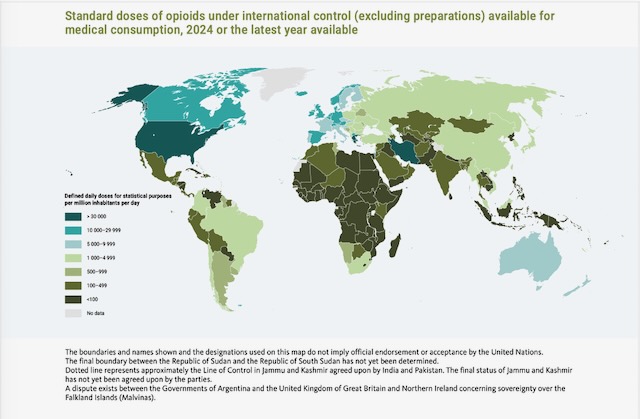
Source, UNODC World Drug Report 2026
Allan Rock, President Emeritus of the University of Ottawa, and Natalie Yu-Lin Morris-Sharma, Senior Director and Senior State Counsel at the Attorney-General’s Chambers of Singapore, co-chair the inter-disciplinary expert panel, constituted by members from Algeria, Australia, Belgium, China, Colombia, the Czech Republic, Ecuador, Egypt, India, Latvia, Malaysia, Morocco, the Netherlands, Paraguay, Peru, Ukraine, and the USA.
Drug policy and palliative care? Really?
Palliative care and international drug control are joined at the hip, legally speaking, since essential palliative care medicines such as morphine and other opioid analgesics are listed in the schedules of the (1961/1972) Single Convention on Narcotic Drugs. This sets them up for special national and international monitoring and control measures.
Since the Convention was drafted, approved, and adopted by member states long before the development of palliative medicine and substance use disorder treatments, most governments, in their efforts to prevent diversion and misuse, adopted regulations and restrictions that have made them largely unavailable in most of the world as the map shows.
Those regulations need a second look!
The Expert Panel can ask your governments to take that second look if they receive accurate evidence and recommendations on the topic.
In two words: what you can advocate for
Balanced regulations. The central principle of “balance,” developed by palliative care advocates to improve the situation on the ground in countries where access is inadequate, represents the dual obligation of governments to establish a system of control that
(1) ensures the adequate availability of controlled substances for medical and scientific purposes while
(2) discouraging their nonmedical use, diversion, and trafficking, two primary goals of the international control system.
On the one hand, although strong opioids, including morphine, are absolutely necessary for the relief of severe pain, legitimate access to opioids for pain treatment and palliative care is lacking in the majority of the world’s countries.
On the other hand, diversion and nonmedical use are increasingly prevalent in a few high-income countries with higher , poorly regulated, opioid availability.
Diversion and non-medical use are not necessary consequences of adequate availability provided health workers who regulate, oversee, prescribe and administer opioids have proper clinical and ethical training.
Act now to make the situation in your country visible!
The Expert Panel needs to hear from those of you who work at the coal face, in the trenches, with patients, as pharmacists and caregivers, about the problems they face getting the essential medicines the need to relieve patients’ pain.
It would also be good to air stories about whether people go to the black market when they can’t find what they need in the pharmacy, and what the consequences of that are.
Read the call for submissions carefully, consult with colleagues, and begin drafting. This is the chance of a lifetime to contribute to an important international discussion that could well improve care at the bedside in your country.
The 1500 words you will submit by November 15 must include some concrete recommendations that relate to the problems you encounter in your own setting.
Your voice is very important.
If you have any doubts or questions, please feel free to email me at kpettus@iahpc.com.
Katherine Pettus, PhD Senior Advocacy and Partnerships Director
International Association for Hospice and Palliative Care
——————–
ehospice is proud to help promote individual, local, national and international voices in Hospice & Palliative Care
We are on target to have over One Million page views this year.
To stay in touch with colleagues and news around the world subscribe to our free Newsletter


I don’t know if this belongs here but we should look at CD wastage in “first world” countries. There must be a way to donate CDs that are within date and have been stored in controlled conditions. At the moment we are denaturing / destroying them when a patient switches opiates, dies or goes home without them just because they are allocated as “patients own”. There are serious problems with access for patients in other countries and we are literally chucking ours away.
Yes, i agree we need to advocate for availability and adequate controlled drugs for our clients.