

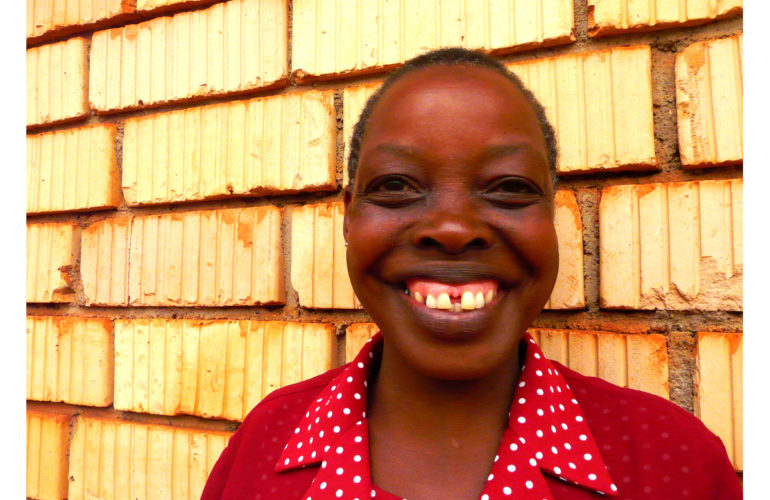
Annie is a short woman who holds herself tall and is never without a friendly smile. She talks about her voluntary work at the Joint Clinical Research Centre, where she offers support for children living with HIV.
“I thought there was no hope until someone helped me. Now I want to help these children,” she explains.
The Joint Clinical Research Centre where Annie volunteers is a HIV/AIDS care and research institution which provides a range of services for people living with HIV/AIDS, including support for young people. It is also a recognised medical research centre and has contributed to groundbreaking HIV/AIDS trials including the first African Antiretroviral (ARV) drug trial in 1992.
The clinic provided the drugs that the HIV positive children need, and Annie runs workshops with the children in arts and crafts, drama, and singing.
The workshops encourage the children to come regularly to have check-ups and pick up their ARV drugs, which must be taken regularly to be effective.
The clinic can only provide the children with ARVs, so Annie helps them make and sell colourful beaded necklaces and other crafts to raise small amounts of money. This can be used to buy other medicine needed to treat children with malaria or fevers. “There is so much they need,” Annie explains, “soap, food, clothes. I wish I could do more, but there just isn’t enough money.”
Many of the children who participate are orphans and have to look after younger siblings. The workshops provide an opportunity for them to play and many of them look up to Annie as a surrogate parent figure. “It is important,” Annie says, “that the children have fun and learn to have some hope.”
Annie knows from personal experience the importance of hope when living with HIV. She lost her husband to AIDS, but is thankful that the disease was not passed on to her now 19 year old son.
When Annie discovered she had HIV, she was devastated and for some time her family were very worried about her. “But now,” she beams, “my son does not need to worry – he can leave the house and he knows I am well.”
Uganda is widely held up as a success story for tackling the spread of HIV/AIDS. With nearly a third of the population infected with HIV in some areas in the 1990s, the prevalence of HIV was reduced to 14% by 1998. But worryingly, reports show an increase in HIV prevalence in recent years, rising from a low of 6.4% in 2006 to 7.3% in 2012. Many, including Annie, are worried about this increase.
Annie has now lived for over 10 years with HIV. She believes that telling the children openly that she is HIV positive helps them not to be ashamed. As a strong, healthy and positive mother, it also helps to show them it is possible to be HIV positive and to lead a happy and fulfilled life.
But life hasn’t always been easy. Annie was the headteacher of a school for children with learning disabilities when she was diagnosed with HIV. Despite the fact that her son is not HIV positive, they both experienced discrimination.
“They were scared that my son would give the children HIV so the other children wouldn’t play with him or touch anything he touched,” she explains. Because of the discrimination they faced, Annie chose to leave her job.
She now works full time caring for adults with learning disabilities, as well as volunteering whenever she can at the Joint Clinical Research Centre.
Annie is also the centre of the local community, always ready to help with a smile or a cheerful word. Yet few know of the extraordinary work that she does or the journey she has been on.
Anne, in her own quiet way, is striving for change and working tirelessly to make the world a better place.


Leave a Reply