

On World Hospice and Palliative Care Day, it is time for governments to stop treating pain relief as optional
By Howard Kinyua, Communications Manager – Worldwide Hospice Palliative Care Alliance
Over twenty million people will die in unnecessary pain this year. Not because we lack the science to prevent it. Not because the medicines do not exist. But because the world has made a quiet, largely unexamined decision that the relief of pain at the end of life is, for most of the people on this planet, simply not a priority.
That decision has a cost. It is measured not in policy documents or budget lines but in the final hours of a mother in sub-Saharan Africa, a child in South Asia, an elderly man in a rural community where the nearest clinic has never stocked morphine and the nearest policymaker has never been asked why. It is measured in the silence of suffering that goes unnamed, unreported, and most damagingly unaddressed.
On 10 October, the world marks World Hospice and Palliative Care Day. This year’s theme, Pain Management: An Essential Part of Palliative Care, is not a gentle invitation to reflect. It is an indictment. And it demands a response from every government that has signed a commitment to Universal Health Coverage while leaving pain management out of its national health strategy.
The Crisis is Not Complicated. The Inaction Is.
Let us be precise about what we are dealing with. Over 73 million people require palliative care every year. Of these, only around 14% receive it. More than 75% of the global need sits in low- and middle-income countries, the very countries where health budgets are tightest, opioid regulations are most restrictive, and the gap between a patient’s suffering and a government’s awareness of it is widest.
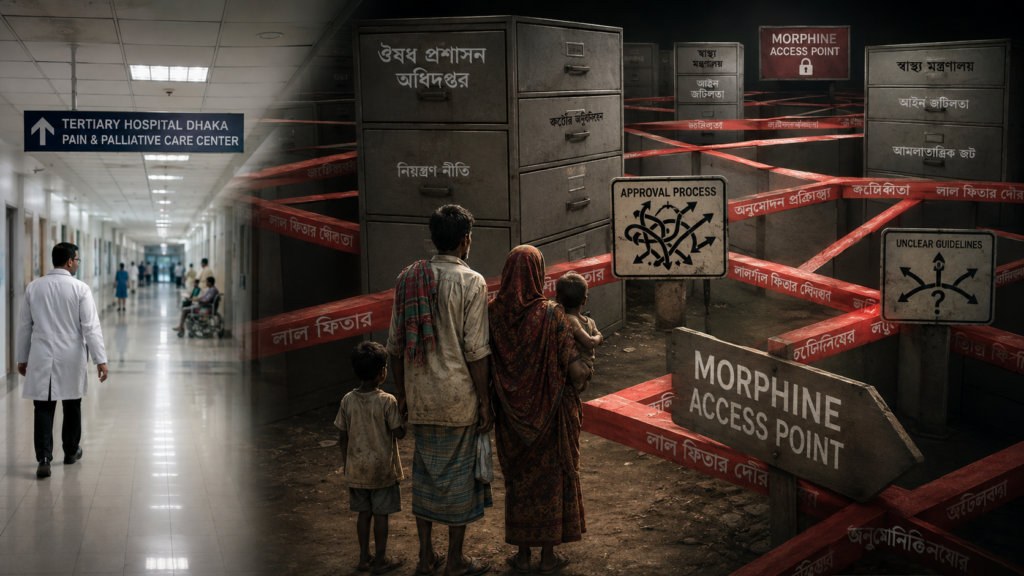
Oral morphine is one of the most effective medicines for managing severe pain at the end of life and can cost pennies in USD per dose. It has been on the World Health Organization’s Model List of Essential Medicines for decades. It is neither experimental nor expensive. Yet over 75% of the world’s population lives in countries with inadequate access, blocked by regulatory frameworks designed in a different era, for a different problem, and never adequately reformed.
This is not a supply problem. It is a political problem dressed up as a logistical one. And it is long past time we named it as such.
The 2025 Global Palliative Care Ranking, the first comprehensive assessment of its kind across 201 countries using WHO indicators, confirmed what those of us working in this field have known for years: medicine access remains one of the weakest dimensions of palliative care development globally. Countries that score relatively well on policy and education frameworks continue to fail their patients at the point of medicine availability. In many countries, the gap between a national palliative care strategy on paper and a patient receiving adequate pain relief in practice is vast.
Stigma is Doing the Work That Policy Should Be Doing Instead.
There is a less visible dimension to this crisis that data alone does not capture. In many communities across Africa, Asia, Latin America, and beyond, pain is culturally accepted as an inevitable companion to serious illness. Patients do not ask for relief because they have been taught, explicitly or implicitly, that asking is a sign of weakness, or of giving up, or of something morally suspect. Families watch their loved ones suffer in silence because the silence has been normalised.
Healthcare workers, meanwhile, face a parallel stigma from the other direction. Clinicians in low- and middle-income countries frequently operate under restrictive opioid prescribing regulations that expose them to legal risk for doing precisely what good medicine requires. The result is a system in which the patient is afraid to ask, the clinician is afraid to prescribe, and the suffering continues invisible, preventable, and entirely the consequence of policy failure.
This is not compassionate governance. It is not even neutral governance. It is an active choice to prioritise regulatory caution over human dignity, and it has a body count.
We Must Treat the Whole Pain, Not Just the Physical Symptom.
More than sixty years ago, Dame Cicely Saunders, the founder of the modern hospice movement, introduced a concept that remains as radical today as it was when she first articulated it: total pain. Saunders understood, from her years of work with dying patients at St Christopher’s Hospice in London, that pain at the end of life is never simply physical. It is a compound experience physical, psychological, social, and spiritual and that treating only the body while leaving the mind, relationships, and soul unattended is not pain management. It is pain management abandoned halfway.
Her insight was not merely clinical. It was a moral argument. A patient who is physically sedated but emotionally terrified, socially isolated, and spiritually despairing has not had their pain managed. They have had one dimension of their suffering addressed while the rest is left to consume them. Saunders refused to accept this as adequate care, and so must we.
The implications for policy and practice are significant. Yes, access to opioids is non-negotiable without adequate medicines for physical pain; everything else is built on an inadequate foundation. But the goal of palliative care is not simply to remove pain from the body. It is to restore as much as possible of a person’s ability to live with dignity, connection, and peace in whatever time they have remaining. That requires a multidisciplinary response: trained physicians and nurses who can manage physical symptoms, yes, but also psychologists, social workers, chaplains, community volunteers, and family caregivers who can address the fear, grief, loneliness, and existential anguish that so often accompany serious illness.
Pain that is rooted in the terror of dying, in the anxiety of leaving children behind, in the guilt of being a burden, in the unresolved grief of a life’s fractured relationships, in the spiritual search for meaning at the edge of existence cannot be treated with morphine alone. It requires listening. It requires presence. It requires systems that value the whole human being, not just the biological organism.
This is what Saunders gave us: a framework sophisticated enough to hold the full complexity of human suffering, and humble enough to admit that medicine alone is not enough. In 2026, we must build health systems and train workforces that are equal to that framework. Governments that invest in opioid access without also investing in psychosocial and spiritual care are solving half the problem and calling it done. Total pain demands a total response.
What Governments Must Do Now!
Advocacy without specificity is noise. So let me be direct about what is needed.
First and most urgently: governments must review and reform national opioid access policies to remove barriers that prevent the medical use of morphine and other essential analgesics in palliative care settings. Uganda demonstrated more than two decades ago that this is achievable — making oral morphine available free of charge through government health facilities and building a replicable model that others have been too slow to follow. There is no credible argument, in 2026, for why more countries have not done the same.
Second: pain management must be explicitly named and funded within Universal Health Coverage frameworks. It is not sufficient to include palliative care as a general category in a UHC benefit package and assume that pain relief will follow. It must be specified, budgeted, and monitored. Countries like Kenya, Chile, and Mongolia have demonstrated that UHC inclusion of palliative care is achievable and delivers measurable results. The political will to replicate this exists, or it should.
Third: governments must invest in the workforce, and that investment must go beyond prescribing. Holistic pain management requires interdisciplinary teams: physicians, nurses, psychologists, social workers, spiritual care providers, and trained community volunteers working together around the patient. Even where medicines are available, pain goes undertreated because health workers lack the training to assess and manage its full dimensions. Palliative care education must move from the periphery of medical and nursing curricula to its centre, and must include the psychological, social, and spiritual dimensions of care that Cicely Saunders identified as inseparable from the physical.
Finally, children must be explicitly included. About 14% of those who need palliative care are children, the majority in low- and middle-income countries, yet paediatric pain management remains critically underfunded and deprioritised globally. Age-appropriate medicine formulations, paediatric-specific training, and dedicated funding for children’s palliative care are not optional extras. They are obligations.
The Measure of a Health System is How it Treats its Most Vulnerable.
There is a phrase that has guided this movement for years: palliative care is everyone’s business. It is true. But it is also, increasingly, a statement that risks becoming a comfortable way of distributing responsibility so broadly that no single actor feels the full weight of it.
So let me narrow the frame. Pain management in palliative care is, specifically and urgently, the business of health ministers who have signed UHC commitments without ensuring their countries can prescribe morphine. It is the business of finance ministers who have cut health budgets without considering what austerity costs in human suffering at the end of life. It is the business of regulatory agencies that have restricted opioid access in response to misuse without simultaneously protecting the right of dying patients to adequate relief.
The rest of us the advocates, the clinicians, the researchers, the communications professionals, the caregivers are doing our part. We are naming the problem, building the evidence, training the workforce, and refusing to accept unnecessary suffering as inevitable.
On 10 October, World Hospice and Palliative Care Day, we ask governments to do theirs.
Over twenty million people will die in unnecessary pain this year. That number does not have to be the same next year. The medicines exist. The models exist. The evidence exists. And thanks to Cicely Saunders, the framework for treating the whole person body, mind, spirit, and community has existed for over half a century.
What is needed now is the political will to act and the recognition that every year of delay is not a policy gap. It is a human tragedy.


It is a crime against Humanity to let patients die in pain. I know how difficult it is to get morphine to alleviate the pain & suffering of the slowly dying. When will the governments wake up & act, God alone knows.