

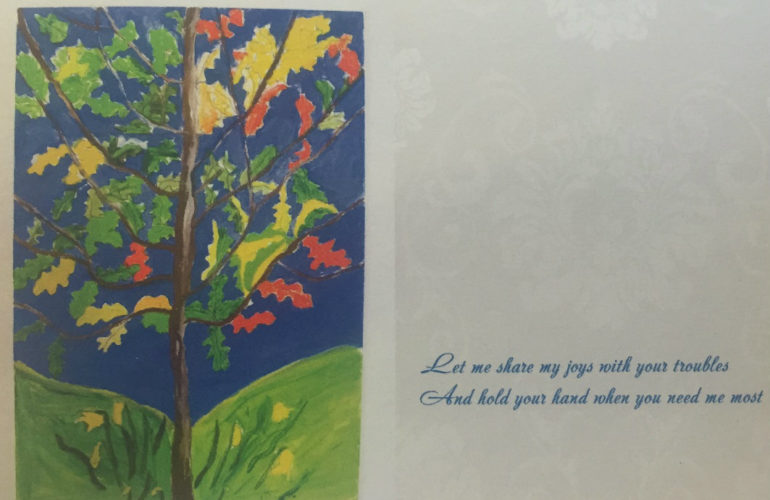
Staff at the Brooklodge Nursing Home in Co Galway came up with the initiative after taking part in the Irish Hospice Foundation’s Journey of Change – a programme developed for the residential care sector.
Ann Cummins, Brooklodge Nursing Home’s Director of Nursing spoke about the sympathy card at the IHF’s recent Innovation & Excellence: End of Life Care in Residential Care Settings seminar.
Ann said: “It was after taking part in Journey of Change the staff got together and were looking at ways to make the end of life better for people.
“Staff came up with the idea of the card and consulted the residents about it, however they suggested that it could also be used for other purposes too for example if someone was ill or in hospital.
“They feel this is a legacy they can leave and their families will be supported when they pass away. They also wanted the card to be bright as death is a part of life.”
Residents who were taking part in an art class got together and with the help of an artist designed the card. The image on the card is of an oak tree that was planted in the grounds of the nursing home in memory of all of the residents whose lives have passed away in the nursing home.
It contains the words: “Let me share my joys with your troubles. And hold your hands when you need me most.”
The residents also designed a wreath card with the same oak tree image to send to bereaved families.
Ann was among a range of national and international speakers that spoke at the one-day seminar held in Tullamore on October 20th.
The one day event was organised to support staff to deliver the highest quality end-of-life care to people living in residential care settings.
A quarter of all deaths in Ireland every year – about 7,500 occur in a residential care setting.
The seminar was attended by more than 100 nurses, healthcare assistant and education providers who work in residential care.
Anna de Siún, National Development Coordinator of Journey of Change said: “Good end-of-life care can only be delivered where there is recognition of the uniqueness of each person’s journey through life and a shared understanding of the importance of supporting and respecting each individual person’s needs and wishes on that journey.”
The European perspective on end-of-life care, diagnosing spiritual pain and the importance of self-care were among the topics discussed.
Ann Cummins was among the front front-line staff that outlined innovations in end-of-life care happening around the country.
Sinead O’Donoghue, Clinical Nurse Manager at Caherass Nursing Home, Limerick said they now ensure that all staff are involved in end-of-life care planning, no longer ‘just the nurse’.
Breda O’Donovan, Clinical Nurse Manager from Bandon Community Hospital said staff have more confidence in communicating sooner to residents and families about end of life decisions after learning through A Journey of Change
Professor Richard Groves, Co-Founder and Executive Director of the Sacred Art of Living Center, Oregon spoke about “The Art of Diagnosing Spiritual Pain” at end-of-life.
Professor Sheila Payne, Emeritus professor, International Observatory on End-of-Life Care, Lancaster University spoke about “An Innovative Intervention to Improve Palliative Care in Long Term Care Facilities in Europe (PACE) project.
Interior designer, Will Seaman spoke from Dublin spoke about Spending Time with “the One and Only” his mother Lily who is now in a nursing home.
Lily is now in her 90s and has dementia .Will spoke about the special relationship he still enjoys with his mother. They still have chats although they are now different, he still takes photographs with her and puts them on social media.
I realised if I was to continue to chat to my mother I better started learning a language she was able to understand.
“I have often described that learning experience as: “Turning the keyboard upside down” The vocabulary is there – you just have to look harder. Construct your sentences differently,” he said.
Breffni McGuinness, Irish Hospice Foundation, Bereavement Services, Training & Development Manager said nursing homes and hospitals must acknowledge the emotional impact caring for someone at end-of-life has healthcare workers.
Healthcare workers were also advised that they must take sure that they “mind themselves” too when caring for patients at end-of-life.
“What we know that working in end-of-life care with people who are dying is very rewarding but can also be very demanding for people both emotionally as well as physically and psychologically.
“This kind of work does have an impact on you and in order to stay healthy and to stay enjoying the work and feeling fulfilled in the work you need to mind yourself in that.”
He added: “The thing about self-care is it won’t happen by itself, you have to be proactive and you have to take responsibility and build it into your schedules. The time you most need to take a break and the time you most need to look after yourself is that time when you feel you can’t.”
He urged healthcare works to make sure they “have balance” in their lives by ensuring they are eating well, exercising, taking breaks from work, and doing the things they enjoy in life.
Mr McGuinness said work places also need to acknowledge that staff are impacted by this work. He said organisations need to be supportive of staff and proactively support the impact working in end-of-life situations have on staff.
Interior designer, Will Seaman spoke from Dublin spoke about Spending Time with “the One and Only” his mother Lily who is now in a nursing home.
Lily is now in her 90s and has dementia .Will spoke about the special relationship he still enjoys with his mother. They still have chats although they are now different, he still takes photographs with her and puts them on social media.
I realised if I was to continue to chat to my mother I better started learning a language she was able to understand.
“I have often described that learning experience as: “Turning the keyboard upside down” The vocabulary is there – you just have to look harder. Construct your sentences differently,” he said.
So far more than 105 nursing homes have taken part in Journey of Change training.
Croghan Active Retirement Group performed two short sketches they developed showing how families can disempower an older person by smothering them and the second sketch on how older people can empower each other to still be active.
The Irish Hospice Foundation’s Journey of Change’ provides staff with information on all aspects of end-of-life care, from the losses a resident may be experiencing as they move into a nursing home, to initiating discussions with residents about what care they may or may not like in the future.
‘A Journey of Change’ gives staff the training and tools they need to reflect on their end-of-life care practices, to celebrate what is being done well, to see what could be done differently, and to make effective change, where change is needed.
The Irish Hospice Foundation seminar was supported by HSE NMPD.


Leave a Reply