

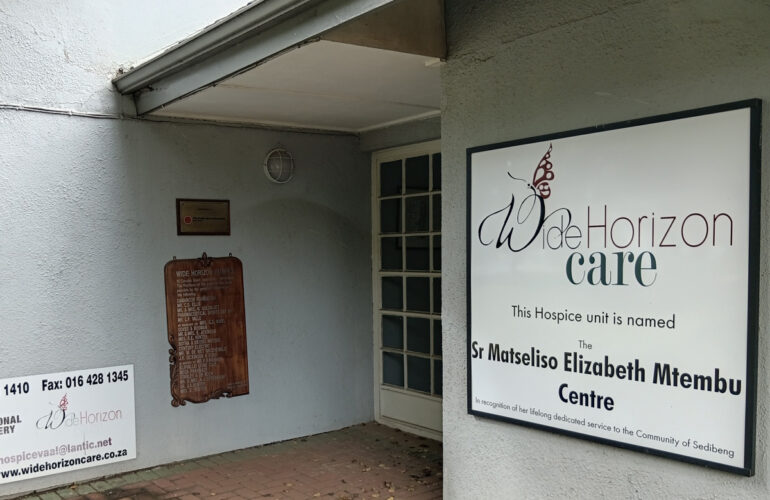
For decades, Wide Horizon Hospice has provided comfort, dignity and compassionate care to patients and families across South Africa’s Vaal Triangle.
But, like many hospices operating in an increasingly difficult funding environment, the organisation faced significant challenges in the years following the COVID-19 pandemic. Declining funding, staffing pressures and rising operational demands eventually resulted in the closure of its In-Patient Unit.
It could have been the beginning of the end for a much-needed community service.
Instead, it became the catalyst for a different approach, one built on collaboration, shared responsibility and a determination to protect access to palliative care.
Throughout this difficult period, Wide Horizon’s board, staff and volunteers worked to preserve services wherever possible. Despite increasingly constrained resources, the organisation remained focused on the patients and families who depended on its care.
Eventually, however, it became clear that securing the long-term future of hospice services in the Vaal Triangle would require additional support.
Wide Horizon Hospice approached Stepping Stone Hospice & Care Services to explore how the two organisations could work together to ensure that palliative care remained available within the community.
Following extensive planning and due diligence, Stepping Stone assumed responsibility for the management of Wide Horizon.
The partnership was not approached simply as organisational expansion. At its heart was a shared commitment: that people living with serious and life-limiting illnesses in the Vaal Triangle should continue to have access to compassionate, quality palliative care close to home.
On 29 June, that commitment reached an important milestone when the Wide Horizon Hospice In-Patient Unit officially reopened.
Restoring more than beds
The reopening represents considerably more than the return of an inpatient facility. It reflects the determination of one hospice to preserve its purpose, the willingness of another to step forward in support, and a shared recognition that protecting access to palliative care sometimes requires new ways of working.
The In-Patient Unit has initially reopened with 10 beds, with a phased approach intended to support sustainable growth while maintaining high standards of patient care.
Home-based care services are already operational, supported by strengthened governance, shared clinical oversight and integrated operational support.
The partnership has also created employment opportunities within the local community and introduced initiatives intended to strengthen the hospice’s longer-term financial sustainability.
Among these is the Pink Bin campaign, through which residents, schools and businesses are encouraged to donate pre-loved goods. These are sold through the hospice charity shop, with proceeds helping to support patient care.
Volunteers, businesses and other community partners will remain central to these efforts.
“It is about restoring hope”
Speaking at the official reopening, Stepping Stone and Wide Horizon Hospice CEO Tersia Burger emphasised that the occasion represented far more than reopening a building.
“It is about restoring hope. It is about ensuring that people living with serious and life-limiting illnesses have access to compassionate, quality care close to home. It is about reaffirming a fundamental belief that every person deserves dignity, comfort, respect and support, regardless of their diagnosis, age or circumstances.”
The reopening was made possible not only by a new management partnership, but by the people who protected the organisation and its purpose during its most difficult years. The dedication of its board, staff and volunteers ensured that a legacy of care remained intact and could ultimately be strengthened for the future.
A wider lesson for hospice and palliative care
Wide Horizon’s experience will resonate with hospices well beyond the Vaal Triangle. Keeping services running in the face of funding constraints, staffing shortages and growing operational costs is a reality many organisations know only too well. In this case, finding a way forward meant being willing to work differently and, ultimately, working together.
There are no simple solutions to these pressures, and every organisation operates within its own circumstances. Wide Horizon’s experience does, however, show what collaboration can make possible. Sharing expertise, strengthening governance and integrating resources created a way forward when continuing alone was no longer sustainable.
At the heart of those decisions were the patients and families who rely on hospice care. For the people of the Vaal Triangle, the outcome is tangible: inpatient palliative care is once again available close to home.
That is perhaps the most important measure of what has been achieved. Wide Horizon has entered a new chapter, but the purpose that sustained it through its most difficult years remains unchanged: ensuring that people living with serious and life-limiting illness can receive the care, dignity and support they need.


Leave a Reply