

“Without a community involvement at the end of life, professional involvement must become a rationalization and poor substitute for the multidimensional relationships that any one person enjoyed before encountering the local health service.” (Kellehear A 2009:ix)
This declaration sums up the need for service providers to acknowledge and appreciate the role of community in people’s access to health care services.
My study in 2007-2008 demonstrated that many people in Birmingham have an affiliation to some kind of community group. It is these community groups that are, in many cases, first on the scene and last to leave in times of celebrations, illness or bereavements.
Birmingham St Mary’s Hospice is situated in the south of the city of Birmingham, in the West Midlands. The city has a population of about one million people; a third of who are from Black, Asian and other Minority (BAME) communities (2011 census). We also work in Sandwell, one of Birmingham’s neighbouring boroughs.
In 2006 the hospice commissioned a perception survey to better understand the extent to which people in the city were aware of the services we provide. The researchers found that people from BAME communities had not responded to the survey and recommended that we find ways of engaging with them. This appeared to confirm anecdotal evidence from hospice staff that a limited number of patients from BAME communities were accessing our services.
The hospice employed a designated social worker to carry out work with local BAME community groups to identify barriers to hospice care services for them and how these could be addressed. Some of the findings from that work were that:
- there was a lack of information about hospice care services within BAME communities
- people from the diverse religions expressed fears to do with ‘spiritual safety’ in a hospice whose name originated from Christian traditions
- there were fears around personal care that was not gender sensitive
- fears around religiously/culturally defined diets and practices not being respected
- being the only one looking different on the ward.
Recommendations
The main recommendation was that the hospice needed to mainstream diversity and equality into the DNA of the hospice.
In order to achieve this, major changes would have to be made in several areas within the organisation, including a review of the Human Resources recruitment and retention policy, a review of the spiritual care provision and a review of the Diet and Hydration policy and an annual review of the of the hospice’s Reaching People Agenda.
And to form stronger relationships with local communities, it was recognised that the hospice would need to provide staff training on diversity and equality and form closer links with the media targeting BAME communities in order to raise awareness. To strengthen this further it was recommended that the hospice established an Equalities Service Development Team.
The building’s décor would also need to change to reflect the inclusive nature of the hospice services.
Hospice response
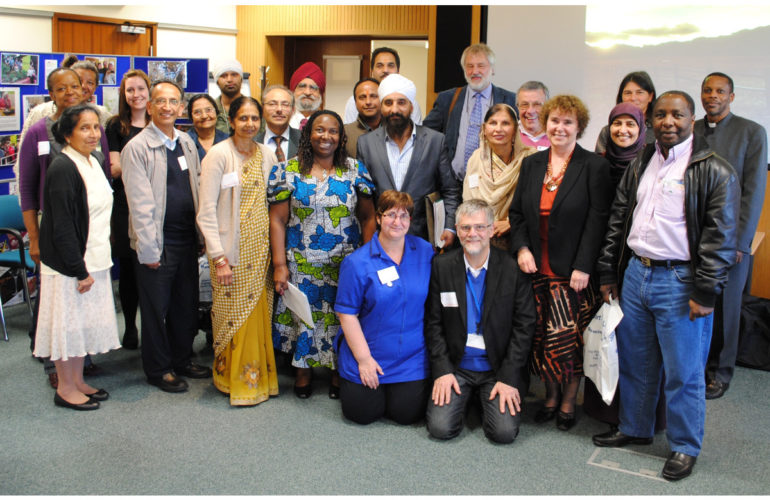
The hospice began work on a second phase of the Reaching People Agenda which became known as the Compassionate Communities Project (CCP).
The CCP looked into the feasibility of working in partnership with community groups to support more people to achieve their preferred place of care, wherever that might be.
Through the work of the CCP, the hospice was able to open meaningful dialogue with community groups so as to increase our mutual understanding of people’s needs in end of life. Simultaneously it helped us raise the profile of hospice services within local populations.
All BAME communities stressed the importance of service providers asking service users about their illness. All communities also said it is not what service providers ask but rather how they ask which matters.
It was highlighted that open conversations with patients about their knowledge and understanding of their illness may make the difference between a bad death and grief and a good death and grief.
Compassionate communities work has increased our understanding of the role of culture and spirituality in accessing health and social care services, and the need for professionals to always maintain an attitude of unconditional positive regard. At end of life people wish to know that professionals value them and that their (patients’) experiences and knowledge are taken seriously.
Alongside the CCP, the Spiritual Care Service Development Team (SCSDT) was charged with reviewing our spiritual care service provision and consequently the Chapel was refurbished. In 2011 its name was changed to the ‘Peace Room’ – a place fit for all spiritualties and cultures.
Through this partnership working we have learnt more about the people who use our services too; for example, in supporting a Muslim patient to face Mecca as they are dying we know not to let the soles of their feet point towards Mecca.
We found that some Muslims need to die with the name of Allah on their lips and if they can’t speak those in the room must say the name Allah as the patient dies. And we learnt that when a Muslim is certified dead they can still feel embarrassment and pain if their body is not handled properly – but of course not all Muslims will feel this way, every death is individual.
In some cases (eg Sub Saharan Africans) causation and treatment of diseases may be attributed to supernatural origins such as witchcraft, bad winds and avenging ancestral spirits, and may need the intervention of prophets and pastors, or traditional healers and witchdoctors. These beliefs may dictate how patients and families will comply with medical advice.
Finally, a Reference Group made up of staff, and people from the diverse communities was also established to advise us on issues pertaining to their communities. The Reference Group members act as cultural/spiritual brokers where appropriate. They provide training to our staff and other service providers from Birmingham and Sandwell on issues to do with their communities when appropriate.
Final thoughts
The hospice remains committed to increasing access to our services for patients from the BAME communities and any other hard to reach groups. Working in partnership with community resources may enhance the patient’s experience and support them to achieve their preferred place of care. It may also support the family in bereavement. The main messages from our work are:
- Ask patients about their experiences.
- Each patient is unique and their experiences and feelings are valid.
- Do not make assumptions about people from the little knowledge we have about ‘people from their community’.
- Only involve community if that is the wish of the patient and his loved ones.
- Where appropriate, community involvement can support patients achieve their ‘good death’ and families experience a ‘good grief’.
References
Kellehear, A. Compassionate Cities: Public health and end of life care. London and New York: Routledge;2005.
Murungu, D. An Exploratory Study to identify and Address Barriers to Specialist Palliative Care Services at Birmingham St. Mary’s Hospice for people from Black and Minority Ethnic Communities. Unpublished;2007.
Murungu D. Sharing The Care Conference. Unpublished;2010.


Leave a Reply