

Before Covid, we facilitated patients donating their corneas. It was quiet work. It mattered. I had set this up, then Covid stopped everything. For four years, we weren’t able to do this. When you look back now, that loss feels heavier than you realise at the time. Small things matter more than you think.
When we started again, we couldn’t just pick up where we left off. The NHS blood and transplant team had changed the inclusion and exclusion criteria. That meant we had to change our policy and how we did things.
And we didn’t just restart on the ward (In-Patient Unit). We took it out into the community too.
THE MOMENT THAT CHANGED THINGS
One afternoon, a patient’s relative came up to the Palliative Care Registrar on the ward round. The patient wanted to donate their corneas when they died. Could we help?
Our registrar had never done this before. She hesitated. She talked to me. She had had teaching on corneal donation on her Registrar study day, so she knew what to do. Then she had the conversation.
“I’d never discussed corneal donation before, so I was nervous,” she says. “But the patient’s relative brought it up first, which helped. I checked the policy. I talked to a senior colleague. I wanted to get it right.
It felt daunting, honestly. Talking about organ donation when people are dying, I wasn’t sure how they’d take it. But the patient was clear. She wanted to donate. The family was on board, wanting to do what the patient asked.
I found it much less difficult than I thought it would be. It felt really rewarding to help make that happen for her.”
That conversation changed things. It showed the team that this could be done. That it was possible. That mattered.
MAKING IT HAPPEN
When the patient agreed, one of our new GP trainees took it on. She’d only been here two weeks. She heard about eye donation during her first weekend on call and wanted to be part of it. The team trusted her, and she got stuck in.
She got the details right. Then, after the patient died, she made the call to the transplant team. She made sure everything went through.
“I’d only been here two weeks,” she says. “Being asked to do something this important meant a lot. When I made that referral and knew the patient’s wish was going to happen, that was incredible. It showed me what this team does and why it matters.”
IN PEOPLE’S HOMES
Our community Clinical Nurse Specialist (CNS) worked with me to update the policy. She was bringing the same option to people dying at home. Just a nurse and a family in their own space at the hardest time.
She completed the eye donation training online1. But she knew the real challenge would be the conversation itself.
“Discussing eye donation as part of advance care planning felt daunting,” she says. “Advance care planning is difficult enough, and this felt like another step. But I’d gained an appreciation for what this could do for others, and I wanted to get it right.”
During a palliative review, she was discussing end-of-life care with a patient’s wife. The patient was unresponsive, in his last days. The wife was calm, asking practical questions about what to expect. That felt like the right moment.
“I used what I’d learned from the training to broach it carefully. Her response was instant, she said how glad she was I’d asked. Then she told me their daughter was partially sighted and had benefited from two corneal donations already. She said her husband would absolutely want to give back to something their family had been so grateful to benefit from.
The beauty of that moment, this patient being able to give back to something his own family had received, it was incredible. It meant so much to them. He died that night. I confirmed all the details with the transplant team the next day to make sure everything was in order.
That experience changed how I see this work. I feel so much more confident to broach this in future, as long as it feels clinically right. And I want to share this with others.”
TWO IN TWO WEEKS
A few weeks after we restarted, something happened. In two weeks, we facilitated two families with eye donation. One on the ward and one at home.
What mattered wasn’t the number. It was that people who weren’t sure they could do this had done it. That families were glad to be asked. That’s what lifted everyone.
It takes work to bring something like this back. Change the policy. Do the training. Have hard conversations. But when families are grateful to be asked, you know it matters.
We are a proud team, and we brought this back together.
——————
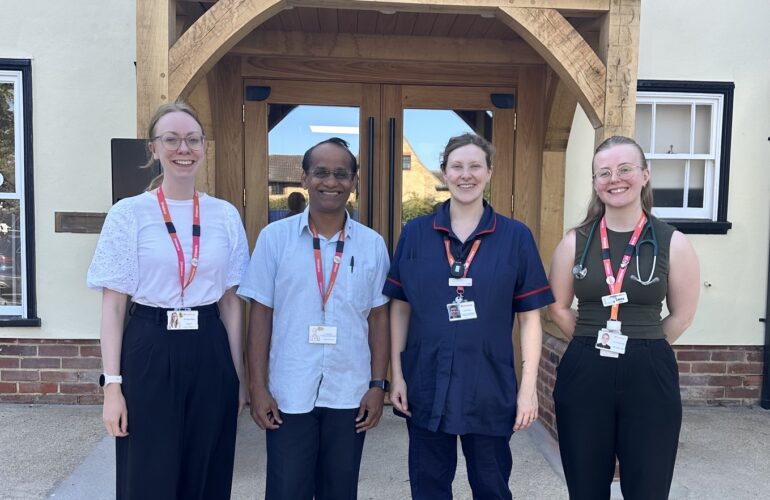
In the picture: from left to right
Dr Anna Hilton (Palliative Medicine Registrar), Dr Ramesh Thulavavenkateswaran (Specialist Grade Doctor), Julia Heard (CNS) and Dr Emma Gove (GP Trainee)
Dr Ramesh Thulavavenkateswaran, Specialist Grade Doctor in Palliative Medicine
St.Helena Hospice
—————–
1.Eye donation online module
e-LfH Eye Donation module: End of Life Care (e-ELCA) > e-ELCA 05: Specific conditions and contexts > 05_04 Specific contexts > Eye donation
https://portal.e-lfh.org.uk/Dashboard
=================
ehospice is proud to help promote individual, local, national and international voices in Hospice & Palliative Care
We are on target to have over One Million page views this year.
To stay in touch with colleagues and news around the world subscribe to our free Newsletter


Leave a Reply