

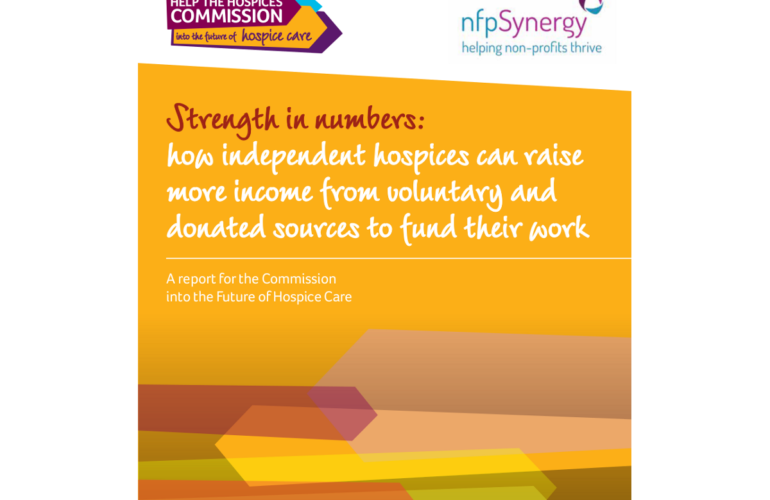
As the Commission into the Future of Hospice Care highlighted earlier this year, demand for hospice care is going to increase and so hospices will need to raise more money in the future to cope with this increase in demand.
In general, hospices are pretty good at fundraising – even during the recession – however, a new report by nfpSynergy for the Commission shows that there is huge potential for hospices to increase their voluntary income. The report, ‘Strength in numbers‘, draws on survey data and interviews within the hospice sector to make a number of recommendations for hospices, fundraisers and organisations representing hospices at a national level.
Greater collaboration is a key theme throughout the report’s recommendations. The report highlights a number of good examples of collaboration between individual hospices, such as the lottery organised by Farleigh Hospice which is letting organisations as far apart as Scotland and the south of England join in.
The report also highlights the need for local hospices and organisations such as Help the Hospices to work together at the national level. It suggests collaborating on nationwide projects, for example to promote leaving a legacy to a hospice. It also suggests that a centralised direct marketing programme would enable local hospices to take advantage of economies of scale.
The report highlights how the hospice movement does not do enough to share fundraising ideas and best practice. It recommends the creation of networks of fundraisers to share skills and come up with new ideas, and the creation of a mentoring scheme, by which the most successful hospices in fundraising can help their peers mimic their success.
It also highlights the need for a national fundraising conference aimed at fundraising directors, senior fundraising staff and CEOs as well as a strategy steering group of fundraising directors.
The report also recommends improving communications skills in the hospice network and the development of codes of best practice around specific issues, such as how to deal with the tensions between fundraisers and clinical teams, and with overlaps of geographical footprints.
Joe Saxton, author of the report, said: “Hospices are already a powerful fundraising force in the UK, but there is so much potential to raise even more money. The challenge in raising more money is for hospices and the hospice movement to work not just harder, but smarter. That means more collaboration, less obsession about independence, more focus on nation-wide fundraising ventures and less focus on re-inventing the wheel in every hospice.”
Dame Clare Tickell, chief executive of Action for Children and Chair of the Commission into the future of hospice care, said: “The Commission into the future of hospice care enthusiastically welcomes this report and its recommendations. In evidence sessions we have discussed the increasing demands for high quality end of life care that are likely to exist in 10-15 years’ time and we recognise that hospices could play a vital role in delivering this care.
“Voluntary income is already critical to support the work of hospices, and even more funds will be required in the future to meet increased levels of need. New opportunities for fundraising, such as those offered by nfpSynergy are invaluable to hospices looking to maximise income, and also for national organisations supporting hospices in their work.”
Barbara Gelb, CEO of Together for Short Lives, also welcomed the report: “There is a real opportunity now for services to think even more creatively about how best to achieve a sustainable future, in the best interests of children and families. As the leading charity for UK children’s palliative care including children’s hospices, Together for Short Lives welcomes Strength in numbers. It is a practical and valuable tool that will help children’s hospices to address these difficult issues and to maximise all opportunities. We will recommend it to our members, and it is equally valuable to us, as the national body representing the sector.”
Antonia Bunnin, director of hospice support and development at Help the Hospices, said: “This report highlights the many successful and innovative fundraising techniques used by hospices.
“However, it also takes an unflinching view of the challenges for hospice fundraising. It contains some robust recommendations, particularly on the need for closer and more widespread collaboration between hospices, nurturing a more supportive culture for fundraising and also for more national strategic support on fundraising.
“This all presents some tremendous opportunities for the hospice sector. We look forward to working in partnership with our member hospices to further develop their fundraising potential in the future for the benefit of hospice care.”
The Commission into the Future of Hospice Care was set up by Help the Hospices in 2011 following a report by think tank Demos entitled ‘Dying for Change’ which highlighted some of the challenges facing hospices in the future. The Commission has been researching a number of areas, including future need for hospice care, the hospice workforce, funding opportunities and new models and approaches to care, with the aim of providing information and guidance to help hospices prepare for the future.
The report, ‘Strength in numbers: how independent hospices can raise more income from voluntary and donated sources to fund their work’, can be downloaded from the Commission’s website.


Leave a Reply