

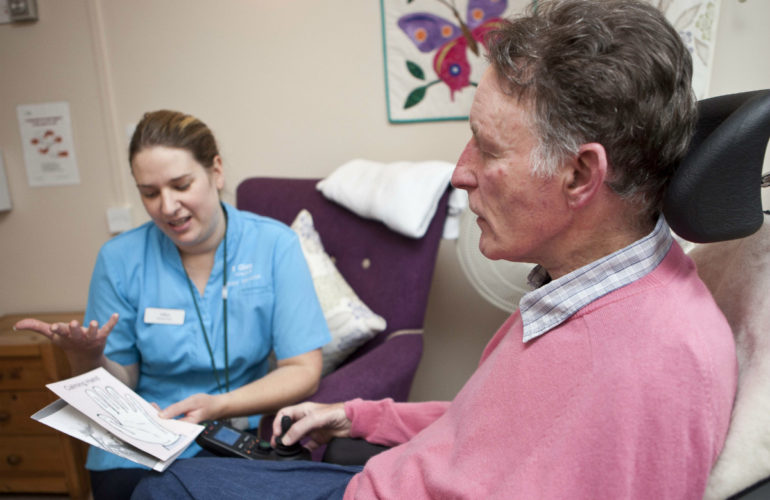
Motor neurone disease (MND) is a progressive and terminal disease that results in degeneration of the motor neurones, or nerves, in the brain and spinal cord. It can affect how people walk, talk, eat, drink, breathe and think.
Although there are interventions such as non-invasive ventilation and gastrostomy to manage symptoms and, in some cases, improve survival, there is no cure.
A third of people with the disease die within a year of diagnosis and more than half die within two years.
Because the condition can be rapidly progressive, support from specialist palliative care services, as soon as is appropriate for an individual, can make a huge difference to quality of life.
The right support at the right time
People with MND, and their carers, often describe MND as a series of losses: the loss of a shared future and loss of mobility, speech and eventually, in most cases, respiratory function.
MND can be variable in its presentation, range and order of symptoms: everyone diagnosed experiences the condition in a different way. However, the often rapid progression of the condition means that people with MND can be adjusting to one aspect, just as things change again.
Establishing early links with a specialist palliative care team encompassing a range of disciplines can provide a crucial source of support through these changes.
It can be difficult to introduce the concept of palliative or hospice care to someone who is still coming to terms with a diagnosis of MND – especially where there is a lack of understanding of what this care is and what it can provide.
But where this is managed successfully, a multidisciplinary team of palliative care professionals with specialist knowledge of MND is well placed to provide coordinated support with the complex care and support needs of those living with the condition. In some cases this will be provided in tandem with an MND specialist team, network or care centre.
“Professionals often say that people with MND and their families do not want to access specialist care shortly after diagnosis – it is too soon. However, once people with MND have accessed specialist palliative care services they say they wished they had accessed services earlier.” Summary report from the All Party Parliamentary Group (APPG) for MND Inquiry into Specialist Palliative Care for people with MND (2011)
In many cases, people with MND will be introduced to the services of the hospice through day care or respite. While support can be provided for psychological and spiritual needs, along with services such as complementary therapies, hospice and specialist palliative care services can also explore options for managing the symptoms of MND, including pain, breathlessness, anxiety and depression.
Advance care planning
More than 80% of people with MND develop speech impairment over the course of their illness, with most losing the ability to speak at all, and up to half may experience some degree of cognitive change. Early discussion of end of life choices is therefore crucial, before the need is urgent or the capacity to communicate is limited or tiring.
Having the opportunity to think things through and to know that wishes have been recorded gives many people peace of mind. Developing the relationship with hospice staff at an earlier stage can also help someone to decide where they might want to spend their final days.
“It’s about preparing for a good death… I want to be somewhere where people are used to having people die. At the hospice, the staff have support too, and that’s critically important.” – a person affected by MND
Support for carers and family
Periods of respite can be beneficial for the person with MND, but also their carer and family members.
In many cases, those close to a person with MND will experience considerable psychological and emotional distress. Assumptions, hopes, plans and expectations for the future may have to be reviewed.
Caring for someone with MND can be physically and emotionally challenging and often leads to feelings of isolation. Without crucial breaks, the ability of the carer to perform their role can be affected, and their own health can suffer.
“The hospice appointed a ‘friend’ to us, whom my wife talks to a lot. It is really helpful for us and we keep in close contact… when you go there you feel like a friend not a patient.” – a person affected by MND
The All Party Parliamentary Group (APPG) for MND Inquiry into Specialist Palliative Care for people with MND (2011) recognised that pressures on funding and fragmented services mean that access to specialist palliative care services for people with MND can be variable across the UK. The report outlined recommendations that would both benefit people with MND and ensure better value for money for services.
There are excellent examples across the country of hospices and specialist palliative care teams providing multidisciplinary support suited to the needs of people with MND and those who support them.
In the words of one person with MND in a message to professionals: “You can’t make it better, but you can make it easier.”
June is MND Awareness Month – find out more about our 2015 campaign on the MND Association website.
The MND Association produces a range of publications and online resources for people living with and affected by MND, and the professionals supporting them.
About the MND Association
We are the only national charity in England, Wales and Northern Ireland focused on MND care, research and campaigning.
Our mission
- We improve care and support for people with MND, their families and carers.
- We fund and promote research that leads to new understanding and treatments, and brings us closer to a cure for MND.
- We campaign and raise awareness so the needs of people with MND and everyone who cares for them are recognised and addressed by wider society.
Our vision is a world free from MND.
References
- Bäumer D, Talbot K and Turner MR. Advances in motor neurone disease. Journal of the Royal Society of Medicine. 2014; 107(1):14-21.
- Bede P et al. Palliative care in amyotrophic lateral sclerosis: a review of current international guidelines and initiatives. BMJ Supportive & Palliative Care. 2011; 1:343-348.
- Connolly S, Galvin M and Hardiman O. End-of-life management in patients with amyotrophic lateral sclerosis. The Lancet Neurology. 2015; 14(4):435-42.
- Picker Institute Europe/MND Association. Improving MND Care – MND Association’s tracking survey: the experiences and views of people living with MND. July 2013. Available from: http://www.mndassociation.org/get-involved/campaigning-influencing/improving-mnd-care/
- Picker Institute Europe/MND Association. Choices and Control when you have a life-shortening illness: researching the views of people with motor neurone disease. April 2012. Available from: http://www.mndassociation.org/life-with-mnd/treatment-and-care/choices-and-control/
- Pagnini F. Psychological wellbeing and quality of life in amyotrophic lateral sclerosis: a review. International Journal of Psychology. 2013; 48(3):194-205.
- The All Party Parliamentary Group (APPG) for MND. Inquiry into Access to Specialist Palliative Care for people with Motor Neurone Disease in England. June 2011. Available from: http://www.mndassociation.org/get-involved/campaigning-influencing/all-party-parliamentary-group-appg-on-mnd/
- Tomik B and Guiloff RJ. Dysarthria in amyotrophic lateral sclerosis: A review. Amyotrophic Lateral Sclerosis. 2010; 11:4-15.



Leave a Reply