

With this in mind, we recently established two advisory panels. Our stakeholder panel includes 22 experts and professionals who work in the bereavement sector, including representatives from local charities, hospices and community organisations in Bristol and the surrounding area.
Our lived experience panel brings together a diverse group of 20 people from the region with lived experience of bereavement. We hope both panels will continue to meet regularly, helping to shape the questions we ask, the way we work and the partnerships we build.
Thinking together
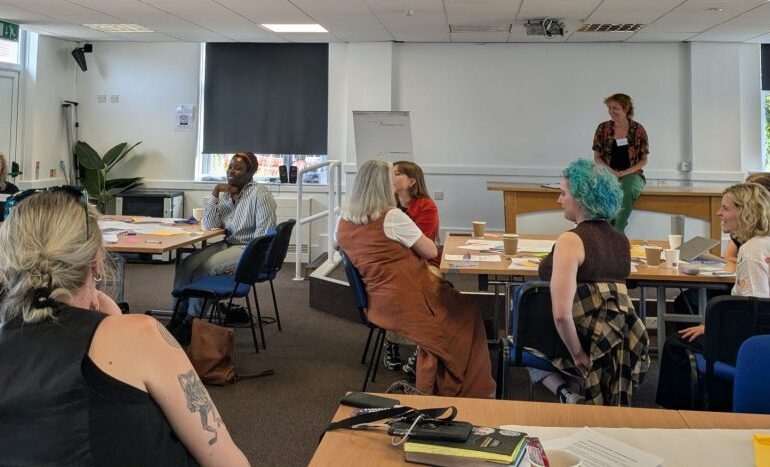
We held our workshop for bereavement professionals in person at the University of Bristol in May and then welcomed our lived experience panel to the Vassall Centre a month later. Both half-day workshops were designed and delivered by Kat Lyons in collaboration with the research team at the Centre, Christina Saltmarsh, Clinical Lead at The Harbour, and Rachel Ashley, co-founder of the Wild Widows support group, who also brought lived experience of bereavement.

Kat’s thoughtful, creative approach opened space for both groups to reflect, share experiences and imagine what the Centre could become. We began by mapping the landscapes of grief, identifying places of isolation and overwhelm alongside moments of connection and renewal.
One group described the loneliness of a city, where other people carry on with their lives while bereaved people look in from the outside; another imagined a place drained of colour: ‘we didn’t ask to go here. We landed here’. Against the deserts, grey buildings and ‘icy fog’ on the maps sat signs of hope: a calm sea and space to notice the beauty that is still there.
The exercise sparked rich conversations, as we recognised common threads while also reflecting on the different ways bereavement is shaped by culture, relationships, identity and the circumstances of a loss.
We then filled Post-it notes with barriers that can prevent people from accessing support or make it more difficult for organisations to provide it, building a wall of challenges across the room. From there, the conversation shifted to what might help dismantle those barriers and the role that the Centre – and the advisory panels themselves – could play in supporting that change.


What we learned
Although every conversation was different, many of the same questions and priorities resurfaced across both workshops. Discussion often returned to the barriers that can prevent people from getting the support they need, from social expectations about how grief ‘should’ look and stigma surrounding some forms of bereavement, to practical challenges such as navigating services, financial pressures and finding support at the right time.
Both groups questioned systems that require grief to be framed as a medical or pathological problem before support becomes available. They were frustrated by services that feel too brief or too rigid, from arbitrary caps on the number of counselling sessions to eligibility thresholds that turn people away, whether they are a child who falls just below the line for mental health services or someone bereaved by a drug-related death who is left feeling like they have nowhere to go.
While some of the solutions were service-focused, many were not, with participants raising the importance of normalising conversations about death, improving grief literacy from school age onwards, and looking beyond traditional therapy to the connection, creativity, education and peer support that build more grief-informed communities.
Alongside identifying research priorities, the workshops highlighted the value of creating spaces where people could connect and learn from one another, while contributing their valuable insight to inform the Centre’s future activities. A bereavement professional welcomed the ‘diversity of stakeholders’ and reflected: ‘it was great to come together [in person] and have an opportunity to have conversations with colleagues’.
Meanwhile, a participant in the lived experience workshop described it as a ‘rich, supportive and safe environment’ where ‘we could all relate with each other’s experiences even though these were so varied’. Panel members also spoke of the personal impact of taking part. One wrote, ‘I left feeling empowered and looking forward to being part of the project going forward’. Participants told us they felt listened to, valued and able to contribute meaningfully, something we hope will remain central to the advisory panels as they develop.


Looking ahead
It was a privilege to be in both rooms. We were struck not only by the depth of insight that people brought, but also by the openness and compassion with which they shared their ideas and, in many cases, deeply personal experiences. We are enormously grateful to everyone who gave their time, energy and trust to the process.
These workshops were the first step in what we hope will be an ongoing conversation. We look forward to continuing to learn and work alongside our advisory panels, ensuring what we do remains collaborative, inclusive and responsive to bereaved people and those who work with them. Full reports from the workshops will be made available on our website in due course.
The workshops were generously funded by the NIHR School of Primary Care Research via the Centre for Academic Primary Care (CAPC), University of Bristol, and the NHS Bristol, North Somerset and South Gloucestershire Integrated Care Board (BNSSG ICB).
——————
Lead Photo Caption: The Lived Experience of Bereavement Workshop, The Vassall Centre


Leave a Reply