

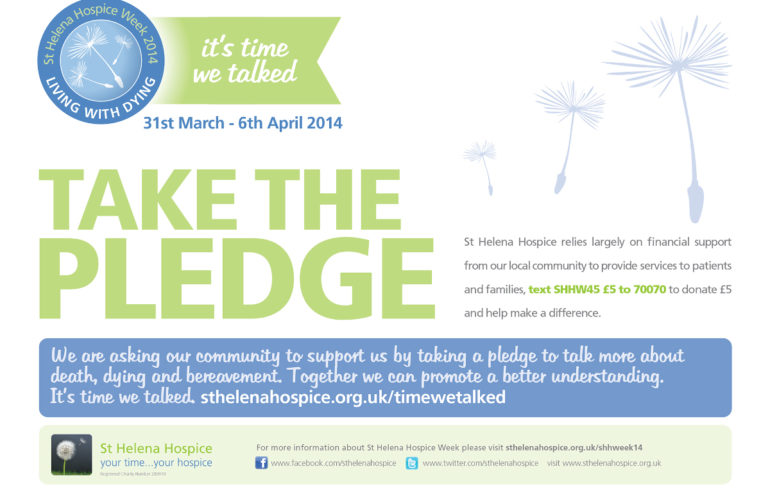
‘St Helena Hospice Week 2014: Living with dying’ took place between Monday 31 March and Sunday 6 April with the theme “it’s time we talked”. The aim of the week was to promote open and positive attitudes towards conversations around death, dying and bereavement.
The theme was chosen based on the organisation’s recently released strategic goals for the next three financial years; one of which being: “We will promote open attitudes in our community towards death and dying and provide bereavement support to all that need it.”
The week was also held in the context of a growing demand for hospice services, and the knowledge that a lack of openness can affect the quality and range of support and care services available to patients and families, and our ability as individuals to die where or how we would wish.
The pledge
The majority of the week’s activity was centred on driving traffic to the St Helena Hospice website in order for individuals/companies/healthcare providers to take the pledge: “As part of St Helena Hospice Week 2014, I pledge to talk more about death, dying and bereavement to my family, friends, colleagues and loved ones.”
The pledge could only be taken electronically, which invariably excluded non-internet users from the campaign. This decision was taken because there was no resource available to record and measure written pledges and because the campaign was running for such a limited time.
To support the pledge campaign, an A5 card was produced promoting the pledge and the website address where people could sign up.
The reverse of the card provided tips on how to start conversations around death and dying, and support someone who has been bereaved, as well as details of our expanded bereavement service which offers support to all newly bereaved people in North East Essex
The pledge cards were distributed organisation-wide to staff and volunteers prior to the week, and were handed out by hospice staff to those accessing hospice services (if appropriate) and during the various events taking place.
A week of events
Afternoon tea was held at our two day centres, organised by the teams there and supported by the marketing team, who advertised these events externally through traditional media and through our contact with local GP surgeries and other relevant healthcare providers. This led to attendance by practice nurses, a paramedic and members of the public who had never been inside our day centres before, as well as patients and their families.
A number of hospice nurse specialists also joined me at our local hospital during the week for a roadshow, to engage with hospital staff. During the three hours we distributed 150 of the pledge cards, as well as other relevant hospice literature, both on clinical services and fundraising.
Our retail outlets were also asked to put on special events and window displays throughout the week and to engage with each customer coming into the shop, asking them what had brought them in. Initial findings show an increase in footfall across the majority of our outlets during the week.
A social media campaign was planned and implemented during the week, not only to drive people to the website but also to increase engagement on the organisation’s Facebook and Twitter pages. This was centred on multi-media content; particularly videos entitled ‘What song would you like at your funeral?’. These videos were produced by the marketing team and featured members of staff from across the organisation, including the senior management team.
Increased online engagement
Traffic to the hospice website increased from 1,651 visits the previous week to 2,053 visits during St Helena Hospice Week. Considering all online and offline communications during the week were centred around St Helena Hospice Week alone, it can be assumed that much of this traffic was generated because of the week itself.
We also recorded an increase in engagement on Facebook of around 20% compared to the week before which, which means an increase of 78% in the number of people reached.
During the week we had only 25 pledges completed in total but, through Google Analytics we saw that there were actually 174 visits to the pledge page. We discovered that take-up of the pledge had been low because people had been visiting the site and clicking on the pledge button to signify that they were making a pledge but not scrolling down to click ‘done’. We were able to reiterate instructions via our social media sites and on the pledge page itself at this point but unfortunately it did come a bit late.
Final thoughts
In summary, the week required a huge amount of work and project leadership from the marketing team, particularly with engaging the entire organisation internally. Results were good, with an increase in engagement in many areas, good media coverage and a sensitive approach to what are very difficult subjects.
With a project of this size, I think ambition can sometimes get the better of people, and to repeat something similar would certainly involve having more people on a project team, from all areas of the organisation, to ensure a shared responsibility and greater internal buy-in.
However, knowing that the campaign has personally helped a small amount of individuals makes the blood, sweat and tears, entirely worth it. An email received from a member of our inpatient unit sums this up: “Thank you so much for the link [to the videos]. I actually watched them at home last night with my husband and it sparked a really good conversation! We are very open with each other and often talk about death and dying as you can imagine [I’m a palliative care nurse] however he did not know that I wanted that song at my funeral. I just want to say what an excellent idea and thank you all for all that you do to support us in the IPU [inpatient unit].”


Leave a Reply