

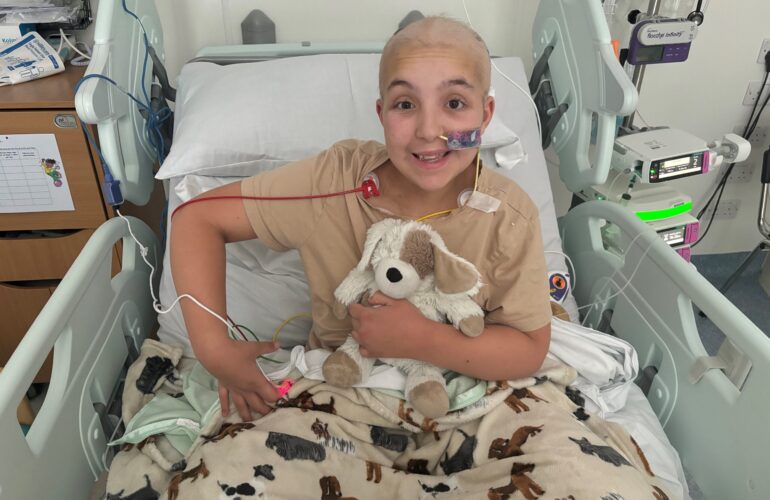
A teenager who spent months receiving hospital care has written a letter which is being used to shape the next generation of doctors and nurses in Leicester and beyond.
Lexi Johnson from the city, was born with a rare immune deficiency.
At 12 years old she was approved for a stem cell transplant, offering her hope of a non-medicalised life and long-term health.
Lexi received intensive and dedicated treatment away from home, living in isolation in hospital supported by her parents Liz and Andy, who took it in turns to be her full-time carers. Sadly, she died in 2025, aged 14, from complications arising from the transplant
After one particularly long and difficult day of treatment, Lexi created a list of helpful tips she wanted to pass onto medical staff dealing with young people in hospital so that they could communicate better with young patients like her and offer the best support.
Now those words are being used by teaching staff at the University of Leicester, including the Stoneygate Centre of Empathic Healthcare, to pass on vital skills needed for student doctors, nurses, midwives and other health professionals.
Known as Lexi’s Letter it includes simple yet effective advice including:
- Making sure any healthcare professional explains why they are there and what their job is
- Ensuring they address the young patient in the room
- Asking what the patient likes to be called
- Asking how they want to be given difficult information if there is any
Lexi’s Letter has also been made into a short animation, voiced by her younger sister, Ella.
The letter has already been adopted by several hospital trusts throughout the country, including Newcastle Hospitals NHS Foundation Trust, where Lexi received some of her treatment. Not only that but Lexi’s Letter has also reached Tasmania and Canada, and been shared at an international conference in Spain, championed by the stem cell charity Anthony Nolan.
University of Leicester Nursing lecturer, Stephen Caldwell, said: “When I was sent the information about Lexi’s Letter it was something I really wanted to be involved with. Being a relatively new member of staff, and coming from a Paediatric Specialist Nurse point of view, I was acutely aware of the importance in not just communicating with the family but actually speaking with the child. It not only empowers them to be involved in their own care but it allows them to make decisions on how that care is given.
“At times it can be difficult working in a busy ward area that you forget to take the time to explain what you’re doing. I want to instil this into our nursing students so they can take this into practice as they become the future NHS nurses.”
Lexi’s parents, Liz and Andy, both University of Leicester alumni, visited Nursing students on Wednesday (13 May) to share the story of how Lexi’s Letter was written and see for themselves the impact Lexi’s advice has on healthcare professionals.
Liz said: “It was incredibly important to Lexi to have her words reach as many people in healthcare as possible. She started this because she wanted to use her voice to make a difference and having spent so long in hospital she knew exactly what she was talking about.
“It means everything to us to continue her work, spread Lexi’s words as far as possible and leave a lasting legacy for her. I think she would have felt immensely proud. Lexi wanted to have a career in healthcare and we like to think that in this way, she is.”
Lexi died on 3 September 2025. She didn’t get to see the whole animation completely finished, but she saw the first half. The day before she died, she watched it quietly and said: “That’s good.”
Andy added: “I’m so grateful for Lexi’s Letter. It gives us a way to share her views and experiences with people and it’s wonderful to hear the impact it has when people watch it.”
First year Nursing student Chinwendu Amadi, 19, was among those hearing about the letter on Wednesday.
She said: “It was very emotional to hear about Lexi’s Letter – not something that I’ll ever forget – because we could visually see the family’s pain. I’ve learned a lot from Lexi’s story and the advice she put together and I’ll definitely carry that on into my next placement and hopefully the rest of my career.”
Fellow student Michelle Idigbogu added: “The patient has to be at the heart of everything and how you connect with them is really important – Lexi’s Letter is an amazing reminder of how to do that.”
Find out more about Lexi’s Letter here. Please use #LexisLetter on social media and help Lexi’s voice be heard.
——————
Transcript of Lexi’s letter:
When you spend time with me, please remember;
- Tell me what job you do and why you are in my room, even if you have a badge
or you have been in before. I see a lot of healthcare professionals - You talk about this topic all the time, but it might be the only time I will have
this conversation - Ask me how I like to communicate, be told information, what I like to be
called and how I want to be told difficult news if there is any - You know more about the medical side of things, but I am the expert on
me and my story. I have had many experiences in hospital over many years, some
positive, some scary, some painful. All of these experiences are with me now. - Don’t talk about me to others in the room without including me
- I can only have one conversation at once, especially if you are telling me complex
information or instructions - Things which are normal for you might be strange or scary for me;
- I might never have heard of them before or only have half-knowledge about them
- Before making a decision, I might need time to digest information and ask questions
- To check I understand, ask me to explain back to you what I think is happening,
or about to happen, to me. - My time in hospital affects me medically, socially and psychologically,
please try to consider all three aspects together - I might seem ok, even be laughing and smiling, but I might not be ok
- I have interests, passions, likes and dislikes, just like you. Ask me about them
or look around me for clues. Maybe share something about yourself. - I might feel self-conscious about my body, especially if it has changed through
treatment or I need personal care from you. I might feel a loss of dignity, or
embarrassed by not being able to look after myself - Hospitals are loud, scary, bright, stuffy, clinical and strange places. You go
home and have a break from it. I’m surrounded by it all the time, day and night - It’s ok to laugh and joke; take your cue from me
whether it’s time for fun or time to be serious - I can feel stuck in a system I don’t understand
and I’m often waiting for information or for the
next stage in my treatment. When you leave my room,
please tell me what will happen next, and when.
Thank you for all of your expertise, your care and your
commitment to the wellbeing of your patients, even when
I’m grumpy.
Dear Healthcare Professional,
From Lexi
#LexisLetter
——————-
About the University of Leicester
The University of Leicester is a leading global university, home to more than 21,000 students and 4,000 staff, with an outstanding reputation for world‑class research, innovative teaching and widening access to higher education. It holds an overall Gold rating in TEF 2023 and is ranked among the UK’s Top 30 for research quality, with 89% of research rated world‑leading or internationally excellent (REF 2021).
Leicester ranks 25th in the UK in the 2026 Times Higher Education World University Rankings and 33rdin the Complete University Guide 2026, and is top 10 in the UK for student experience and top 15 for student satisfaction in the 2025 National Student Survey.
Named the Daily Mail University of the Year 2025 and shortlisted for the Times Higher Education University of the Year 2024 and The Times and The Sunday Times University of the Year 2025, Leicester is driven by a commitment to excellence, inclusion and meaningful global impact.


Leave a Reply