

There is substantial evidence supporting the use of simulation within healthcare professional education. Coupled with advances in technology, simulation has contributed significantly to the changing landscape of healthcare education, offering valuable opportunities to enhance student learning, particularly in the area of clinical skills development (Elendu et al., 2024).
Background
Simulation
As technology continues to evolve, it presents further opportunities for broader educational initiatives, especially through the widespread use of the internet to access learning resources.
Even though simulation has traditionally been linked with high-fidelity manikins and specialist centres, effective learning is increasingly recognised as being determined by good educational design rather than sophisticated high-tech.
Subsequently, low fidelity practices, including tabletop simulation, have evolved as an accessible and inexpensive approach of experiential learning (Jones and Mercer, 2026). It uses a miniature environment and physical objects to stand for complex patient situations, to explore communication challenges and multidisciplinary decision making within a collaborative learning environment.
A recent scoping review revealed positive educational results across healthcare settings, with improvements in learner engagement, clinical judgement and interprofessional collaboration (Frégeau et al., 2025).
Within palliative care education, technology enhanced learning has been widely adopted in post registration education, including the use of online educational platforms within the NHS (NHS England’s e-Learning for Healthcare (elfh) platform, including the End of Life Care for All (e-ELCA).
Similarly, Virtual Learning Environments (VLEs) have expanded opportunities for flexible learning by providing access to educational resources and facilitating interaction between learners and educators (Weller, 2007; Caprara and Caprara, 2022).
Ivy Street: A virtual learning environment for palliative care
Within palliative care education, a partnership between Queenscourt Hospice and Edge Hill University developed a Master’s-level programme in which a VLE formed a core educational component. Central to this approach was the creation of a virtual street known as Ivy Street, a fictitious road comprising five properties (four residential houses and one care home).
Ivy Street was designed using pictorial representations of each property. By clicking on an individual property, students could access a vignette outlining the circumstances of the resident and their family. As the course progressed, a regularly updated newsfeed highlighted the physical, psychological, and social issues experienced by residents of Ivy Street.
This was accompanied by facilitated discussion about the overall management and care of the residents, many of whom developed complex clinical issues requiring multidisciplinary input.
Evaluation of this educational model showed that it was highly valued by students. It enabled participants to develop their knowledge and, importantly, apply theory to practice through the rapid implementation of learning within a safe educational environment (Clabburn, Groves and Jack, 2020).
Development of Travelling Street
Although the Ivy Street simulation showed the educational impact within a digital environment, practical challenges exist when facilitating palliative care education in various settings.
Education sessions for healthcare professionals are frequently delivered by hospice educators across various external venues, and, due to ongoing clinical responsibilities, these sessions are often time-limited. Consequently, access to reliable electricity, internet connectivity, computers or formal virtual learning environments may not always be possible.
In response to these practical considerations, the Transform Team (which provides education and support to healthcare professionals caring for people in the final days of life across hospital, community and care home settings) at Queenscourt Hospice developed The Travelling Street a portable, physical adaptation of the simulated street concept that could be transported directly to the setting where education was being delivered.
The Travelling Street was inspired by a visit to the Hospice UK Conference and the principles underpinning Ivy Street: the use of fictional environments, patient narratives and evolving scenarios to support exploration of complex palliative care situations.
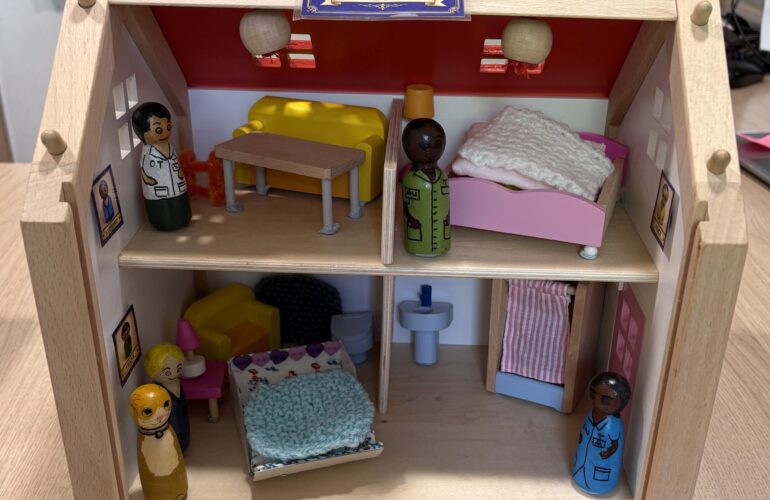
However, rather than using a virtual platform, The Travelling Streettranslates these principles into a tangible tabletop simulation using miniature environments, wooden peg dolls and facilitated discussion.
The aim was not to substitute for digital learning but to offer a simple alternative that preserved the strengths of narrative based simulation while allowing face-to-face, collaborative learning in a variety of locations.
Description of the Travelling Street
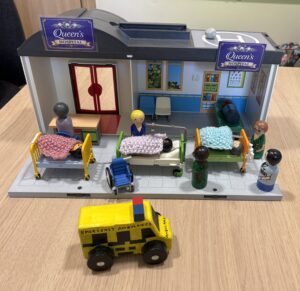
The Travelling Street consists of a portable miniature environment demonstrating the journey of people receiving palliative and end of life care. The model includes fictional care settings, including Queen’s Grove Care Home and Queen’s Hospital on Jack Street, which were created specifically for educational purposes.
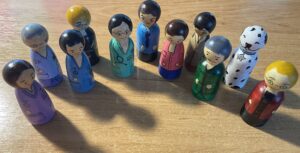
The street provides a visual representation of transitions between care environments and enables learners to explore how care is coordinated across organisational boundaries. Wooden peg dolls represent patient/residents, family members and various healthcare professionals, allowing learners to focus on the individual experience of illness, rather than solely on clinical tasks.
Similar to Ivy Street, the three residents living at Queen’s Grove Care Home have individualised narratives, including personal history, family circumstances, health challenges and changing care needs. These scenarios are intended to encourage discussion around communication, decision making, and multidisciplinary working.
A key scenario that has been used follows one particular resident from Queen’s Grove Care Home who deteriorates and is transferred to Queen’s Hospital on Jack Street. During admission, the individual is recognised as approaching the end of life, requiring the team to recognise their wishes, preferred place of care and to navigate the practical challenges associated with rapid transfer back to the care home.
Escape room learning within The Travelling Street
The escape room element was part of the initial development as an educational approach to support active engagement with a patient scenario. It is a structured technique used to encourage learners to apply knowledge, communicate effectively and work collaboratively as a team.
Escape rooms are increasingly recognised within healthcare education as a form of gamified learning that promotes problem solving, teamwork, communication and clinical thinking (Lee et al., 2025). Within The Travelling Street, the escape room format provides a framework through for learners to progress through the patient journey.
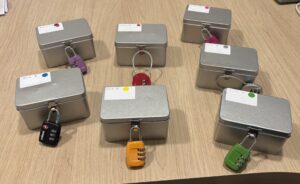
The scenario involves learners unlocking seven miniature boxes. Each box represents a stage in the person’s journey and clinical questions linked to the Five Priorities for Care of the Dying Person (Leadership Alliance for the Care of Dying People, 2014) and rapid transfer home.
Learners work collectively to answer each question correctly and are given a number of options and must get the three correct numbers in order to unlock each padlock and reveal the next wooden peg doll.
The escape room creation generates curiosity and encourages discussion; however, the educational value lies within the facilitated reflection and debrief, where learners consider how the scenario relates to their own clinical practice.
Progress
Over the last seven months the travelling street has been used on 24 occasions across a range of clinical settings, including hospital, care home and hospice. 154 participants have engaged with the sessions, representing a range of professional roles from registered practitioners to healthcare assistants (HCAs).
The resource has been delivered to learners from a range of healthcare and support roles, including registered nurses, healthcare assistant, student nurses, receptionist and phlebotomist. Its adaptable format allows the scenario and complexity to be modified according to learner experience and professional background.
Evaluation
Overall, participant feedback regarding The Travelling Street has been highly positive. Analysis of evaluation comments identified five key themes: increased confidence and knowledge, improved communication and compassion, enhanced teamwork and holistic care, learner engagement, and the practical value of the escape room format. Feedback demonstrated consistent themes across the learner groups. Several key themes were identified from evaluation responses, with selected participant quotations included for illustrative purposes.
Confidence and knowledge development
Participants reported that the simulation helped consolidate existing knowledge while increasing their understanding of end of life care. Learners described the practical nature of the activity as particularly helpful in supporting knowledge retention and translating learning into practice.
“The practical session helped me remember all the things I have learnt.”
“I have learnt so many new things as a healthcare assistant about what to do when a patient is end of life.”
Communication and compassionate care
Many participants highlighted the impact of the activity on their communication skills and their ability to respond compassionately to patients and families. The scenarios encouraged reflection on the importance of listening, empathy and person centred care when supporting people approaching the end of life.
“It has helped me listen more before saying anything.”
“Helped me become a better person around responding and relating to families of a dying patient.”
Teamwork and holistic care
The tabletop simulation and escape room activities encouraged collaborative learning and prompted participants to consider all aspects of a person’s care. Learners reported that working together to solve challenges promoted discussion and a broader understanding of holistic palliative care.
“Using the escape room made everyone involved, working as a team and thinking of all aspects of care.”
Engagement and learning experience
Participants consistently described the educational approach as engaging, enjoyable and different from traditional classroom based teaching. The interactive nature of the activity appeared to support learner participation and keep attention throughout the session.
“Really enjoyed the way of teaching and the practical session.”
“Interactive, a lot more fun than just a presentation.”
“Worked well with my ADHD.”
Value of the escape room approach
The escape room format was viewed positively as a mechanism for keeping focus and encouraging active participation. Learners valued the opportunity to apply knowledge through problem solving rather than passively receiving information.
“Questions were short and brief to keep you focused also a little quiz like.”
“Escape room kept us engaged in the activity.”
“I gained more from this way of training.”
Application to clinical practice
Importantly, participants found clear links between the learning experience and their clinical roles. Many reported increased awareness of the needs of people approaching the end of life and an intention to apply learning within their own practice settings.
“Will use this on wards to ensure I think about what is important to dying patients.”
Summary
These findings suggest that The Travelling Street is an engaging and accessible educational intervention that supports knowledge development, communication, teamwork and the application of palliative care principles to clinical practice.
The combination of tabletop simulation, storytelling and escape room method appears to promote active participation and meaningful reflection across a range of professional groups.
Going Forward
The Travelling Street proves how the educational principles of a virtual learning environment can be successfully translated into a portable tabletop simulation. Combining storytelling, tabletop simulation, escape room learning and a facilitator led PowerPoint presentation provides a blended educational approach that supports different learning styles and reinforces key palliative care concepts. The PowerPoint presentation introduces the patient scenario, learning outcomes and evidence base, while the tabletop simulation enables learners to actively apply knowledge through discussion, collaboration and problem solving.
Participant feedback has proved that this approach not only enhances knowledge and confidence but also strengthens communication, teamwork, compassionate care and the application of learning to clinical practice. The portability and flexibility of the resource allow it to be delivered within hospitals, care homes, hospices and community settings, making high quality palliative care education accessible to multidisciplinary teams regardless of location.
As the project develops, there are opportunities to expand the range of scenarios within The Travelling Street to include topics such as advance and future care planning to include other residents within the care home. Furthermore, this model is a relatively low cost educational intervention and may therefore have particular value within resource limited settings where palliative care education is still developing.
Julie Davidson, who led the initiative, stated:
“Developing The Travelling Street has been one of the most rewarding educational projects I have undertaken. Watching a simple collection of wooden peg dolls, miniature environments and patient stories evolve into an engaging learning experience has been incredibly fulfilling.
Seeing healthcare professionals actively take part, challenge one another, and reflect on how they will apply their learning in practice has reinforced the value of creative, person centred education. It has been a privilege to transform an idea into a practical resource that is now supporting palliative and end of life care education across a range of healthcare settings.”
https://www.queenscourt.org.uk
Authors
Julie Davidson Cross Boundary Education Lead Queenscourt Hospice
Kate Dawson Transform Education Facilitator Queenscourt Hospice
Emma Maher Transform Education Facilitator Queenscourt Hospice
Hilary Piper Transform Education Facilitator Queenscourt Hospice
Dr Andrew Khodabukus Consultant in Palliative Medicine Queenscourt Hospice
Karen Groves Founder Queenscourt Hospice and Honorary Professor Edge Hill University
Professor Barbara Jack Emeritus Professor of Palliative and End of Life Care Edge Hill University
————–
References
CAPRARA, L. and CAPRARA, C., 2022. Effects of virtual learning environments: A scoping review of literature. Education and Information Technologies [online]. 27 (3), pp. 3683–3722. Available from: http://dx.doi.org/10.1007/s10639-021-10768-w [Accessed 5 August 2026].
CLABBURN, O., GROVES, K.E. and JACK, B., 2020. Virtual learning environment (‘Ivy Street’) for palliative medicine education: student and facilitator evaluation. BMJ Supportive and Palliative Care. 10 (3) pp. 318-323.
ELENDU, C., AMAECHI, D.C., OKATTA, A.U., AMAECHI, E.C., ELENDU, T.C., EZEH, C.P., and ELENDU, I.D., 2024. The impact of simulation-based training in medical education: A review. Medicine [online]. 103 (27), p. e38813. Available from: http://dx.doi.org/10.1097/MD.0000000000038813 [Accessed 5 August 2026].
FRÉGEAU, A., VINETTE, B., LAPIERRE, A., MAHEU-CADOTTE, M.-A., FONTAINE, G., CASTONGUAY, V., FLORES-SOTO, R., GARCEAU-TREMBLAY, Z., BLAIS, S., VIGNEAULT, L.-P., HANSEN-JAUMARD, D., LARAMÉE, F., ISEPPON, M., DAOUST, R., COSSETTE, S., BUYCK, M., FLEET, R., and COURNOYER, A., 2025. Tabletop simulations in medical emergencies: A scoping review. Simulation in Healthcare: Journal of the Society for Simulation in Healthcare [online]. 20 (4), pp. 223–228. Available from: http://dx.doi.org/10.1097/SIH.0000000000000838 [Accessed 7 August 2026].
JONES, R. and MERCER, S., 2026. Playmobil, pressure and prioritisation:
a simulation for stepping up to ST4. Rcoa.ac.uk [online]. Available from: https://rcoa.ac.uk/bulletin/winter-2026/playmobil-pressure-prioritisation-simulation-stepping-st42 [Accessed 7 Aug 2026].
LEADERSHIP ALLIANCE FOR THE CARE OF DYING PEOPLE, 2014. One chance to get it right: improving people’s experience of care in the last few days and hours of life. Available from: GOV.UK One Chance to Get it Right PDF [Accessed 7 Aug 2026].
LEE, C.-Y., LEE, C.-H., LAI, H.-Y., CHEN, P.-J., CHEN, M.-M., and YAU, S.-Y., 2025. Emerging trends in gamification for clinical reasoning education: a scoping review. BMC Medical Education [online]. 25 (1), p. 435. Available from: http://dx.doi.org/10.1186/s12909-025-07044-7 [Accessed 7 Aug 2026].
WELLER, M. 2007 Virtual learning environments: using, choosing, and developing your VLE. Abingdon, UK: Routledge.


This seems to be an amazing resource – congratulations to all developers!