

Nepal has made a remarkable achievement in improving the health of its population over 30 years. Maternal mortality rates fell from 901 per 100,000 live births in 1990 to 151 in 2021. Similarly, deaths of children under 5 years reduced from 162 to 28 per 1,000 live births in the same time-period.
Much of this has been due to public health measures including better nutrition and increased childhood vaccination as well as antenatal care and improved management of acute gastrointestinal illness.
These remarkable changes have been in no small part a result of the efforts of over 50,000 Female Community Health Volunteers (FCHV) who work within their rural communities. Introduced in 1988 by the Nepal government, FCHVs’ primary role has been to enhance the health of mothers and children; however, they also support the overall well-being of the family and community. Such has been their success that in September 2025 the WHO South-East Asia Regional Office awarded the newly introduced “Award for Public Health Champion” to Nepal’s FCHVs.
In 2017 the Nepal Palliative Care Strategy highlighted the important role of FCHVs in identifying people in need of palliative care in the local community, supporting them and their families and providing a link between them and health care services. The Sunita Project, 2022-2025, a UK Aid Fund Matched programme delivered by EMMS International and INF Nepal, provided an opportunity for developing a model of rural palliative care which included FCHVs.
Sunita operated in four districts of two provinces in Nepal (Kaski, Lamjung, Surkhet and Rukum West). At the project outset workshops were conducted to understand how FCHVs worked, what experience they already had with people with advanced illness in their communities and what they thought their role in caring for these people could be. Workshop participants indicated that they were often asked for advice, but because of no previous training, they felt powerless to help.
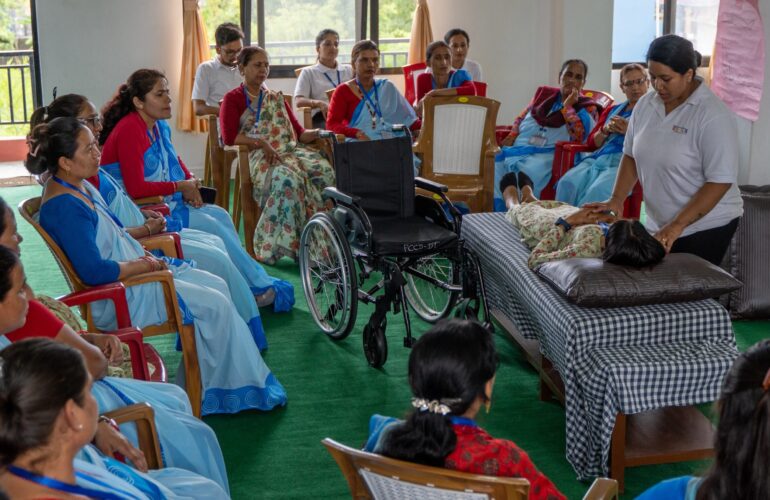
Using the learning from these workshops, a training programme was designed. Over 400 FCHVs took part in a two day training event. Refresher sessions were also offered and enthusiastically taken up. Training focused on introducing the concept of palliative care, identification of people in need and instruction in practical home-based care.
Following training, FCHVs worked alongside rural palliative care health workers. Towards the end of the project focus groups allowed FCHVs to express what they had learned and the impact their learning had on their communities.
FCVHs expressed how they had learned the importance of holistic care and listening to people with palliative care needs.
“For depressed patients [who were terminally ill], we used to tell them they would be cured after taking medicine. But after the training, we listen to them more. We make them feel they too have someone to hear them. Even with the illness, we make them feel we are hearing them more and speaking less.”
They particularly valued the practical skills training and felt empowered through what they had learned.
“We learned about how to care for bedridden patients and how to turn them. We learned about preventing bed sores, how to help them get out of bed. We learned all these practically through role playing patients and FCHVs in the training.”
“There is one grandmother in my locality. She is bedridden and had bed sores from sleeping on one sided only. I suggested her family to change her sides from time to time and they followed my suggestions. Now the wound is improving and looks much better. “
They recognized that family members are central to providing care and that they could offer them emotional support and share their burden. FCHVs also emphasised supporting bereaved families, recognizing grief care as essential and calling for more training in this area.
“The most important part is the family because they are the ones to provide care. Our role is only to provide suggestions.”
“Care is provided by the family. We work with them and support them. We don’t deal with them daily… the family are with them and take the daily caring role…they need care also.”

In their work alongside healthcare staff they identified people with palliative care needs and provided an essential link with health services. They described a stepwise approach: providing basic advice and support at home and referring to local health posts or primary care facilities when needed.
“We are providing [care] to some patients at home. For others, we can send them to the health post. Also, there are Palliative Health Care Workers at the district hospital. For cases that can’t be treated at our health post, we can send them to the district hospital”
Another important aspect of their new role was to engage in awareness building sessions within their communities. For instance, they often integrated palliative care awareness training into Mothers’ Group meetings.
“After training I spoke with the Mothers’ Group members and the community and got them to gather for the palliative care training. Sunita Project staff also facilitated the training and told everything about managing non-communicable diseases.”
The Sunita Project has been able to demonstrate the vital role FCHVs can play in providing palliative care in communities in rural Nepal. A short video is available showing palliative care delivery during the project including the role of FCHVs. The WHO Public Health Champion Award was well deserved by the FCHVs of Nepal and we are sure that their ongoing work for people with palliative care needs in their communities will bring much needed care for many.
Neha Shahi and Arati Poudel
INF Green Pastures Hospital, Pokhara, Nepal





What an excellent project! Well done all!