

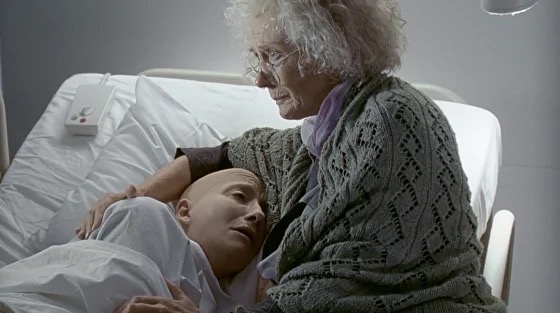
By Uliana Pavlovskaia, PACED: Today, we take a look at the film Wit (2001). Although it was released twenty-five years ago, it remains one of the most relevant works on the experience of a critically ill person within the healthcare system. The film is regularly recommended to medical students, doctors, nurses, and palliative care specialists to raise complex, still unresolved ethical questions.
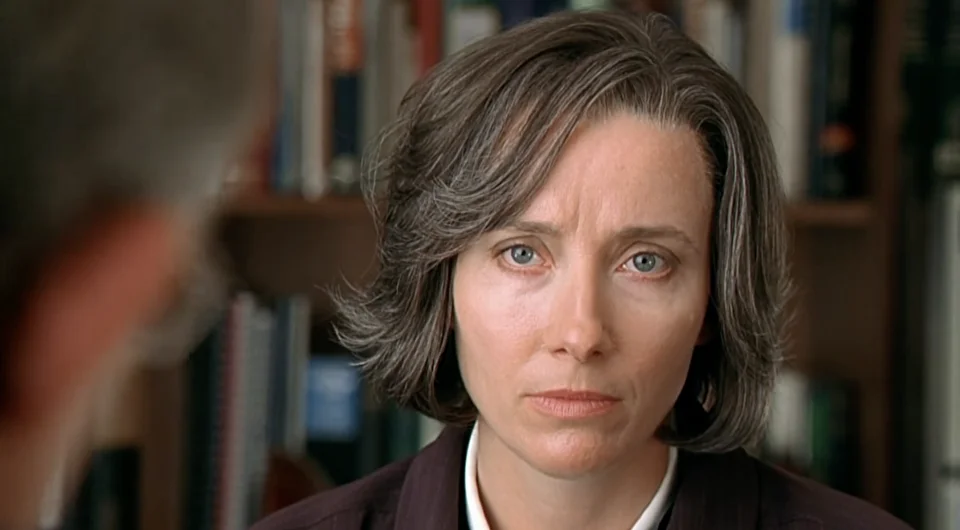
This phrase sets the tone for the entire film: what happens when the pursuit of scientific knowledge completely overshadows humanity?
Vivian is a brilliant scholar. Her course is widely regarded as one of the most demanding at the university. Having been educated by a stern mentor, she has devoted her life to upholding unquestioning academic standards and has demanded the same of her students. Throughout the film, the viewer watches not so much a medical history as a gradual shift in the heroine’s perspective on the people around her, on science, and on her own life.
This device is fundamental to the film: we observe the situation from the patient’s perspective. Even more—we become her allies. While the doctors discuss indicators, lab results, and the effectiveness of the treatment regimen, Vivian tells us what they fail to notice: the fear, the awkwardness, the pain, and the solitude. She tells us how she tries not to lose herself in circumstances where less and less belongs to her—both because of the illness and because of depersonalisation on the part of the doctors.
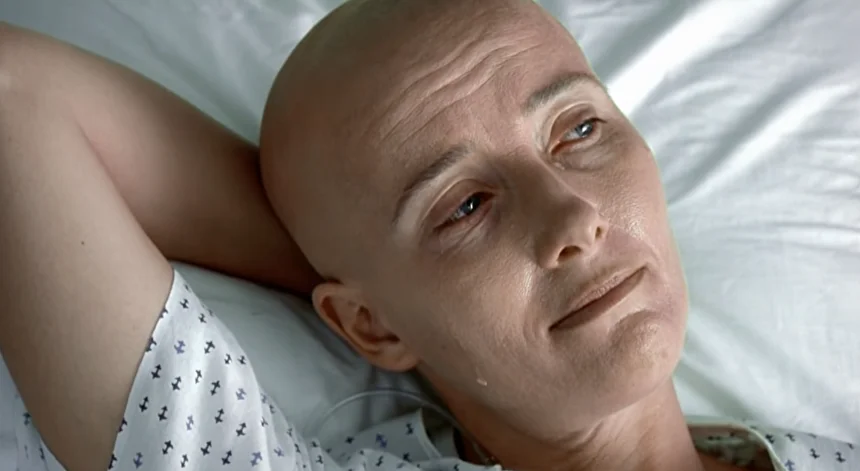
Another example is the regular ward round. Vivian remains conscious and feels relatively well. Her attending physician, Dr Kelekian, enters the room with a group of young interns, lifts her gown, and they all examine her tumour.
Before leaving the room, Dr Kelekian stops the young Dr Posner and asks him to ‘finish the exam.’ We expect further procedures or questions, but it turns out only the final line of the protocol needs to be reached. Dr Posner turns around, says, ‘Thank you very much, Miss Bearing,’ and they all leave.
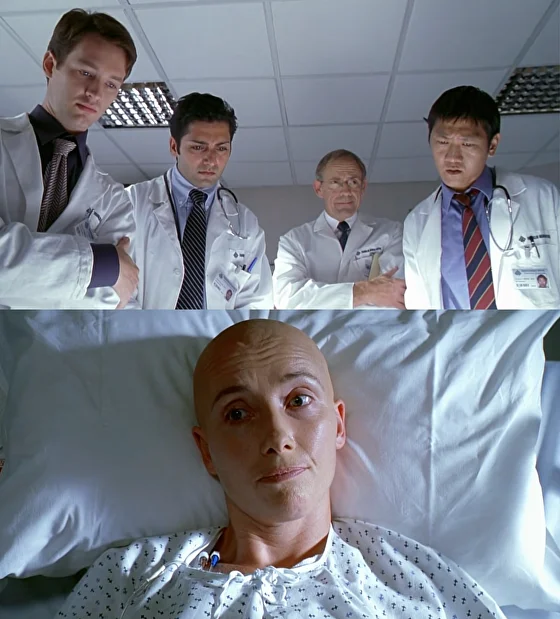
A scene of a regular ward round with interns. Image: HBO Film, 2001.
After describing the arduous course of therapy, Dr Kelekian tells Vivian she will need to be very tough and asks whether she can manage it. At first glance, this might sound supportive. But there is another side to this phrasing. If agreeing to the most aggressive treatment means ‘being tough,’ then what does refusal become? Weakness?
Vivian agrees.
Formally, she has been informed. Formally, she has given consent. But can this decision truly be considered informed?
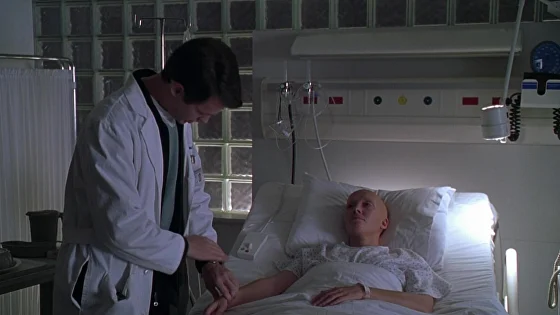
His intern, young Dr Jason Posner (a former student of Vivian’s who takes immense pride in having once passed her notoriously difficult exam), puts it even more bluntly. He tells Vivian that an entire university course was dedicated to patient communication, calling it ‘a colossal waste of time for a researcher.’
‘And what do you say when a patient is apprehensive, frightened?’ Vivian asks him. ‘Of who?’ Dr Posner asks, genuinely bewildered.
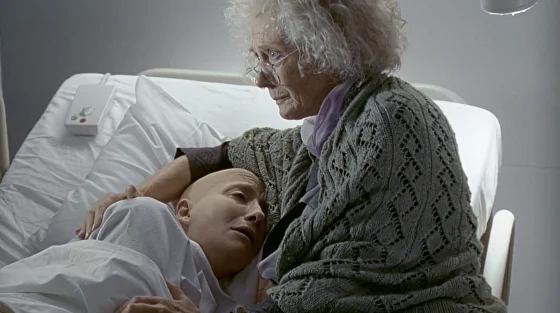
Yet, towards the end of the film, Vivian articulates a fundamental shift in her perception of what is happening:
‘Now is not the time for verbal swordplay… Now is the time for simplicity… Now is the time for—dare I say it—kindness.’
Stills from the film: Dr. Posner conducting an examination (top), Professor Ashford and Vivian (bottom).
Image: HBO Films, 2001.
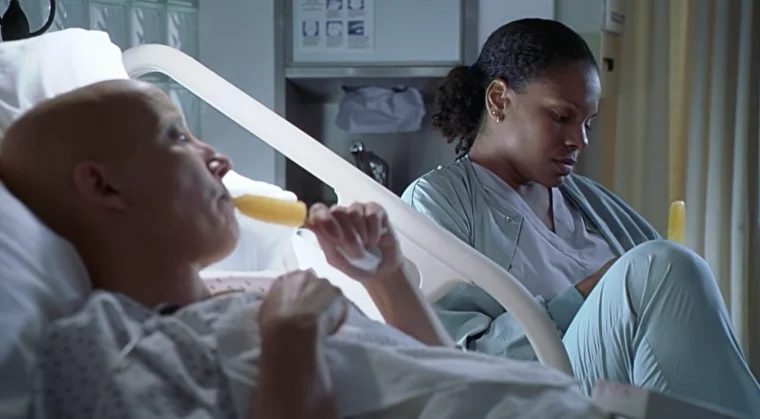
It is Susie who has an honest conversation with Vivian about the possibility that the cancer may not recede, suggesting that she record her consent or refusal regarding resuscitation in advance, thereby protecting her autonomy.
Even when Vivian is unconscious, Susie continues to talk through each action she takes. When a doctor asks sceptically why she is doing this, given that the patient cannot hear, Susie answers simply: ‘It’s just nice to do.’
This episode encapsulates a crucial point about dignity: respect for a patient should not depend on their ability to respond, express gratitude, understand an explanation, or even hear it. The promise made to Vivian to ‘be there’ remains in force even when she can no longer verify whether it has been kept.
Conclusion
One of the most poignant and accurate observations was made by Vivian herself: ‘I am not in isolation because I have cancer. I am in isolation… because I am being treated for cancer.’
The film demonstrates with utmost precision that the loss of a patient’s agency rarely stems from deliberate malice. Far more often, it is brought about by a chain of ordinary details: a person was not covered after an exam, was discussed in the third person in their presence, had someone enter their room unannounced, was not given an explanation of a procedure, or was asked a superficial question without waiting for an answer.
None of these episodes looks like a catastrophe on its own, but accumulated, they radically alter the experience of illness.
The film Wit is not merely a drama about disease. It is a stark and candid conversation about where the boundary lies between striving for results—be it gaining knowledge or even achieving a cure—and preserving humanity.





Leave a Reply