


Clinical research has recently brought the subject of resilience, a complex and often neglected aspect of patient care, into the spotlight. The focus of interest lies with exploring the complexity of the human response to the challenges of ill-health, in order to explain why some individuals are better able to cope with adversity than others.
The concept of resilience has particular relevance for patients within palliative care who are confronting their own mortality and the intense loss which accompanies a life-limiting illness.
Resilience offers a means of protection, particularly against the negative impact of stress, at the same time supporting an individual’s adjustment to their end-of-life care (Molina et al 2014; Seiler and Jenewein 2019).
Fostering resilience primarily rests with a comprehensive understanding of the specific factors underpinning a person’s innate capacity to cope and the unique combination with which each patient presents. This helps to identify those who may need additional support and enables practitioners to tailor aromatherapy interventions specific to the patient’s individual strengths and needs.
Definitions of resilience
In his powerful memoirs of life in Auschwitz, Professor Viktor Frankl (1984) wrote, ‘When we are no longer able to change a situation, we are challenged to change ourselves.’ In the worst imaginable circumstances, his firm belief was that the human spirit can rise above any given situation. These early and striking observations of resilience are human realities which are difficult to define.
The concept of resilience has since continued to evolve with the focus of research extending beyond the individual to other areas of human experience. This includes palliative care, where a broader outlook considers the patient, their families, staff, organisations and communities. For definitions specific to these areas, readers are referred to the exceptional collective works, edited by Monroe and Oliviere (2009), Resilience in Palliative Care.
Resilience can be considered as an individual’s ability to maintain or restore relatively stable psychological and physical functioning when confronted with stressful life events and adversity (Bonanno, Westphal and Mancini 2011). A view which aligns with the holistic nature of palliative care.
Resilience in the context of cancer
Resilience has predominantly been evaluated in patients receiving active forms of cancer treatment and survivors of cancer. Optimism, hope and early coping were identified as critical elements of resilience in a systematic review conducted by Molina et al (2014). Opportunities for personal growth and improved quality-of-life were evident in many who overcame cancer and its treatment.
Importantly, the authors highlight that adversity presents itself across the entire cancer trajectory with each stage generating its own unique set of stressful challenges. However, not everyone reacts to adversity in the same way, raising questions as to whether clinical differences exist in how resilience manifests across the cancer spectrum and whether interventions to foster resilience need to be adjusted at each stage.
In a recent large-scale review, Seiler and Jenewein (2019) examined factors which promote resilience and post-traumatic growth in patients across the cancer trajectory. Currently, limited evidence is available to support a reliable relationship between socio-demographic factors and resilience in patients with cancer, in addition to disease-related variables such as the time since diagnosis and the severity of the disease itself.
However, strong associations were identified in four common areas as shown in table 1.
Table 1 Common factors underpinning resilience in patients with cancer (Seiler and Jenewein 2019)
| · Personality traits
· Social circumstances · Positive coping strategies · Optimism, hope and spirituality |
Personality traits
Anecdotal evidence has long supported the relationship of positive personality traits underpinning resilience in patients facing life-threatening illness. Research-based findings have been more specific, identifying optimism, self-esteem, positive emotions and personal control, as being central to an individual’s resilience (Seiler and Jenewein 2019).
Integral to positivity is laughter and the expression of positive emotions, including gratitude, interest and love, all of which have been shown to increase levels of resilience and improve quality-of-life (Manne et al 2015; Tugade, Fredrickson and Barrett 2004). Predominantly, this has been evaluated around the time of diagnosis or during cancer treatment.
Social circumstances
Supportive, meaningful relationships, where an individual has the perception of being loved, valued and esteemed, are considered strong determinants of resilience. Specifically, Seiler and Jenewein (2019) identified sustainable relationships, which enable patients to share and process their cancer-related experiences, as an important means of support when adjusting to each stage of the cancer trajectory. Patients with this level of social support generally report higher levels of resilience and lower levels of distress (Somasundaram and Devamani 2016).
Positive coping strategies
A critical element of resilience is the ability to employ problem-focused coping strategies. Self-determination to overcome difficulties, self-efficacy, flexibility in adapting to change, positive reappraisal and social interaction are among several strategies used, where patients report less distress and experience an improved quality-of-life (Eicher et al 2015; Seiler and Jenewein 2019).
Optimism, hope and spirituality
In patients with cancer, optimism is consistently associated with better adjustment to the disease itself, an improved sense of well-being, reduced distress and is positively linked to resilience and hope (Seiler and Jenewein 2019). Existential strategies which foster hope are also central to building resilience in this patient group. Hope is considered a flexible experience which changes over time and is influenced by personality, relationships and social support (Li et al 2016).
Resilience in the context of life-limiting illness
Few studies have evaluated resilience in those with advanced stage disease. Of those meeting entry criteria for systematic review, high-levels of social and psychological support, combined with optimism, hope and spirituality, are central to increased levels of resilience in this patient group (Molina et al 2014; Seiler and Jenewein 2019).
Resilience is an important area and although under-researched in patients with life-limiting illness, there are parallels to be drawn with studies evaluating quality-of-life in these patients.
In a systematic review of qualitative data, McCaffrey et al (2016) identified a broad range of domains which patients consider important to their quality-of-life. These are summarised in table 2. Spiritual aspects were identified in all but one of the studies which met the robust selection criteria (n=24), closely followed by social and physical domains. When compared with table 1, several similar threads exist. Therefore, it seems reasonable that fostering resilience in patients with life-limiting illness has the potential to positively influence several important aspects of their quality-of-life.
Table 2 Patient reported aspects important to their quality-of-life (McCaffery et al 2016)
| Aspect | Examples |
| Cognitive aspects | · Mental alertness, ability to read, watch television, hold a conversation
· Fearful of losing cognitive capacity |
| Emotional aspects | · Optimism and positive thoughts considered important to combat negativity |
| Aspects of health care | · Access, co-ordination, continuity of healthcare services |
| Aspects of personal autonomy | · Having choice, control
· Maintaining independence contributes to normalcy · Loss of independence leads to loss of dignity and increased frustration |
| Physical aspects | · Physical health
· Strength and ability to get around, continue activities such as gardening · Uncontrolled symptoms impair quality-of-life |
| Preparatory aspects | · Making preparations, organising finances, Wills, funeral arrangements, delegating tasks, dealing with unresolved issues, saying final farewells |
| Social aspects | · Relationships are critical to quality-of-life, including partner intimacy
· Retaining social networks, role in society · Being treated with respect, feeling valued · Maintaining dignity and a sense of normalcy |
| Spiritual aspects | · Hope, comfort, meaning and purpose were all voiced by patients
· Organised religion for some patients · Environment (indoor/outdoor) influenced quality-of-life · Being among nature enhanced quality-of-life |
The holistic nature of resilience
Resilience is a complex area, largely defined by the interplay of several factors, as summarised in tables 1 and 2. These factors align with the holistic care model where an individual is considered an integrated whole, comprising physical, psychological, social and spiritual dimensions (see figure 1). Each patient presents with a unique combination of these dimensions, relevant to their individual circumstances.
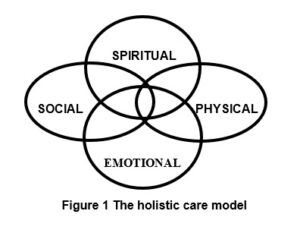
Figure 1 The holistic care model
Although the holistic care model is integral to the philosophies of several health disciplines, including palliative care, the deeply embedded root of the biomedical model often reduces the focus of its care to the physical element.
Specifically, the diagnosis of disease and the physical aspects of symptoms and their management. Consequently, insufficient attention is given to a patient’s social, emotional and spiritual dimensions and the inter-connectedness which exists (Youngson 2012).
This is increasingly evident in patients with life-limiting illness, where studies evaluating psychological and spiritual aspects of care identified these symptoms as being frequently under-recognised by healthcare professionals and consequently undertreated (Austen et al 2016; Balboni et al 2009; Edwards et al 2010; Epstein-Peterson et al 2015; O’Connor et al 2010). Furthermore, this implies a negative impact to a patient’s level of resilience and quality-of-life.
The potential of aromatherapy
Interventions which foster resilience generally target existential and psychosocial distress. These areas are recognised aspects of successful aromatherapy intervention which are explored in chapters 5 and 6 of Integrating Clinical Aromatherapy in Palliative Care (Rose 2023).
Understanding the factors which underpin resilience (see table 1) helps to identify patients in need of additional support and tailor interventions to address their unique capacities. Within aromatherapy, the following case study demonstrates the beneficial effects of integrating clinical aromatherapy approaches.
Case study: Winnie’s experience
Referral
Winnie presented to the specialist palliative care team in a rapidly deteriorating state of health with a complex range of symptoms arising from advanced cancer of unconfirmed sources. Clinical concern surrounding her essential oil ingestion prompted an aromatherapy referral by the nursing team to ensure safe integration with prescribed pharmacology.
Background summary
Throughout her life, this independent, erudite 69-year-old lady, had used plant-based medicine to maintain her health and well-being. Although taking prescribed opioids for pain-relief and anti-emetics for nausea, her preference was to integrate natural approaches alongside her conventional regime. She felt overly drowsy with prescribed pharmacology, particularly anti-emetics, which she had stopped taking because she felt it was easier to cope with persistent nausea than intense drowsiness.
Winnie was self-medicating with essential oil ingestion. Unfortunately, this was not based on the professional advice of a qualified aromatherapist and involved:
Boswellia carterii (frankincense) 2-drops undiluted, sublingually 3-times daily
Copaifera officinalis (copaiba balsam) 2-drops undiluted, sublingually 3-times daily
Personal goals
Having experienced a complex pathway through the healthcare system, Winnie’s priorities were:
- To be involved in all treatment decisions
- To continue self-administration of essential oils
- To live as well and independently as she could in the life she had left
- To see her new grandchild, due to be born in a few months
Aromatherapy intervention
Many of the extended family were present at the first home visit and space was limited. Winnie was weak with fatigue and largely confined to one room due to the limitations of her breathlessness for which she required supplemental oxygen. Her oral mucosa was red and dry but intact.
We discussed her current ingestion of essential oils, which had been ongoing for several weeks with no alleviation of her symptoms and further deterioration in her health noted. Winnie described a spiritual and cultural connection with Boswellia carterii (frankincense) and enjoyed the aroma of the Copaifera officinalis(copaiba balsam). As such, it was suggested that she continue using both essential oils but change the route of application from sub-lingual to topical use.
We considered other essential oils and base substances with analgesic and anti-inflammatory properties, more suited to her current pain experience relating to the right kidney. Being mindful of her deteriorating renal function, a suggestion was proposed for a topical pain-relief blend starting at a concentration of 3%, plus an aromatherapy inhaler stick formulated with her choice of essential oils from a selection designed to alleviate nausea (see table 3). Winnie was willing to try this combination and agreed to stop essential oil ingestion.
Table 3 Winnie’s aromatherapy interventions
| Method of application | Botanical products Botanical name (common name) |
Amount used | Directions for use |
| Topical blend ‘Pain-relief’ 3% |
Boswellia carterii (frankincense) Copaifera officinalis (copaiba balsam) Kunzea ambigua (kunzea) Lavandula latifolia (spike lavender) Zingiber cassumunar (plai) |
10% 25% 30% 25% 10% |
Patient-assisted Apply THREE times daily After 1-week, review |
| Calophyllum inophyllum (tamanu) Simmondsia chinensis (jojoba) oil |
40% 60% |
||
| Aromatherapy inhaler stick ‘Nausea-relief’ |
Lavandula angustifolia (lavender true) Citrus bergamia (bergamot) Zingiber officinalis CO2-total extract (ginger CO2) Simmondsia chinensis (jojoba) oil |
4-drops 5-drops 4-drops |
1mlPatient-directed as required
At each use, inhale 4-8 breath cycles
Within 24-hours, the clinical team reported that Winnie was less restless at night with an associated reduction in pain intensity. One week later, at the next home visit, Winnie described how she was sleeping through the night, she no longer required supplemental oxygen and the nausea was easing.
By the third visit, (1-week later again), her breathlessness had totally resolved and the nausea was well-controlled with regular use of the aromatherapy inhaler stick. Her pain level had significantly reduced to the extent she had completely stopped her prescribed opioids. However, fatigue remained a persistent issue which we explored.
Winnie spoke of the exhaustion she felt from no longer being independent. This was not how she had lived her life. Conversations ensued between the multi-disciplinary team (MDT) and her close family members to determine how she could achieve her goal of living more independently. With improved physical symptoms, the support of a daily carer, as well as the clinical team available via a 24-hour on-call service, Winnie was quickly able to return to independent living.
At the next aromatherapy follow-up, she attended the hospice day centre. She described how she had returned to her normal diet, was feeling physically stronger, less fatigued and sleeping well. This resulted in a further decrease in her level of pain intensity, with an associated self-reduction in the pain-relief blend to twice daily applications.
Reflection
From a patient’s perspective, personal autonomy is a central aspect of palliative care (McCaffrey 2016).
In this case, autonomy was achieved by supporting Winnie’s decision to integrate natural approaches within her end-of-life care and involve her in all essential oil choices and intervention options.
Central to the success of this approach is the cohesive nature of the MDT. Recognising and utilising the strengths of each discipline, together with timely intervention, provided a structure of holistic support for this lady. This in turn fostered her resilience to the extent that she was able to return to independent living with a restored degree of ‘normalcy’ in the life she had left. Winnie was also able to welcome her second grandchild into the world.
In Winnie’s words: ‘The most important part is being listened to and being heard. It’s about being supported in how I want to do things. The positivity this (Hospice) team brings is allowing me to do that and to live my life well.’
————————
Author: Carol Rose BSc (HONS) Palliative Nursing, RN, Dip Aroma, RMT
Registered Nurse, Clinical Aromatherapist, Educator & Author
Email: carol@thearomary.co.nz
Current position: RN in specialist palliative care, North Haven Hospice, Whangarei, New Zealand
Acknowledgement
This is an abridged version of the chapter, ‘Fostering resilience in patients with life-limiting illness’ taken from Carol Rose’s recently published book, Integrating Clinical Aromatherapy in Palliative Care, London: Singing Dragon.

Carol Rose – Short Biography
Carol Rose is a Clinical Aromatherapist, Educator, Author and Registered Nurse with a BSC (HONS) in Palliative Nursing, specialising in clinical aromatherapy in patients with life-limiting illness. She has published a number of international articles on subjects relating to aromatherapy in oncology and palliative care and is a member of the International Journal of Clinical Aromatherapy (IJCA) Editorial Advisory Board and a Fellow of the International Clinical Aromatherapy Network (ICAN).
A dedicated practitioner and advocate of evidence-based complementary therapies for patients with life-limiting illness, she is also the author of the recently released textbook, Integrating Clinical Aromatherapy in Palliative Care which explores how to effectively bridge the gap between conventional healthcare approaches and safe integration of clinical aromatherapy as a healing modality in specialist palliative care. She lives with her husband in the far north of New Zealand where they spend any spare time tending their 7-acre garden.
References
Austen, P., Macleod, R., Siddall, P., McSherry, W., Egan, R. (2016) The ability of hospital staff to recognise and meet patient’s spiritual needs: a pilot study. Journal for the Study of Spirituality 6, 1, 20-37.
Balboni, T., Paulk, M., Balboni, M., Phelps, A. et al. (2009) Provision of spiritual care to patients with advanced cancer: associations with medical care and quality of life near death. American Society of Clinical Oncology 28, 3, 445-452.
Bonanno, G., Westphal, M., Mancini, A. (2011) Resilience to loss and potential trauma. Annual review of Clinical Psychology. doi: 10.1146/annurev-clinpsy-032210–10452
Edwards, A., Pang, N., Shiu, V., Chan, C. (2010) The understanding of spirituality and the potential role of spiritual care in end-of-life and palliative care: a meta-study of qualitative research. Palliative Medicine 24, 8, 1-18.
Eicher, M., Matzka, M., Dubey, C., White, K. (2015) Resilience in adult cancer care: an integrative literature review. Oncology Nursing Forum 42, 1, E3–16.
doi:10.1188/15.ONF.E3-E16
Epstein-Peterson, Z., Sullivan, A., Enzinger, A., Trevino, K. et al. (2015) Examining forms of spiritual care provided in the advanced cancer setting. American Journal of Hospital Palliative Care 32, 7, 750-757.
Frankl, V. (1984) Man’s Search for Meaning: An Introduction to Logotherapy. New York: Simon and Schuster. (Original work published in 1946).
Li, M., Yang, Y., Liu, L., Wang, L. (2016) Effects of social support, hope and resilience on quality of life among Chinese bladder cancer patients: a cross-sectional study. Health Quality of Life Outcomes 14, 73. doi: 10.1186/s12955-016-0481-z.
Manne, S., Myers-Virtue, S., Kashy, D., Ozga, M. et al. (2015) Resilience, positive coping, and quality of life among women newly diagnosed with gynaecological cancers. Cancer Nursing 38, 5, 375–82.
McCaffrey, N., Bradley, S., Ratcliffe, J., Currow, D. (2016) What aspects of quality of life are important from palliative care patient’s perspectives? Journal of Pain & Symptom Management 52, 2, 318-328.
Molina, Y., Yi, J., Martinez-Gutierrez, J., Reding, K., Yi-Frazier, J., Rosenberg, A. (2014) Resilience among patients across the cancer continuum: diverse perspectives. Clinical Journal of Oncological Nursing 18, 1, 93-101.
Monroe, B., Oliviere, D. (2009) Resilience in Palliative Care – achievement in adversity (2nd ed). New York: Oxford University Press Inc.
O’Connor, M., White, K., Kristjanson, L., Cousins, K., Wilkes, L. (2010) The prevalence of anxiety and depression in palliative care patients with cancer in Western Australia and New South Wales. The Medical Journal of Australia 193, 5, S44-47.
Rose, C. (2023) Integrating Clinical Aromatherapy in Palliative Care. London: Singing Dragon.
Seiler, A., Jenewein, J. (2019) Resilience in cancer patients. Frontiers in Psychiatry 10, article 208, 1-31.
Somasundaram, R., Devamani, K. (2016) A comparative study on resilience, perceived social support and hopelessness among cancer patients treated with curative and palliative care. Indian Journal of Palliative Care 22, 2, 135–40.
Tugade, M., Fredrickson, B., Barrett, L. (2004) Psychological resilience and positive emotional granularity: examining the benefits of positive emotions on coping and health. Journal of Personality 72, 6, 1161–90.
Youngson, R. (2012) Time to Care. Raglan: Rebelheart Publishers.



Leave a Reply