


Together with colleagues around the world we are saddened to learn of the death of Dr Robert Twycross. In June 2021 he wrote an editorial for ehospice – ‘Looking back and looking forward’ which we are pleased to republish below. We have also included a personal tribute from Dr Michael Minton. Our thoughts go out to his family and friends and all who were fortunate enough to know and learn from him.
We have also linked, beneath his article, some of the obituaries which are beginning to appear.
Looking back and Looking Forward – by Dr Robert Twycross, June 2021
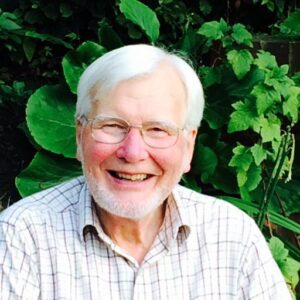
I moved from general medicine into hospice-palliative care 50 years ago – in March1971 – when, at the invitation of Cicely Saunders, Founder and Medical Director of St Christopher’s Hospice in London, I accepted the post of Research Fellow in Therapeutics.
Later, in 1976, I moved back to Oxford (my alma mater) to a new free-standing palliative care unit on the campus of one of the University Teaching Hospitals. After I retired in 2001, I have continued writing with younger colleagues and teaching ‘on request’.
My professional life has been immeasurably rich and rewarding: I have been privileged to care for thousands of people with end-stage disease, taught countless medical students, doctors and others and, in the early years, conducted research mainly into the use of morphine by mouth for cancer pain. Thus my career has comprised a trinity of patient care, education, and research.
Since 1971 the world of palliative care has changed beyond recognition. [Gomez-Batiste & Connor 2017] Palliative Medicine is now a recognized specialty in an increasing number of countries, and university departments have been established. The fact that palliative care is now seen by both the World Health Organization and the United Nations as an essential component of ‘universal health coverage’ should facilitate development in countries where palliative care is still virtually non-existent. [Global Atlas 2020]
The present pandemic has led to even greater recognition of the need for high quality end-of-life care, and it has seen the involvement of palliative care teams in Intensive Care and other specialist care units. The President of the Association for Palliative Medicine here in the UK recently wrote that ‘Palliative care really came to the fore during 2020 and moved to a new space and a new thinking and my hope is that that movement continues. We have to continue to evolve and grow as a specialty.’ However, although palliative care has spread enormously and diversified considerably over the last half century, should we be aiming to evolve even further?
As a ‘dinosaur’ from the last Century, this is not for me to say.
On the other hand, I think it most important to remember our roots, namely holistic partnership-based care for those approaching the end of life focused on comfort and quality of life
We must also not forget the many challenges which we will continue to face. Inevitably, there will be never-ending financial ones. In addition, the values of the wider ‘Health Industry’ – competition, rationalism, productivity, efficiency, and profit – are essentially incompatible with compassion and caring. [Youngson & Blennerhassett 2016].
Further, there is still antagonism within the medical profession in some countries. This is partly fuelled by the distaste which many doctors feel when confronted with end-stage disease, and the reluctance to change the focus of care from disease control to comfort. Communication skills are still often distressingly poor. Linked with this is the inability of many doctors to engage sensitively in discussions about impending death. ‘Attention to detail’ in relation to pain and symptom management is often lacking.
Thus the challenge of providing high quality palliative care long-term should not be under-estimated. It requires determination, resilience, and high level clinical skills, sustained by a positive attitude toward our patients as people of worth, as verbalized by Cicely Saunders:
‘You matter because you are you. You matter to the last moment of your life, and we will do all we can, not only to help you die peacefully, but to live until you die.’
References
Global Atlas of Palliative Care, 2nd Edition (2020): available at https://bit.ly/3dESF4h
Gomez-Batiste X & Connor S (2017). Building Integrated Palliative Care Programs and Services. Worldwide Hospice and Palliative Care Alliance. https://www.thewhpca.org/resources/category/building-integrated-palliative-care-programs-and-services
Youngson R and Blennerhassett M (2016) Humanising healthcare. BMJ. 355:466–467.
———————-
Robert Twycross was Emeritus Clinical Reader in Palliative Medicine, University of Oxford, UK, and one of the early pioneers within the specialty. From 1988–2005 he was Head of the WHO Collaborating Centre for Palliative Care. He is co-author of several widely acclaimed textbooks, notably the Palliative Care Formulary (up to 6th edition 2017) and Introducing Palliative Care (6th edition 2021). He has received numerous awards from professional organizations. Since 2017, he has been a Trustee of the Palliative Care Education Foundation (PACED; www.paced.org.uk)
——————————
and his 2021 interview with IAHPC:
A personal tribute to my colleague and friend Robert Twycross who died on 20th October 2024 – by Michael Minton
The younger generation may only know the name of R.G.Twycross. Robert was a huge pioneer over his 50-year career and established so much of Palliative Medicine that we know and teach today.
While a student in 1964 he had invited Dame Cicely Saunders to talk in Oxford. He later did his MD with Dame Cicely and thereafter became an ambassador for Palliative Care (PC).
He wrote most of the standard textbooks including “Introducing Palliative Care“ (now in its 6 th edition)which evolved from the innovative 5 day course that Robert established for the Oxford clinical medical students in the early 1980s before the medical specialty had been recognised (1987).
He was a brilliant teacher and mentor to a whole generation including myself. He was passionate and wholly committed to PC which took him around the world inspiring others to develop PC services.
He had a commanding and authoritative presence as a lecturer and advocate, he recognised that as a pioneer for PC he needed to be prepared to put his head above the parapet and for that we are most grateful.
He was always updating his ideas and developing new projects such as the PC Formulary. He would never give the same talk twice – it would be updated every time. He was an enthusiastic writer and commentator up to the end of his life. He would always be prepared to re edit, even up to 10 times, to satisfy his standards.
It was sometimes hard keeping up with him! So, we were always challenged but also inspired.
He taught that we should be psycho-physicians having attention to detail in all aspects of care. His mantra to “Review, Review, Review” should always be at the core of our responsibility as PC doctors.
I had the privilege of working with Robert for over 20 years and have seen at first hand the changes that he has influenced in the development of PC in the UK and abroad.
I encourage you to read some of the many tributes from around the world that identify his numerous contributions which included being a founder member of the Association of Palliative Medicine APM in 1985.
Michael Minton,
Oxford 22nd October 2024.
Cicely Saunders International pays tribute to Dr Robert Twycross
We are sad to learn that Dr. Robert Twycross, a pioneering figure in hospice and palliative care, has died. He leaves behind a profound legacy that reshaped the way end-of-life care is provided worldwide. As one of the early leaders in this field, Robert’s work helped transform the care of patients with terminal illnesses, with a particular focus on pain and symptom management and the compassionate alleviation of suffering…..
TheIAPC pays heartfelt tribute to Dr. Robert Twycross: India’s ‘Teacher of Palliative Care’
Dr. Robert Twycross’ contributions to Palliative Care in India were enormous. Dr. Twycross will forever be revered as the ‘Teacher of Palliative Care’ in India. Through his tireless efforts and selfless dedication, Dr. Twycross significantly contributed to the development of India’s palliative care landscape. As a visionary pioneer, he inspired the first generation of palliative care physicians in India, sowing the seeds of this vital service. Through his exceptional education and training, Dr. Twycross empowered countless doctors and nurses across India, leaving a lasting legacy.
The IAHPC pays tribute:
His life’s work has had a lasting impact on the development and recognition of palliative care as a vital aspect of modern medicine and his incalculable contributions live on in IAHPCs vision of a world free from health-related suffering.
Many reflections and voices of gratitude are also to be found on Facebook and LinkedIn


Leave a Reply