

A Brazilian experience using Sound Healing as a complementary practice for humanisation in palliative care: Not all care takes place through a procedure. Some forms of care begin when someone finds, for the first time in a long while, a space simply to exist.
In palliative care, we learn every day that alleviating suffering goes far beyond symptom control. And yet, one question continues to accompany me throughout my journey with care through sound:
How can we offer presence when not everything can be cured?
This question gave rise to O Som do Cuidar – The Sound of Care, a programme of care, humanisation and emotional regulation through sound, developed as a complementary practice for people living with life-threatening illnesses, their families and healthcare professionals.
Inspired by the vision of care pioneered by Cicely Saunders and aligned with the guidelines of the World Health Organization (WHO, 2020), the programme understands that, even when cure is no longer possible, care remains a deeply human experience.
The programme is grounded in an essential understanding of palliative care: care is directed not only towards the person who is ill, but also towards those who walk alongside them — especially their family members and support network (Arantes, 2016, p. 53). For this reason, its experiences can be developed in different care settings, adapting to the needs of patients, families and healthcare teams.
More than proposing an intervention, the programme was born from a desire to create the conditions for something essential, but not always available in the everyday life of healthcare services: a pause. A space for presence. A time in which care can also happen through experience.
Sound as a Soft Technology of Care
Although the scientific literature on Sound Healing is still evolving, there is growing scientific interest in the potential contribution of sound-based experiences to wellbeing across a range of healthcare settings.
An observational study of sound meditation using Tibetan singing bowls identified significant reductions in tension, anxiety, fatigue and negative mood states following a single session (Goldsby et al., 2017).
More recently, a study published in the European Journal of Investigation in Health, Psychology and Education (2023) compared Tibetan singing bowl therapy with progressive muscle relaxation and a wait-list control group. The results indicated greater reductions in self-reported anxiety, as well as physiological changes consistent with a relaxation response, including increases in indicators associated with parasympathetic nervous system activation.
As with many integrative and complementary health practices, the evidence base is still developing. The available findings, however, point to an expanding field of research that merits further investigation with increasing scientific rigour.
In Brazil, physician and public health specialist Emerson Elias Merhy, in dialogue with psychologist, public health specialist and Collective Health researcher Túlio Batista Franco, proposed the concept of soft technologies to characterise the relational dimension of healthcare work, which is fundamental to the production of care: relationships, welcoming, bonds and shared responsibility (Merhy; Franco, 2003).
It is within this relational dimension that I recognise some of the possibilities of sound-based care: listening, presence, welcome, and the creation of a space in which each person can perceive themselves and be cared for in their own uniqueness.
Perhaps it is precisely within this space — between what medicine can treat and what continues to call for presence — that sound-based care reveals one of its greatest contributions.
From this perspective, sound-based care can be understood as a practice that engages with the field of soft technologies: an experience that expands the possibilities for encounter, listening and welcome, without losing sight of what lies at the heart of palliative care — the person in their wholeness.
Not as a resource intended to replace established clinical approaches, nor as an answer to every form of suffering. Rather, as a possibility for creating the conditions for the body to slow down, attention to reorganise, and each person to find, even if only for a few minutes, a space to breathe amid the intensity of illness and caregiving.
A Pause for Those Who Care
In May 2026, Hospital Bom Jesus dos Passos, in Laguna, Santa Catarina, Brazil, welcomed O Som do Cuidar – The Sound of Care. The hospital includes palliative care among the services it provides to the community.
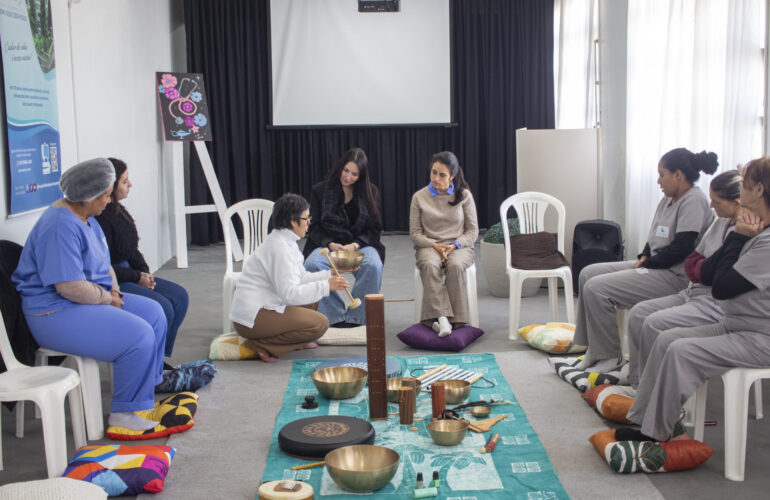
Designed for the hospital’s healthcare professionals, the experience took place over four sessions, bringing together 28 staff members who voluntarily took part in the sound experiences. The intention was to offer a pause from the intensity of everyday hospital life — a moment to slow down, breathe and turn their care towards themselves as well.
The sessions took place in a circle, with everyone seated. At the beginning of each session, participants were invited to place a drop of essential oil in their hands, take a few conscious breaths and silently set an intention for that moment.
The space was then filled with the vibrations of Tibetan singing bowls, chimes, kalimba and other instruments used therapeutically, guiding the group through an experience of listening, presence and relaxation.
The sound travelled differently through each person.
Some relaxed deeply. Others were surprised to notice how much tension their bodies had been holding before the experience. Some found, within that space of silence, a point of contact with emotions that had long remained suspended. One participant shared, visibly moved, that during the experience she was able to access and begin to process the grief surrounding her father’s death — a process that, until then, had not yet found the space to unfold.
The intention was not to produce a particular state or to seek extraordinary experiences. It was to create the conditions for each person to find within themselves whatever, at that moment, needed to be cared for.
In the evaluation conducted after the sessions, the president of Hospital Bom Jesus dos Passos, Dr Tatiana Mansur Blosfeld, highlighted one aspect she considered particularly relevant to the reality of the institution:
“The possibility of offering hospital staff a moment of pause, welcome and connection with themselves, supporting emotional wellbeing and strengthening the care of those who care.”
Immediately after the sessions, Dr Tatiana shared that staff members had been spontaneously talking about the experience in the hospital corridors and expressing a desire for further sessions. She also captured, with great sensitivity, what remained in the environment after the experiences:
“It was beautiful what you initiated here, and it remained reverberating in the air in so many ways. I was very happy with your presence and with everything you brought through these notes and vibrations. We have so much to accomplish together.”
Perhaps this is one of the most distinctive qualities of sound-based care.
Not everything that happens during a sound experience can be described through physiological indicators or assessment scales. Often, its effects remain present in the way people return to breathing, to listening to one another and to inhabiting their work.
It is precisely in this sense that sound-based care resonates with the principles of humanisation: not by adding procedures to the everyday life of healthcare services, but by enhancing the quality of presence in the encounters that are already taking place.
Humanising care means transforming the quality of the encounter
In palliative care, we often speak about dignity, autonomy, relief from suffering and quality of life. These are principles that guide practices, decisions and relationships of care. Yet there is a less tangible dimension — and, precisely for that reason, a more difficult one to measure — that runs through all of them: the quality of presence.
Being present does not simply mean occupying the same space as another person. It means offering a listening ear that welcomes, a silence that does not need to be filled, and a sense of time that respects the pace of the person experiencing illness, those accompanying them through the process, and those who provide care every day.
Perhaps it is in this territory, where not everything can be resolved, that sound-based care finds its greatest contribution.
By supporting states of relaxation, enhancing awareness of the body and creating conditions for experiences of listening and presence, sound does not seek to replace clinical interventions or respond to every form of suffering. It offers a space in which care can be experienced differently.
From this perspective, sound-based care can be understood as a soft technology of care. Its potential lies not only in the instruments used or the vibrations they produce, but in the quality of the relationships it helps to sustain: relationships that are more present, more sensitive and more human.
At a time when healthcare systems are increasingly challenged to respond to the complexity of human experience, perhaps it is also time to broaden our repertoire of care. Not to replace what we already know how to do, but to add new possibilities for presence.
Because humanising care is not about adding procedures. It is about transforming the quality of the encounter. And sound-based care does not seek to change the course of illness. It seeks to transform, even if only for a few moments, the experience of those who journey through it.
——————
Further reading
Sound Healing and its potential effects
- Goldsby, T. L., Goldsby, M. E., McWalters, M., & Mills, P. J. (2017). Effects of Singing Bowl Sound Meditation on Mood, Tension, and Well-being: An Observational Study.
- European Journal of Investigation in Health, Psychology and Education (2023). Study comparing Tibetan singing bowl therapy with progressive muscle relaxation in reducing anxiety.
Humanisation and care
- ARANTES, Ana Claudia Quintana. A morte é um dia que vale a pena viver. São Paulo: Casa da Palavra, 2016.
- MERHY, Emerson Elias; FRANCO, Túlio Batista. Por uma composição técnica do trabalho centrada no campo relacional e nas tecnologias leves. Saúde em Debate, Rio de Janeiro, v. 27, n. 65, p. 316–323, 2003. Article available as a PDF.
- World Health Organization (2020). Palliative Care.
———————-

Thaís Oliveira Chita is a Sound Healer and project manager, with a background in Journalism and Sound Healing. Her training in Sound Healing began at Soundfulness Education. She is the creator of O Som do Cuidar – The Sound of Care, a programme of care, humanisation and emotional regulation through sound that integrates sound-based experiences into care practices for healthcare professionals, patients and families in hospitals and other healthcare settings.
Her work brings together knowledge of Sound Healing, nervous system regulation and the humanisation of care, developing projects that create greater space for presence, listening and wellbeing within healthcare institutions.
HUM Sound Healing
Instagram: @hum.sound.healing
Website I Linkedin
https://thaischita.wixsite.com/humsoundhealing
—————–
ehospice is proud to help promote individual, local, national and international voices in Hospice & Palliative Care
We are on target to have over One Million page views this year.
To stay in touch with colleagues and news around the world subscribe to our free Newsletter





Leave a Reply