

Authors: Lizzie Chambers, Sujeong Kim
In late October, the WHO Palliative Care Working Group met in Seoul to consider one question: how can we ensure that palliative care reaches everyone who needs it?
The answer, it turns out, depends on collaboration and connection, linking the work happening at a local level to actions at the national, regional, and global level.
Anyone who has built a palliative care service, trained a team or worked to get access to morphine knows how isolating that work can feel. Progress is often slow, hard won, and invisible beyond your own hospital. It can be difficult to see how your efforts connect to global commitments, WHO guidance, or the work of colleagues facing the same barriers in other countries.
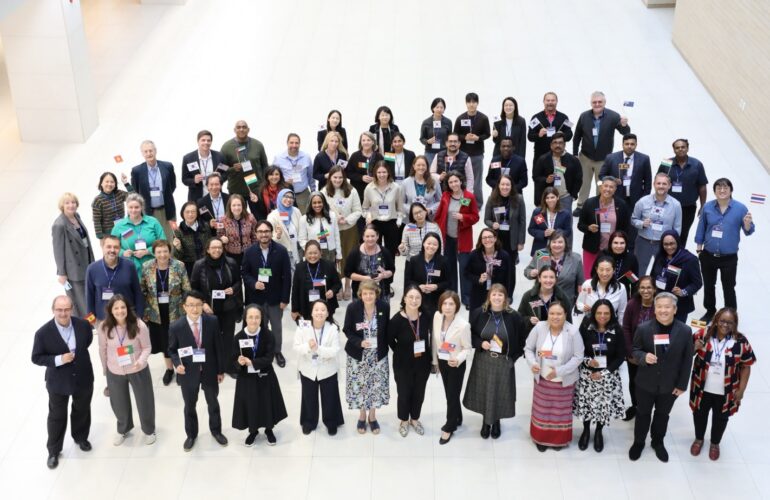
The fourth WHO Palliative Care Global Action Forum, hosted by the Catholic University of Korea College of Nursing (a WHO Collaborating Centre for Training in Hospice and Palliative Care), set out to close that distance. The meeting brought together participants from all six WHO regions, including WHO regional offices, WHO collaborating centres, non-state actors, academic and other key partners. Rather than reporting to each other, they spent two days co-designing what happens next and committing their own time to make it happen. In her opening to the meeting, Dr Megan Doherty, WHO consultant for palliative care, shared a reflection from Dr Ximena Garcia-Quintero.
“What brought us here will not take us there. We must continue with passion and determination – but we also need a shared vision and the courage to think innovatively to create the change palliative care needs.”
~ Dr Ximena Garcia-Quintero
One movement, coordinated globally
The forum is the annual meeting of the WHO-convened Palliative Care Working Group. Its purpose is simple: to make sure that the many organizations working to expand palliative care globally are pulling in the same direction, sharing what works and not duplicating effort. For healthcare providers and advocates on the ground, that coordination matters. It means the tools, evidence and policy arguments you need are being built with input from people who understand your context, and that what you learn locally can shape what happens globally.
Two initiatives show most clearly how this works in practice.
COMPASS: from WHO guidance to national action
 WHO has produced a strong body of guidance on integrating palliative care into health systems. The challenge has always been turning those documents into change within a country. COMPASS, launched in September 2026, does exactly that. Experienced advisors provide technical support to country teams as they work to integrate palliative care into their national health systems, adapting WHO resources to local policies, services and priorities.
In Seoul, the COMPASS team focused on how to share the lessons from COMPASS more widely, with regional associations, donors, in-country stakeholders and the public. If your country is part of COMPASS, there is a national team working on the same goals you are, and a global network of advisors behind them.
COMPASS Countries (2026 Cohort)
Africa: Botswana, Ghana
Eastern Mediterranean: Oman, Pakistan
Europe: Slovenia, Uzbekistan
Americas: Guatemala, Peru
South-East Asia: Bhutan, Nepal, Sri Lanka
Western Pacific: Malaysia, Philippines
Close the Gap: tools you can use today
 Children’s palliative care remains one of the widest gaps in global health. The Close the Gap campaign, led by the International Children’s Palliative Care Network (ICPCN) and integrated with WHO’s Global Initiative for Childhood Cancer, is designed to be used, not just endorsed.
The Close the Gap Toolkit is freely available on the ICPCN website, and new tools, including a country self-assessment tool, are on the way. Over the next year, the working group will co-design and pilot a Champions program, building a community of practice of advocates across all six WHO regions who can use the campaign to complete specific activities designed to drive change in their own countries.
Building the case together
Alongside these two initiatives, working group members committed to three further areas which were prioritized as key global gaps where coordination was essential to drive progress:
 Universal Health Coverage: This workstream will develop a plan for how to ensure palliative care is visible and included within universal health coverage commitments ahead of the UN High-Level Meeting on UHC in September 2027.
 Research to Policy: Evidence exists, but how do we ensure it reaches policymakers? This workstream will develop an Evidence to Policy Package to help translate research into policy, co-designed with low- and middle-income countries.
 Financing Palliative Care: Adequate funding for palliative care is the biggest global gap. This workstream will review evidence and develop a policy brief on the investment case for palliative care, including the hidden costs carried by families and how and why governments need to act now.
Connecting Global to Local
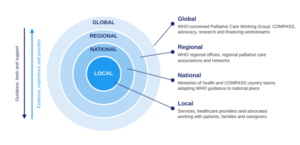
How global, regional, national and local palliative care action connect
Global coordination only matters if it reaches patients, caregivers and their loved ones. Whatever your role, there are ways to connect your work to this effort: use the Close the Gap Toolkit in your own advocacy, find out whether your country is part of COMPASS, and draw on WHO resources when making the case to decision-makers. The message from Seoul was clear: none of us is working alone.
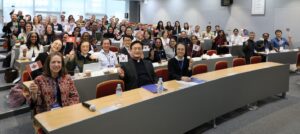
The forum was hosted by the Catholic University of Korea College of Nursing, led by Sujeong Kim with Minjung Kyung, SangA Lee and Spandana Rayala (Sunflower Children’s Network and Two Worlds Cancer Collaboration), with support from St Jude Global, Global Partners in Care, and the Asia Pacific Hospice and Palliative Care Network. More than 30 organizations contributed in-kind support for their representatives to attend the meeting.




Leave a Reply