

Recognising the holistic needs that accompany these emergency situations, a new network – Palliative care in Complex Humanitarian Emergencies (PALCHE) – has been developed to address current limitations in providing palliative care to people facing CHEs.
CHEs are defined by the United Nations as “a humanitarian crisis in a country, region or society where there is total or considerable breakdown of authority resulting from internal or external conflict which requires an international response that goes beyond the mandate or capacity of any single and/or ongoing UN country program.” Natural disasters – such as the 2010 earthquake in Haiti, the more recent earthquakes in Nepal, and epidemics such as Ebola in Western Africa in 2014 – can trigger a CHE. In short, a CHE is an acute emergency layered over ongoing instability that typically needs large-scale, multi-faceted humanitarian assistance.
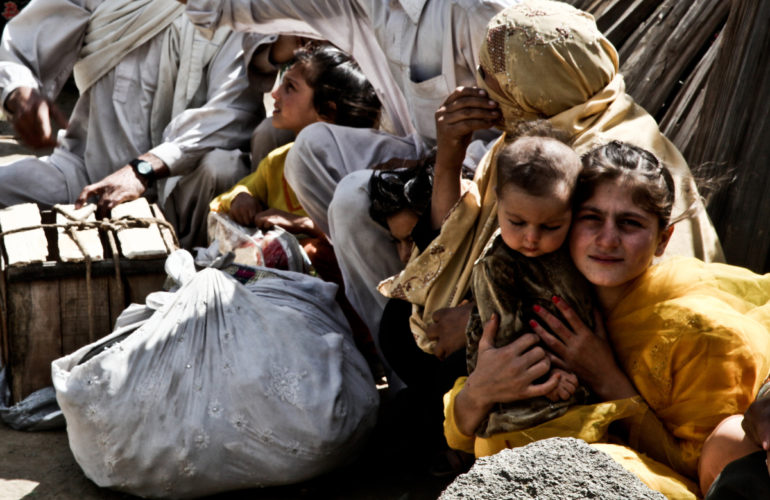
CHEs can generate terror, pain, trauma and hopelessness for people caught up in them. Groups such as children, pregnant and nursing women, migrants, displaced people and those affected by progressive life-limiting illnesses are especially vulnerable in these situations. This vulnerability arises from the catastrophic destruction of social networks and health systems and services, which means that vital needs cannot be met.
Adults and children with existing chronic diseases also face exacerbation of their illness due to conditions caused by a disaster (e.g., lack of water and food, exposure to the elements, disruption in supply of their medications, etc.). As a result, morbidity and mortality from chronic disease increases during disasters and is a specific area where palliative care can assist.
But many people without palliative care needs prior to a CHE may also need palliative care due to their new situation – e.g., Ebola brought life-threatening illness to entire communities – as well as complex bereavement needs which are usually ignored in the face of more ‘urgent’ medical and rescue priorities.
Since 2000 there have been positive palliative care developments globally. However, the significant need for effective palliative care persists. Despite the prioritization of health care in international responses to CHEs, palliative care has historically been neglected, the prime focus generally being on acute medical interventions, e.g., setting broken bones. The PALCHE network plans to address this gap.
PALCHE is an informal collaborative network listed within the International Association for Hospice and Palliative Care (IAHPC) and comprised of individuals committed to increasing availability and access to palliative for those facing war, natural disasters, epidemics, poverty, hunger and displacement.
The nascent network is guided by a philosophy of mutual respect and humility, offering practical assistance and training while seeking to involve, strengthen and learn from local communities. PALCHE will also draw on, and contribute to, existing efforts in this area, such as the work of the International Red Cross and Red Crescent and Médecins Sans Frontières, among others. Currently the network’s broad work areas include advocacy, education, research, clinical practice and fund-raising; areas that will be developed and refined over the coming few months.
Joan Marston, CEO of the International Children’s Palliative Care Network and founder and coordinator of the group, said: “With recent UNHCR figures showing 60 million displaced people in the world this year, over 50% being children, there must be many who have life-liming conditions. Provision of palliative care is a moral imperative for these extremely vulnerable children and adults. We know we cannot relieve all their suffering but we can help to improve their quality of life.”
Liliana de Lima, Executive Director of the IAHPC, said: “At IAHPC we are very glad to help with this extraordinary effort and to support PALCHE. Congratulations to Joan Marston and the rest of the group for raising awareness about the palliative care needs of individuals in humanitarian situations. We look forward to future collaboration with other NGOs and individuals interested in this field.”
Get involved
Have you experienced providing palliative care in Complex Humanitarian Emergencies? Would you like to help in any way? If so, email Joan Marston on joan.icpcn@gmail.com to find out how you can get involved.


Leave a Reply