

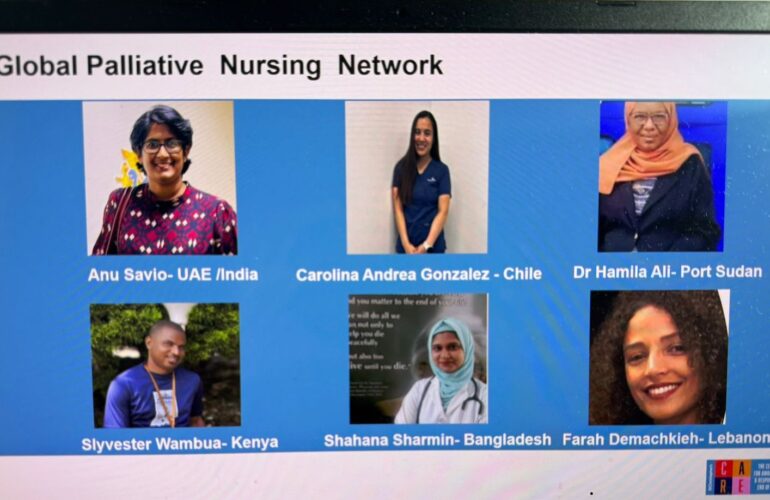
A Report from the International Nurses Day Event — Nursing Now Challenge, 12 May – Anu Savio Thelly, Carolina González Araya, Silvester Wambua, Dr Halima Ali, Shahana Sharmin, Farah Demachkieh
On International Nurses Day, the Global Palliative Care Nursing Network (GPNN) was proud to have two dedicated slots at the Nursing Now Challenge’s global event. Champions of GPNN came together from across the world to lead a powerful, morning session centred on one defining theme: professional identity. What followed was an honest, moving, and energising conversation about who palliative care nurses are and who they must become.
The Soul of Palliative Care Nursing
Anu Savio Thelly opened the session by asking a deceptively simple question: What makes palliative care nursing a distinct professional identity rather than simply a job? She reminded the audience that palliative care nursing lives in the spaces between tasks; in presence, in witness, in the act of sitting beside suffering when there is nothing left to cure but so much left to care for. Much of this work is invisible, she noted, yet it is profoundly powerful. Nurses, she shared, must move beyond the bedside into advocacy, policy, and leadership, because they are the ones who see the gaps most clearly.
Finding the Voice
Carolina González Araya, an Oncology Nurse Practitioner from Chile, shared a personal turning point when nursing became more than clinical competence. In oncology and palliative care, she explained, person-centred care means recognising each patient’s values, fears, and hopes as central to every healthcare decision. She described nurses as a bridge between patients and systems, between science and humanity, and called on the profession to claim its place in research, leadership, and decision-making spaces.
Journeys That Shaped Us
Silvester Wambua, Secretary of the Palliative Nurses Society of Kenya, reflected on the early encounters that drew him into palliative care — particularly a patient enduring unbearable pain from diabetic wounds. That experience shifted his understanding of nursing from treating disease to caring for the whole person. His message was quietly powerful: every patient deserves comfort, every life deserves dignity, and no one should suffer unnecessarily.
The Unseen Barriers
Dr. Halima Ibrahim Malik Ali, Director of Hospice Port Sudan, brought a vital and often uncomfortable truth to the conversation. Despite their frontline expertise and clinical depth, palliative care nurses are routinely marginalised within rigid medical hierarchies. The invisibility of specialised nursing skills, the emotional weight of end-of-life care, and a persistent gap in leadership training all contribute to keeping nurses unheard. Transitioning nurses from the bedside to the boardroom, she argued, is not a luxury — it is a necessity.
Bedside Wisdom as Leadership
Shahana Sharmin, a Nursing Officer at Bangladesh Medical University, explored what she calls the “artistry of nursing.” She shared her team’s community-based initiative in the Korail Slum — a project built on restoring human connection and emotional well-being. Her message: nurses must advocate for themselves as fiercely as they advocate for patients. Through the GPNN, she found what she called “team power” — the collective strength that makes leadership beyond the bedside possible.
Building What Comes Next
Farah Demachkieh from Lebanon brought the session to a close with a forward-looking challenge. The world needs nurses who understand that palliative care is not a speciality confined to a few — it is at the heart of nursing itself. Mentorship, she said, is a professional responsibility. Building communities of connection — spaces where stories are shared and wisdom exchanged — is how the next generation of palliative care nurses will grow stronger, louder, and better prepared.
Together, these six voices made one thing abundantly clear: palliative care nurses are not waiting to be invited to the table. They are building it.
About the Global Palliative Nursing Network (GPNN)
The Global Palliative Nursing Network (GPNN) is a worldwide community of practice hosted by St Christopher’s, bringing together nurses committed to advancing palliative and end-of-life care across all settings and income contexts. GPNN is open to all nurses — those working with children, young people, and adults; those in high-income and low-resource settings alike; and those practising in hospitals, homes, hospices, community clinics, schools, or anywhere care is given. It offers a flexible, virtual space to learn, reflect, and grow alongside a global community of peers.
The network is especially recommended for nurses who have experienced professional loneliness, want greater access to resources and tools, and aspire to become more visible leaders and champions within palliative care. Members can expect peer support, professional development, shared learning, and genuine encouragement to advocate for better care through collaboration.
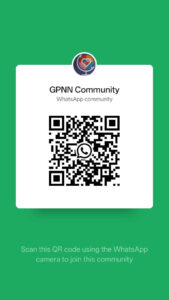
To join this growing movement, visit www.stchristophers.org.uk/gpnn. Please join the WhatsApp group using the QR code to stay updated.





Work full of compassion and empathy,where silence matters.