

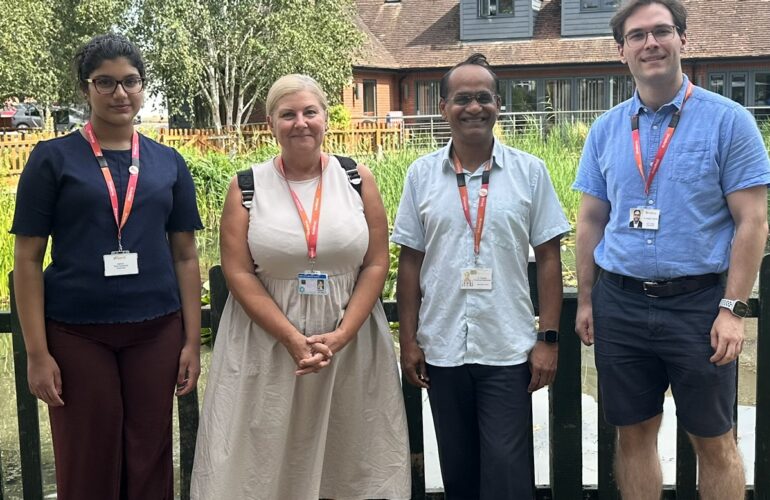
By Dr Ramesh Thulavavenkateswaran, Specialist Grade Doctor in Palliative Medicine: Hospices are increasingly asked to take sixth-formers on work experience, and to a busy service it can feel like one more thing to fit in. But even two days, done with a little thought, is one of the most valuable experiences a future doctor can have, and it need not be a burden on the team.
This is simply how we have come to do it, in case it helps other hospices thinking of trying.
The welcome matters more than it looks. It begins before any of the doctors are involved: our medical team secretary settles them in, shows them where the tea, coffee and juices are, and hands over the Wi-Fi password, since a good few of them now take their notes on their phones. She sees them change over the two days more than any of us do. “They come in quiet, unsure and not feeling confident in a new environment,” she says, “and by the end they are chatting away and asking questions and being part of the team. It is a joy to watch, every single time.”
We make it a supported placement, too, because a hospice does not hide from death, and no young person should carry a hard day home alone; we sit down and talk it through whenever they need to. So, before they have seen anything clinical, they have already learnt the first thing worth knowing: that medicine, done well, is simply people looking after one another. From the very first meeting we make them part of it, not spectators, introducing themselves in the MDT so they belong in the room rather than hovering at the edge.
CARE, NOT CURE
We show them what medicine looks like when cure is no longer the goal. Not every patient can be cured, and a great deal of medicine is not about curing at all, but about caring comfort, communication, and looking after a person’s dignity right to the end.
The home visits leave the biggest mark. Most of them have only ever seen patients in a hospital bed, in a gown, on someone else’s ground; to meet someone in their own home, in their own chair, surrounded by their own life, changes how they understand illness completely.
We do not spare them the difficult parts, so they leave with an honest sense of the work rather than a rosy one.
WHAT MEDICAL SCHOOLS ARE REALLY LOOKING FOR
We are deliberate about what we show them, because it turns out to mirror almost exactly what a medical school is looking for. The teamwork of the MDT, the empathy of a difficult conversation, the whole-person view of a home visit, the way decisions get made and shared in a meeting: these are the very qualities a modern interview sets out to find.
But one thing here is almost theirs alone. They will have sat in on the hardest conversations, the withdrawing of treatment, a decision not to attempt resuscitation. Most applicants prepare for such questions from a textbook; ours will have watched them weighed at a bedside, with all the difficulty left in. So, when the interview turns, as it always does, to ethics or empathy or why they want to do this at all, they are not reaching for something abstract. They have seen it.
WHAT THE STUDENTS SAY
Over the years, we have watched a good many of them go on to achieve their goals. One current student said the placement taught her “what holistic care really means, and to see patients from a whole different perspective, not just as someone in a hospital bed.”
One, now studying medicine, says those “two days are honestly why I applied; until then medicine had just been a plan, and the hospice was where it became real.” Another, who came to medicine later through graduate entry, says it “stayed with me for years; when I finally applied, I already knew the kind of doctor I wanted to be.”
Every so often, the whole thing comes full circle. One of the sixth formers who once came to us on work experience is back with us now as a GP trainee, learning his craft in the same rooms where he first watched it. He arrived, years ago, asking the question they all ask, wondering where the real medicine was; he found it here, and of all the places he could have gone, he chose to come back to it.
None of this asks a great deal, and any hospice could do the same. It costs a little time and a warm welcome, and in return you give a young person a real sense, early, of what caring for the sick asks of a doctor.
These are the doctors who will care for us in years to come. Having a small hand in the sort of doctors they become is, to me, a privilege worth every hour it takes.
Dr Ramesh Thulavavenkateswaran
St.Helena Hospice
=================
ehospice is proud to help promote individual, local, national and international voices in Hospice & Palliative Care
We are on target to have over One Million page views this year.
To stay in touch with colleagues and news around the world subscribe to our free Newsletter
————————
Picture caption: Left to right – Aditi Harikumar (Sixth form student), Jeni Yates (Medical team Secretary), Dr Ramesh Thulavavenkateswaran (Specialist Grade Doctor) and Dr Greg Hayman (GP Trainee).



Very nice article and great work on offering work experience days for sixth formers. Pls continue this work which helps so many future doctors and creates interest in palliative care.