

From Salzburg to the first Brazilian cohort: a journey of learning, translation, and cultural adaptation to strengthen palliative care education.
In January 2026, I had the opportunity to participate in the End-of-Life Nursing Education Consortium (ELNEC) International Seminar in Salzburg, Austria, an international initiative recognized for its contributions to nursing and palliative care education. At that seminar, I had the privilege and responsibility of being the first Brazilian nurse to participate in the program, alongside 33 other professionals from 14 countries.
It was five days of intensive learning, shared experiences, and meaningful connections. Guided by internationally recognized nursing leaders in palliative care, including Betty Ferrell, Judith Paice, Catherine Durham, Sarah Lowry, Carrie Cormack, and Nicoleta Mitrea, we participated in lectures, hands-on activities, discussions, and workshops focused on preparing educators.
More than an opportunity to acquire knowledge, the experience made me reflect on how education can transcend borders. Although we spoke different languages and worked in healthcare systems with distinct realities, we shared similar concerns: How can we prepare professionals to care for people living with life-threatening illnesses? How can we support families during times of suffering? How can we ensure that care is delivered with competence, dignity, and humanity?
It was also an experience of belonging and recognition. Representing Brazil in that setting meant bringing with me not only my professional journey but also the challenges and opportunities involved in advancing palliative care in our country.
By the end of the seminar, it had become even clearer that the experience could not end in Salzburg. The learning needed to be transformed into an opportunity for other Brazilian professionals.
From an International Experience to the Brazilian Context
ELNEC was developed in the United States in 2000 and celebrated its 25th anniversary in 2025. Over the years, it has become an important educational program for nursing professionals, with a curriculum structured around modules addressing different dimensions of palliative care.
In Brazil, although palliative care has advanced significantly in recent years, important challenges remain regarding healthcare professionals’ education and training. Many professionals enter clinical practice without sufficient opportunities to develop competencies in symptom management, communication, ethical and legal issues, care during the final hours of life, and support for patients’ families.
Furthermore, access to educational materials in Portuguese, adapted to the Brazilian context, is essential to expanding access to knowledge.
Recognizing this need, I began translating and adapting ELNEC materials into Brazilian Portuguese. The goal was never simply to translate words, but to bring concepts, examples, and discussions closer to the reality of Brazilian healthcare professionals.
This process involves important challenges. Some content needs to be contextualized to reflect the particularities of the healthcare system, legislation, professional practices, and cultural and religious considerations in Brazil. One example is the module addressing ethical and legal issues, which requires particular attention to ensure that discussions are meaningful within our context.
The intention is to preserve the essence and educational quality of ELNEC while recognizing that each country has its own particularities and needs. After all, sharing knowledge also means making it accessible, understandable, and applicable to the realities of those who learn.
This work also represents an opportunity to bring internationally developed knowledge closer to the needs of Brazilian professionals, contributing to the strengthening of palliative care education in Portuguese.
The First Brazilian Cohort: Turning Knowledge into Practice
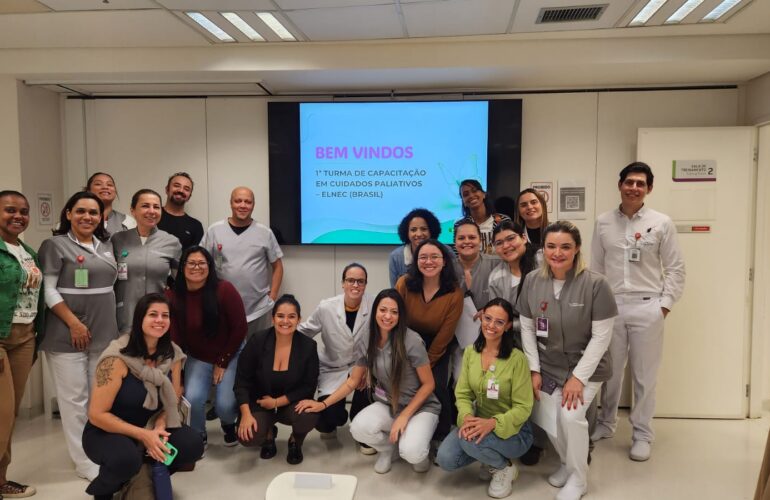
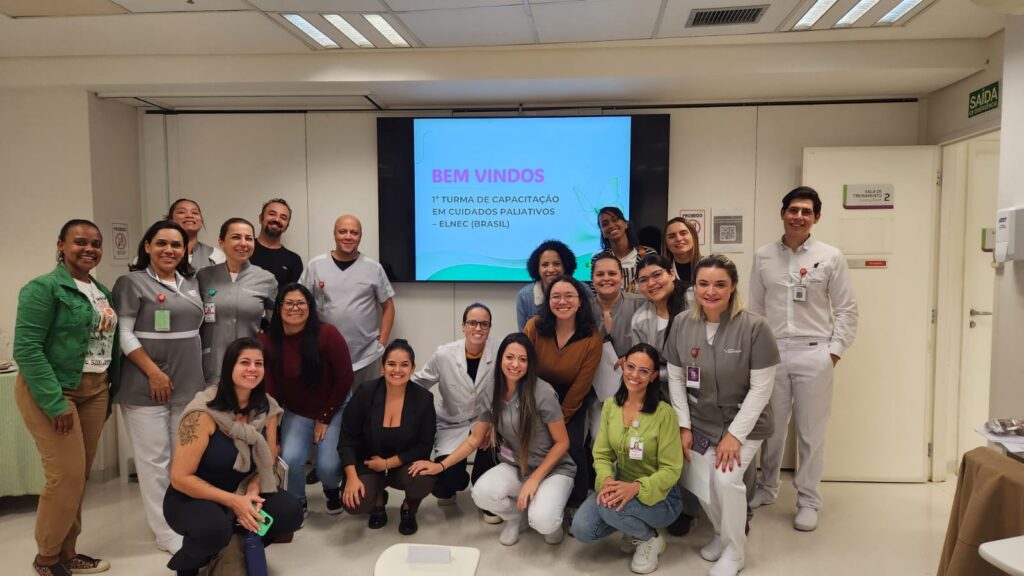
In October 2026, this initiative reached a new milestone with the delivery of the first ELNEC course in Brazil.
Interest exceeded initial expectations: 58 people registered within just four days. The first cohort consisted of 19 nursing professionals who participated in a week of educational activities, Monday through Friday, with four hours of training each day.
Over the five days, eight essential modules for palliative care practice were covered:
- Palliative Nursing;
- Ethical and Legal Issues in Brazil;
- Pain Assessment and Management;
- Symptom Management;
- Loss, Grief & Bereavement;
- Communication;
- Final Hours;
- Cultural and Spiritual Considerations.
The goal was to encourage not only knowledge acquisition but also reflection on the attitudes, values, and responsibilities of professionals caring for patients and families experiencing significant vulnerability.
Interest extended well beyond the first cohort. A second edition is already scheduled for January 2027, with 22 available seats and a waiting list of professionals interested in participating. This response highlights the demand for structured palliative care education opportunities and the importance of expanding access to initiatives of this kind.
What Do Participants Take Back to Their Practice?
Pre- and post-course evaluation forms allowed us to understand participants’ expectations and assess their experience.
The pre-course questionnaire received 19 responses. Most respondents were registered nurses (78.9%), while 21.1% were nursing technicians.
The topic of greatest interest was palliative care in nursing (47.4%), followed by ethical and legal issues in Brazil (21.1%). Participants’ expectations also reflected a desire to expand their knowledge, develop clinical skills, and provide safer, individualized, and more compassionate care.
In the post-course evaluation, which received 18 responses, participants rated their experience very positively. The course duration received an average rating of 9.94 on a scale of 0 to 10, while the average ratings for the eight modules ranged from 9.78 to 10.
However, perhaps the most meaningful findings emerged when participants described what they intended to bring into their professional practice.
Empathy, compassionate support, and humanized care were mentioned by 38.9% of respondents. Whole-person care for patients and families was also mentioned by 38.9%, while 27.8% mentioned the importance of sharing their newly acquired knowledge with other professionals.
Self-care, communication, active listening, confidence, and symptom management were also frequently mentioned.
Some participants’ comments particularly capture the impact of the experience:
“Understanding that palliative care goes far beyond simply controlling symptoms.”
“Reflecting on the perspectives of patients and families. This shift in perspective.”
“Prioritizing self-care. Strengthening yourself so you can care for others.”
“A different, more compassionate perspective, completely transformed by this specialty, which is so beautiful, important, and necessary.”
“Understanding that other people’s pain matters! Knowing how to listen, even if that is all we can do at that moment.”
These reflections reinforce something essential: teaching palliative care is not simply about transmitting technical knowledge. It is also about creating opportunities for professionals to recognize suffering, develop sensitivity, and understand the human dimension of care.
An Initiative That Is Just Beginning
Bringing ELNEC to Brazil represents much more than delivering a course. It is an opportunity to contribute to a culture of continuing education in palliative care, strengthening the role of nursing, and expanding opportunities for knowledge sharing.
The experience in Salzburg taught me that palliative care education is a collective endeavor. No country has all the answers, and exchanging experiences among professionals from different cultures allows us to recognize shared challenges and learn from different perspectives.
Likewise, I believe that knowledge should not remain limited to those who have had the opportunity to participate in international training. It needs to be shared, adapted, and multiplied.
The first Brazilian cohort was an important step in that direction. The interest in the second edition demonstrates a genuine demand for education and reinforces the need to continue creating opportunities to prepare professionals who can provide competent, ethical, and compassionate care.
The translation and adaptation of the educational materials are ongoing, as is the planning of future cohorts and the possibility of expanding the reach of this initiative.
If Salzburg taught me that palliative care is a shared language across countries, I now hope to contribute to making that language accessible to an ever-growing number of professionals in Brazil.
We are just getting started.
Acknowledgments
I am deeply grateful to Betty R. Ferrell, Judith A. Paice, Catherine O. Durham, Sarah Lowry, Carrie L. Cormack, and Nicoleta Mitrea for their generosity, wisdom, and meaningful contributions to my growth as a palliative care nurse.
Suggested Reading
For readers interested in learning more about ELNEC’s history, its contribution to international palliative care education, and the experiences of professionals involved in bringing the program to different countries, we recommend the following publications:
- de Camargo JD. Palliative care as a shared language: reflections from an ELNEC seminar in Salzburg. Palliat Support Care. 2026;24:e115:1-2. doi:10.1017/S1478951526102405.
- Paice JA, Malloy P, Mazanec P, Coyne PJ, Virani-Cooksey RM. Dr. Betty Ferrell and the extraordinary pursuit of worldwide palliative nursing education. J Pain Symptom Manage. 2025;69(1). doi:10.1016/j.jpainsymman.2024.10.008.
- Mitrea N, Moşoiu D, Ancuţa C, Malloy P, Rogozea L. The impact of the End-of-Life Nursing Education Consortium International Training Program on the clinical practice of Eastern European nurses working in specialized palliative care services: a Romanian case study. J Hosp Palliat Nurs. 2017;19(5):424-434. doi:10.1097/NJH.0000000000000367.
==============
ehospice is proud to help promote individual, local, national and international voices in Hospice & Palliative Care
We are on target to have over One Million page views this year.
To stay in touch with colleagues and news around the world subscribe to our free Newsletter


Leave a Reply