


The International Children’s Palliative Care Network (ICPCN) and World Child Cancer (WCC) alongside a range of key stakeholders, have been working collaboratively since 2022 to support the development of Children’s Palliative Care (CPC) in Ghana. This pioneering work has now extended to West Africa, and it is an exciting time for CPC development across the region as capacity for delivering quality care to children living with life limiting conditions and their families continues to rise.
A needs assessment and situational analysis estimated that in 2019 there were 152,238 children < 20years of age who needed palliative care: 101 per 10,000 children, and yet provision of CPC was at a very early stage. Building on this foundational work, Phase 2 of the project (#ChilPalCareGhana), focused on creating education and training opportunities to build capacity for CPC in Ghana. Hence in 2024, a range of strategies for education and capacity building were activated including monthly interactive webinars, multi professional training in CPC, clinical placements in Ghana and the UK and collaboration with the Ghana Colleges of Physicians and Surgeons, Nurses & Midwives and Pharmacists to explore the integration of CPC into their curricula.
Stepping into Phase 3
This year, Phase 3 of the project aims to embed CPC education within the health system in Ghana and establish a hub for CPC across West Africa. The aims and objectives of Phase 3 include:
- Integrating CPC into the three main colleges in Ghana – for Physicians and Surgeons, Nurses and Midwives and Pharmacists
- Extending webinars and virtual training to the West African Region
- Piloting the utilisation of the Children’s Palliative Outcome Scale (C-POS) in routine CPC clinical practice in Ghana and Nigeria
- Supporting other aspects of CPC development in partnership with the Ghana Health Service and Ministry of Health
- Sharing experiences and dissemination of learning
Train the Trainer’s (ToT) Programme
In July 2025, the ToT programme commenced and was conducted in three parts; Initial virtual training sessions x4, two days of face-to-face training and two follow up virtual training sessions. Thirty participants comprising of nurses, doctors and pharmacists were selected from the three colleges in Ghana and four of these participants came through the Hospice Palliative Care Association of Nigeria (HPCAN).
Aims and objectives of the ToT programme:
- To build capacity for delivering children’s palliative care training in Ghana
- To provide a CPC train the trainers programme to a range of professionals working across Ghana and Nigeria through the Colleges
- To develop a group of professionals who can provide training on palliative care for children and young people across Ghana
- To build a community of practice of trainers for CPC in Ghana and Nigeria
Initial Virtual Training
The initial set of four virtual training sessions were set up over two weeks, each session ran for 1.5 hrs providing participants with opportunities to learn from and engage with subject experts. The sessions were supported by partners from Stanford University, St Jude Global Palliative Care as well as Ghanian CPC practitioners. Content covered included introducing the training of trainer’s concept, consideration of challenges for training and skills to teach content both virtually and face-to-face.
Face to face Training
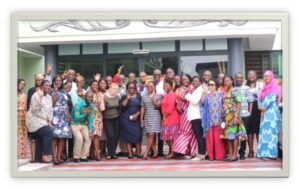
A vibrant group of participants gathered for the in-person training sessions held over two days in Accra. The in -person sessions were supported by Dr Barbara Sekyere and Dr Nihad Salifu, local CPC practitioners. During these sessions, participants were able to embrace real-life experiences as they actively engaged in some of the more practical training sessions e.g. communication skills, case studies, role plays etc. In addition, participants were asked to identify teaching opportunities from their context and to plan a one-hour teaching session on a CPC topic of their choice.
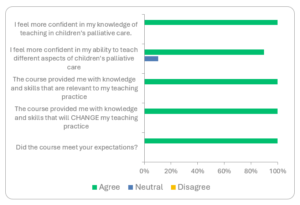
A Survey Monkey based questionnaire was circulated to evaluate the in-person training. Participants were asked to assess the overall training and to choose an option that best reflects their feelings about the training:

Alongside the training, a series of short video film clips were developed to support ongoing training and the sustainability of CPC geared towards the local context. Ghanian personnel contributed to the script and participated in the films, and a range of scenarios were recorded:
- Breaking significant / bad news to family members using the SPIKES protocol
- Use of NURSE framework to contain emotions
- Examples of good and poor active listening
- Pain assessment and management
- Highlighting importance of MDT discussions
Final Virtual Training
The final set of virtual training sessions took place three weeks following the in – person sessions. Participants were asked to facilitate a 5min session outlining aims of their planned session, training methods to be used, resources and some of the practical ways they will do it. These sessions were conducted using Zoom break out rooms and supported by colleagues from St Jude Global Palliative Care and Ghanian CPC practitioners. Several participants expressed appreciation for the opportunity to obtain feedback from experts in a safe, contained environment.
Conclusion
Through local and international partnership, strong foundations for the ongoing development and sustainability of CPC developments in West Africa have been laid. We are excited to be able to continue to work with WCC, the Ghana Palliative Care Association and all our partners in Ghana and Nigeria. The commitment to and enthusiasm for developing the field further is inspiring and encouraging – through the ongoing efforts of these dedicated health care professionals and with the support of strategic partners, CPC is set to soar across the region.
By Alex Daniels, Education Manager, ICPCN



Leave a Reply