


You can watch the webinar video recording in English or Russian on our YouTube channel.
- Introduction
- About the Centre for Palliative Care in Prague
- Healthcare in the Czech Republic
- The Origin of the Hospice Movement in the Czech Republic
- Cesta domů: Broader than Hospice Care
- The Czech Society for Palliative Medicine
- Medical Specialisation
- Money and Funding
- Fundraising in Public Healthcare Systems
- Collaboration
- The Value of the Data
- Introducing Palliative Care in Hospitals
- Introducing Palliative Care in Nursing Homes
- The Advisory Board
- Building Communities
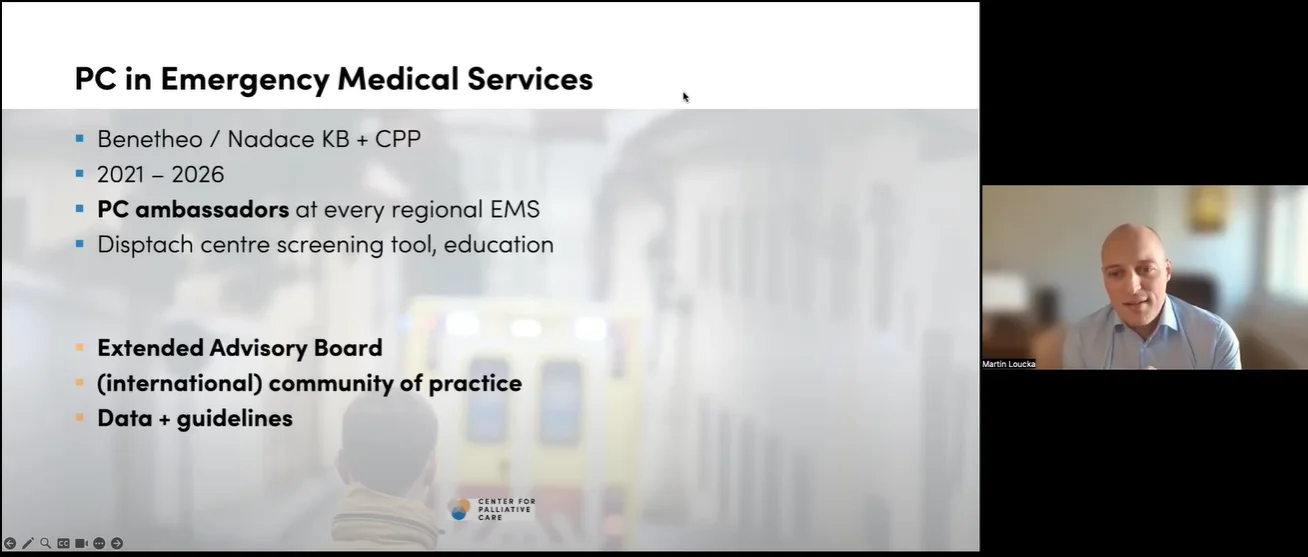
- Introducing Palliative Care in Emergency Medical Services
- Conclusion
- Q&A
My presentation today will be in four sections:
- I will briefly describe our centre.
- I will discuss how our healthcare system operates. It’s crucial to base all the information on the realities of our system.
- I want to share five key points regarding the development of palliative care in our country, from my perspective. While there are undoubtedly many other significant moments and initiatives, these five are the ones I wish to highlight, and we can explore the various aspects later.
- At the end of the presentation, I would like to share three examples of system change projects that my organisation has undertaken. Hopefully, this will inspire those working to improve palliative care in your countries.
We also conduct extensive research because it is essential for advancing palliative care. Many people become emotional when discussing palliative care, and such a response only carries us so far. When considering system development and improving access to palliative care nationally, you will encounter individuals not swayed by patient stories. They will seek data and models to implement within the system. Data is crucial for persuading policymakers and stakeholders involved.
We are an NGO, but we also strive for financial independence. We sell our services, which I had to learn to do. One should achieve a degree of financial independence. Many funders and donors want NGOs to pursue autonomy and not rely solely on external financing.
We currently have around 200 hospitals, which is quite a substantial number for a country of our size. The Czech Republic covers approximately 79,000 square kilometres. Thus, with 200 hospitals in that area, there is a high density of medical institutions. Some people now criticise this as a somewhat outdated model—a remnant of the post-war system, where you effectively had a hospital around every corner. Currently, our system is undergoing reform.
We have approximately 1,000 long-term care facilities in addition to hospitals. These include what you might consider standard nursing homes—similar to those found in many countries—but also encompass what we refer to as ‘long-term care hospitals’. These are not social care institutions but medical facilities that employ physicians and nurses while providing long-term care. Patients may reside there for months, and many of them are, in fact, patients at the end of life.
When I began working in the field, I realised that if we genuinely wanted to create national-level change, we couldn’t achieve that by focusing on just one type of care.
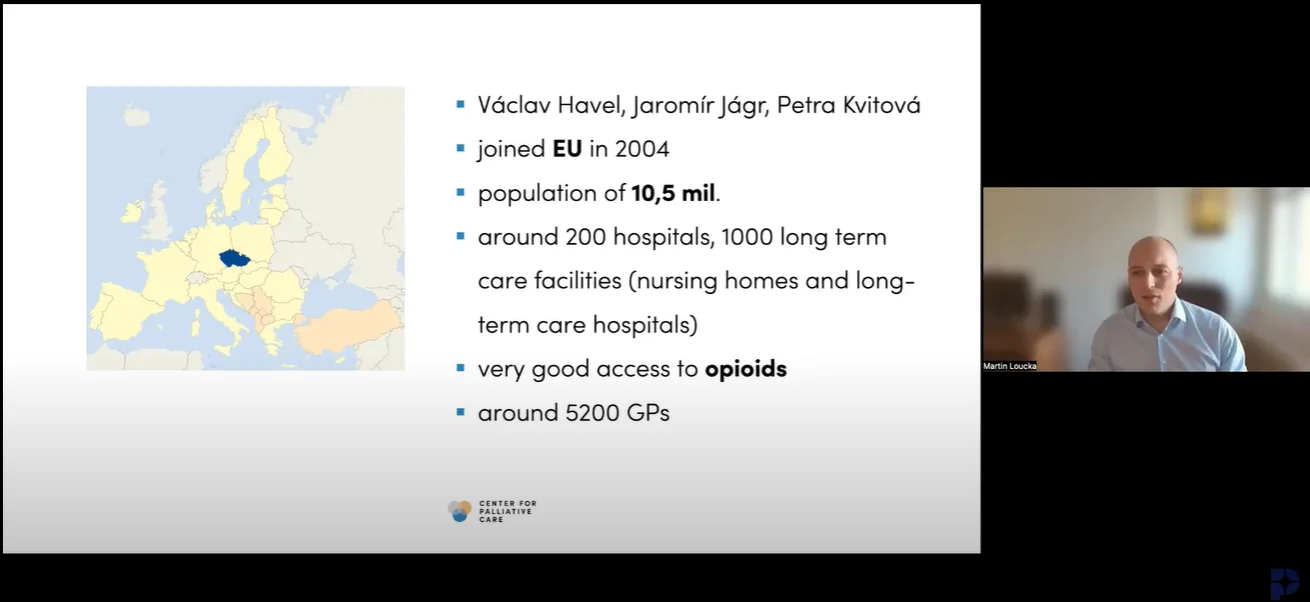
In our country, we’re fortunate to have excellent access to opioids. I understand this is not the case in many Eastern countries, so we recognise how lucky we are. Opioids are readily available, and nearly any physician involved in the care of patients at the end of life can prescribe them. General practitioners, internal medicine doctors, pediatricians, and oncologists—nearly all relevant specialties are authorised to prescribe opioids. Furthermore, these medications can be obtained from local pharmacies—you don’t need to travel to the capital city to access them. This is extremely important. I should also note that several European initiatives have supported enhanced opioid access.
Another critical aspect to emphasise is the role of general practitioners (GPs). We have approximately 5,000 GPs in the country, who are essential to the system. GPs should serve as primary care coordinators for patients nearing the end of life. So again, I encourage everyone to consider what they are doing to support general practitioners in their role in providing palliative care.
In the Czech Republic, our healthcare system is public and based on universal mandatory health insurance. Everyone contributes a portion of their salary and gains access to healthcare that is essentially free at the point of use. The cost covers both an initial visit to a GP and complex procedures like neurosurgery. This universal model closely resembles the systems in the UK and several other countries. It is a publicly funded healthcare system.
In the Czech Republic’s modern history, palliative care began with the emergence of hospices in the 1990s. One extraordinary woman, Dr. Marie Svatošová, was the founder and is widely regarded as the mother of the hospice movement in our country. She emulated the model of St. Christopher’s Hospice in London, the first modern hospice in the UK. Dr. Svatošová traveled to England, visited St. Christopher’s, and then raised the funds to build the first inpatient hospice unit in the Czech Republic in 1995.
Hospice was—and still is—operated as a non-governmental organisation, functioning outside the mainstream healthcare system. This is one of the key lessons we learned during that early phase. After the first hospice opened in 1995, similar services began to emerge in other regions of the Czech Republic—all established as standalone organisations outside the national healthcare system and relying heavily on donations, fundraising, and philanthropic support. Many hospice services worldwide have begun this way. Hospices in the Czech Republic are now fully comparable to those in other Western countries.
Such an approach made sense up to a certain point. Over time, our hospices became somewhat isolated. They existed in their bubble, and the connection between the hospice movement and the broader healthcare system simply didn’t exist. For almost twenty years, there was no real integration. As a result, we found ourselves in a bizarre situation. We had excellent facilities providing high-quality palliative care, yet only about 3% of people in the country died in a hospice.
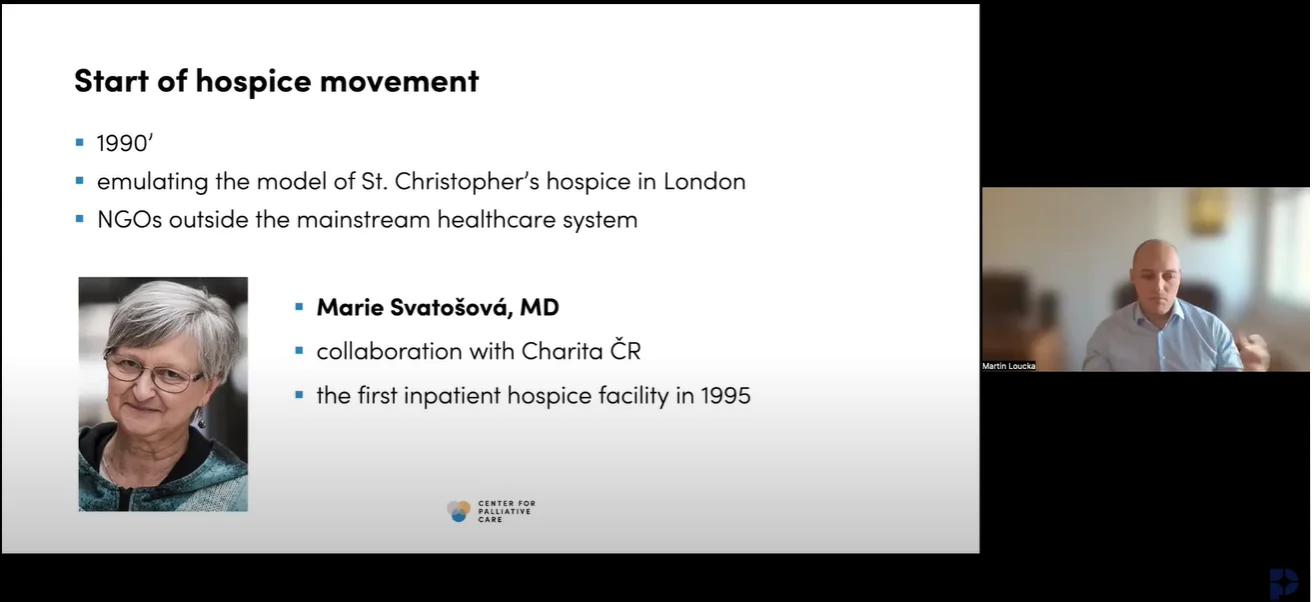
When we established our organisation, one of our first goals was to change that. We realised this is what we need to work on: we need to open the doors and windows and build bridges between these incredible hospice services and the rest of the healthcare system. It simply didn’t make sense to have world-class services that hardly anyone could access.
People didn’t know much about hospices, and there were many stereotypes. They often thought it was only for Christians because the first facility had been affiliated with a Catholic charity. Many assumed that its primary goal was to baptise everyone before they died. Of course, this was not true at all. Yet these misconceptions persisted, trapping people in them.
Early hospice pioneers made significant first steps. Everyone in our country’s palliative care is deeply grateful to Dr. Svatošová for her work. She even negotiated the first reimbursement model for hospice care, which was introduced in 1998. That was such an achievement. To put that into perspective: she managed to secure a financial reimbursement scheme only.
It all began with an organisation called Cesta domů, which translates to ‘the way home’ or ‘homecoming’. Established in 2001, it became the first home hospice organisation in Prague. I want to highlight their example because it is a truly special organisation. Interestingly, Cesta domů was founded by an artist, Martina Špinková. With enthusiasm, she gathered like-minded individuals, including nurses and physicians, who shared her passion for helping people at the end of life. Together, they began building this organisation from the ground up.
From the beginning, they didn’t focus solely on providing care; they also prioritised education, outreach, and advocacy.
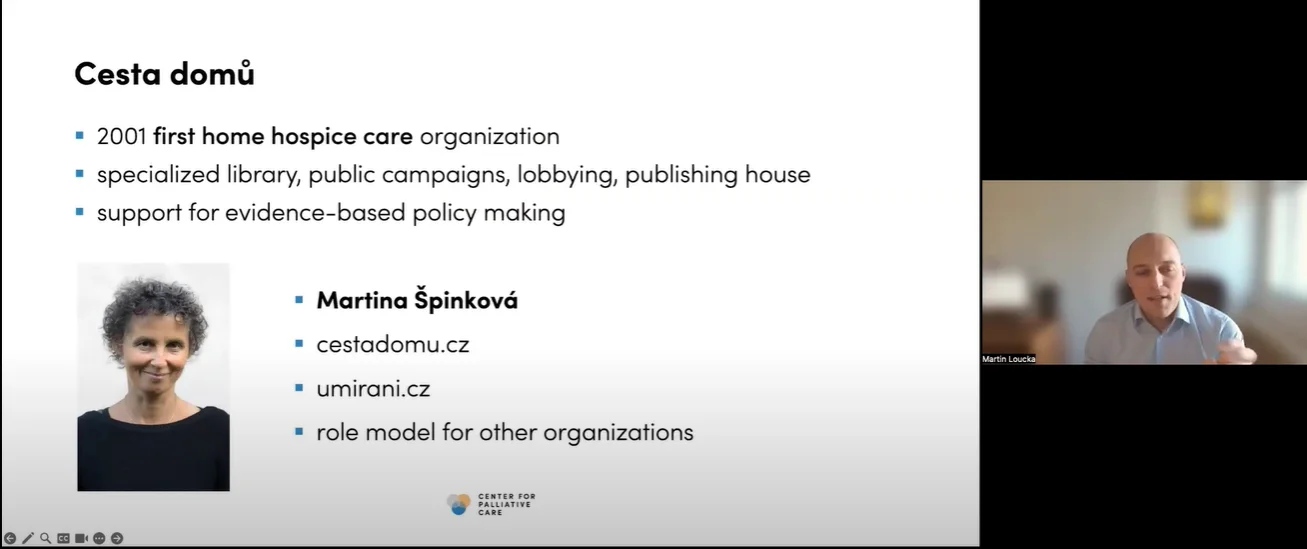
They also support public campaigns and lobbying efforts. Over time, they even established their own publishing house. Today, they are the largest publisher of palliative care literature in the Czech Republic. They translate books from abroad and encourage local authors to document and publish their experiences. If you seriously consider developing palliative care as a field, you need textbooks. You need educational materials that can be utilised in nursing schools, medical faculties, and other training institutions.
That’s why it was crucial that the Czech Society for Palliative Medicine was formally established in 2009. Creating a proper professional society for palliative medicine is essential—a formal space where professionals can meet, share ideas, and develop strategic plans to advance the field. Such a society also aids in establishing palliative care as a legitimate and respected medical discipline, equal to other specialties. Without it, a crucial piece of the puzzle is missing.
In 2016, the Czech Society for Palliative Medicine distinguished these two areas, establishing palliative medicine as a standalone medical specialisation—or subspecialisation—for physicians. Today, approximately 15 to 20 physicians complete this specialty training each year, which is significant.
To provide some context, this number exceeds the number of new clinical oncologists we train each year in the Czech Republic. Palliative medicine is becoming increasingly popular, and formally recognising it as a subspecialty is crucial in legitimising and advancing the field.
Just yesterday, I met with colleagues from the UK, who shared that in their country, palliative medicine is now the 11th largest specialty in the entire healthcare system. That’s an incredible achievement. This model works quite well, especially in systems like ours, where palliative medicine is offered as a subspecialty for doctors with backgrounds in internal medicine, oncology, or other relevant fields. It’s practical and encourages interdisciplinary expertise.
I was nervous when I finished my PhD in the UK and considered returning to the Czech Republic. I was more than nervous—I was pessimistic about how we would secure funding for our work. Especially after spending a few years in the UK, with its long and rich tradition of philanthropy and charity work, where people willingly volunteer and support nonprofit organisations, returning to the Czech Republic felt somewhat daunting.
Because of our history, such as during the communist era, people weren’t willing or able to contribute that way. Even if they had wanted to, the culture of giving simply didn’t exist. We had a minimal tradition of donating to charities, volunteering our time, or using financial resources to support causes. Therefore, I was skeptical about whether we could make it work.
But it did change, gradually yet significantly. Even when I returned in 2014, I noticed successful entrepreneurs and companies interested in supporting meaningful causes. Today, many excellent foundations, companies, and individual philanthropists genuinely want to support good causes. After more than 30 years since the Velvet Revolution, we can no longer attribute our limitations to the old regime. We can achieve great things; it’s simply a matter of discovering how to build the right relationships.
Donors may contribute money if you present them with a touching story—an elderly woman lying in bed, her granddaughter holding her hand, perhaps a dog curled up next to them. That’s beautiful. That’s powerful. And yes, they may send you some money to assist that lady. However, if you aim to create change on a national level, it’s a different story.
One standout example is the Abakus—or Avast—Foundation. Since 2014, it has invested over six million euros in palliative care projects nationwide. Initially established by a private company that developed antivirus software, it has remained a key driving force behind the advancement of palliative care in the Czech Republic.
Over time, we were fortunate to find more donors. Some came from large financial institutions, such as major banks. Others were independent philanthropists or private family foundations. But the bottom line is that you need to secure funding to create change. Often, this means learning how to communicate with those who can support your work emotionally and strategically.
Based on our experience, donors usually do not want to provide permanent funding for services the state is responsible for. However, they are open to supporting pilot projects—often quite generously—and collaborating on new, innovative, and meaningful initiatives that can enhance the effectiveness of the healthcare system. Nevertheless, there is a shared understanding: they do not wish to finance these efforts indefinitely. That expectation is reasonable. In a country with universal healthcare, once something proves effective, the government should ultimately take on its funding.
Governments often take time to adopt new ideas, pilot innovations, and implement changes. That’s why we have found it so effective to collaborate with philanthropic donors—those willing to provide significant funding to test promising pilot models, measure their impact with data, and then use that data as a foundation for advocacy. This is how we engage policymakers and advocate for systemic change.
Sometimes, different groups, all deeply committed to palliative care but not always aligned, create tensions. Even in this beautiful field, we struggle to work together rather than compete. But this mindset—collaboration over competition—is crucial. To have a tangible impact, you must learn to work with others and discover ways to cooperate across disciplines, institutions, and ideologies.
Consider these questions from the start:
- What data do we already possess?
- What data can we compare with other countries?
- How can we use that data in negotiations with policymakers, national insurance companies, or other stakeholders?
- Moreover, what data are we lacking?
- What do we need to gather, and how can we facilitate that?
This became a great example of a pilot project, funded by a private philanthropic foundation. We collaborated with the Czech Society for Palliative Medicine, which gave our small NGO initiative credibility. We collaborated with 26 hospitals for nearly five years to establish palliative care services.
We collected data to analyse the different trajectories hospitals had taken after two years and again after four. We examined the impact of these interventions at the institutional level and across various regions with differing population needs, and then published the results. We created comprehensive guidelines, compiling all the evidence and practical lessons learned, and made them publicly available to anyone interested, from policymakers to local hospitals and NGOs.
We conducted two rounds of this programme, collaborating with 15 nursing homes in each round, 30 in total. I’d like to emphasise that this initiative wasn’t solely about education. Yes, we provided training, but more importantly, we offered mentoring focused on systemic change.
Another major success was the development of advanced care planning tools. As you may know, palliative care is not just about morphine; it involves planning, asking the right questions early, and ensuring that the care provided aligns with the patient’s goals and values. Therefore, we created practical tools for staff to engage in meaningful conversations with residents and families. These tools assisted them in establishing care goals and documenting preferences for end-of-life care. This represents a significant shift—from reactive care to proactive, values-driven planning.
We consistently reached out to individuals from the Ministry of Health, the Ministry of Social Affairs, insurance companies, and other key institutions, requesting that they nominate someone from their organisation to join our extended advisory board. We clearly communicated that we did not require anything specific from the participants and did not impose any commitments. We simply sought their perspectives and opinions. This approach was effective.
In this field, individuals and organisations often feel isolated, as if they are alone in their fight against the system. However, when gathered together in the same room, they realise that they are not alone and are facing similar challenges. This realisation can be incredibly empowering and can accelerate development far more effectively than individual organisations working alone ever could.
Typically, the CEOs or directors of EMS organisations aren’t very interested in palliative care. They’re more focused on acquiring new helicopters or advanced life support technology, which isn’t exactly our topic. However, once they officially nominated someone, that individual suddenly gained recognition within their organisation. This meant they had the authority to email colleagues, organise training, introduce research, and advocate for new initiatives. Many of these ambassadors exceeded our expectations. They generated brilliant ideas—even better than some of what we had initially planned! By granting them this official role, we enabled them to advance matters far more quickly than we could have.
- You need passionate pioneers and advocates. It always starts with people. You must look around and find others who are enthusiastic about doing this work. It’s hard work—it takes a toll—but I firmly believe that in every country, people are willing to join you. Don’t do it alone. Find at least one or two others who can walk the path with you.
- You need to build beacon organisations—real-life examples demonstrating how it works. You need excellent care providers who can showcase what palliative care looks like when it’s done right. These beacon organisations must also possess educational capacity, as one challenge we now face in the Czech Republic is that the demand for palliative care education is outpacing our ability to train new people. Therefore, consider this from the beginning. If you’re creating a model hospice or hospital service, reflect on how you will share what you’ve learned and train others.
- Seek donors to support pilot projects. Frame these as pilots—demonstrate to the funders that they will see tangible results, and that those results will be utilized to negotiate with ministries and insurers.
- Finally, data, data, data. I’ve said it a thousand times, and I believe in it. You need data. If you already have a good clinical organisation, I suggest building partnerships with universities rather than trying to do all the academic work yourself. Having a strong evidence base is essential if your ultimate goal is systemic change.
Which organisation regulates hospices in the Czech Republic? Do they operate under the Ministry of Health, or is there another body that oversees their activities?
Martin Loučka
How have you managed to ensure such good access to opioids in your country, especially with so many different types of doctors (such as GPs, oncologists, etc.) able to prescribe them?
Martin Loučka
This wasn’t my achievement; it had already been in place. What surprises and truly saddens me is that access remains very limited in many other countries. Therefore, the real question is: What can we do to help increase access elsewhere? This shouldn’t be an exception; it should be the standard everywhere. According to the WHO guidelines for pain management, opioids are the recommended treatment, even for moderate pain.
We do have different kinds of problems in our country. Opioids are accessible, yet many doctors still hesitate to prescribe them. Some fear morphine, others believe it should be reserved for patients in their final days, and some are excessively worried about addiction. We’ve also been addressing this, supporting hospitals and GP practices in overcoming these psychological and cultural barriers. There are also administrative challenges, such as documentation requirements, but it’s manageable.
Is connecting with the government and maintaining relationships with ministries essential for the Centre for Palliative Care?
Martin Loučka
Yes, absolutely. If you’re working within a public healthcare system, making a real impact is impossible without cultivating strong relationships with key stakeholders, particularly government institutions.
Have you ever encountered situations where you or the Centre for Palliative Care struggled to find common ground or disagreed with other institutions, such as medical schools, hospitals, or ministries? If so, how did you address those conflicts?
Martin Loučka
I like to think I’m a pretty nice guy, and I’m usually happy to collaborate with anyone willing to work with me. However, I haven’t always been successful. There have been times when I encountered people who simply didn’t want to cooperate or couldn’t find a common language.
One of my mentors from the US once told me, ‘Start working with the people who like you. The others will join later’. I think that’s good advice.
What kind of research has your Centre conducted recently? Is there anything published that we can read, particularly in English?
Martin Loučka:
We publish numerous guidelines and materials in Czech to ensure they are practical and accessible for local service providers. Many of these providers do not read peer-reviewed journals in English. At the same time, we remain committed to rigorous research and publish extensively in international palliative medicine journals. You can find those publications by going to Google Scholar and searching for ‘palliative care Czech Republic’ or even by entering my name.
We publish everything in an academic format because it helps us advocate for palliative medicine as a serious medical field. We need to speak the same language as oncologists and cardiologists. This is also why I strongly recommend collaborating with universities and academic institutions in your own countries; they can assist you in producing research in the most professional and impactful manner possible.
This article was first published on the PACED website and is republished here with permission.
ehospice is proud to be a communications partner with PACED and we regularly republish articles from their website. Working together we seek to increase awareness of and access to hospice and palliative care programmes.
PACED articles recently published in ehospice include:
https://ehospice.com/editorial_posts/women-will-save-the-world-i-believe-in-it/
https://ehospice.com/editorial_posts/learning-about-paced/
https://ehospice.com/editorial_posts/checklist-how-to-observe-a-palliative-care-organisation/


Leave a Reply