

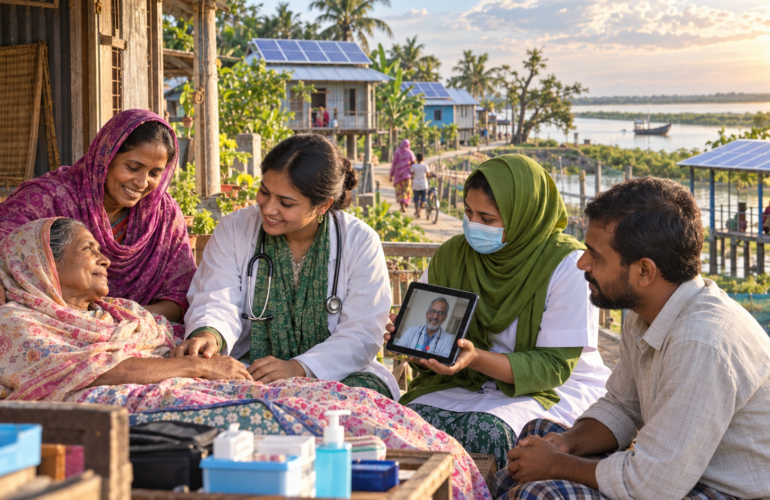
Palliative care does not take place in isolation. It takes place in homes, communities and health facilities—and increasingly, in an environment shaped by climate change, extreme heat, floods, cyclones, air pollution, poor housing and social and economic insecurity. For people living with serious or life-limiting illness, these conditions are not simply background circumstances. They can directly influence symptoms, access to care, family caregiving and, ultimately, a person’s comfort, dignity and quality of life.
This is why the environmental dimension of palliative care deserves much greater attention, particularly in countries such as Bangladesh, where climate vulnerability and unequal access to healthcare intersect.
Bangladesh is already experiencing a changing climate. World Bank analysis shows that the country’s maximum temperature increased by about 1.1°C between 1980 and 2023, while the “feels like” temperature increased by approximately 4.5°C. A nationally representative survey of more than 16,000 people in 2024 also found associations between extreme heat and a range of physical and mental health problems, including persistent cough, respiratory symptoms, exhaustion, depression and anxiety.
For a healthy person, extreme heat may mean discomfort and fatigue. For someone living with advanced cancer, chronic respiratory disease, heart failure, kidney disease, neurological illness or frailty, the same environmental stress can be far more consequential. Heat, dehydration, poor air quality and disrupted sleep may intensify existing symptoms and reduce a person’s ability to cope with illness. Climate change therefore has implications not only for preventing disease, but also for managing suffering among people who are already seriously ill.
The challenge becomes even more visible during disasters. Bangladesh regularly experiences floods, cyclones, extreme rainfall and other climate-related emergencies. These events can damage health facilities, disrupt electricity and transportation, displace families and interrupt the supply of medicines and essential medical equipment. The consequences for palliative care can be profound. A flooded road may mean that a community health worker cannot reach a bedbound patient. A prolonged power outage may affect oxygen-dependent patients or other essential equipment. Disrupted transport may prevent a family from collecting medicines or reaching a health facility.
For someone living with serious illness, therefore, a climate-related disruption is not merely an environmental event. It can become a disruption of care.
This is particularly important because Bangladesh has a substantial unmet need for palliative care. A 2023 study estimated that nearly 602,000 people in Bangladesh require supportive and palliative care each year. Yet access remains highly limited, and specialist services are concentrated mainly in Dhaka. This geographical imbalance means that environmental disruptions can disproportionately affect people living in rural, coastal, flood-prone, remote or economically disadvantaged communities.
The evidence from Bangladesh also tells us something important about where palliative care can be delivered. Community-based care is not simply an alternative to hospital care; it can be an effective way of bringing compassionate support closer to people’s lives. Research from the Compassionate Narayanganj programme found that cancer patients receiving community-based palliative care experienced significant improvements in overall quality of life, along with reductions in pain, drowsiness and shortness of breath. Another evaluation of community palliative care among older people in an urban informal settlement in Dhaka found benefits in psychosocial and spiritual care, caregiver training, emergency response and reductions in out-of-pocket healthcare expenditure.
These findings have a wider implication for Bangladesh: bringing palliative care closer to the community may also make the system more resilient.
But “environment” in palliative care should not be understood only as climate and natural disasters. The environment in which a person spends their final months, weeks or days can be equally important. A hot and poorly ventilated room, inadequate privacy, overcrowding, unsafe housing, lack of clean water, financial insecurity or the absence of a caregiver can all add to suffering. Conversely, a familiar home, adequate ventilation, natural light, privacy, family presence and a sense of security can contribute to comfort and dignity.
This matters because palliative care is fundamentally concerned with the whole person—not simply the disease.
Research from Bangladesh reinforces this broader understanding. Studies of people receiving home-based and community palliative care have highlighted the importance of physical, psychological, social, spiritual and environmental dimensions of quality of life. In low-income communities, where poor housing, poverty and limited access to healthcare often coexist, these factors can become inseparable from the experience of serious illness.
There is also a deeper issue of equity here. The people most exposed to environmental risks are often those with the fewest resources to respond to them. A low-income family caring for a terminally ill patient may already struggle to afford medicines, nutritious food and transportation. When a flood destroys a road, when extreme heat makes a poorly ventilated home unbearable, or when a family member has to stop working to provide care, the financial and emotional burden can increase further.
This is where the principles of palliative care and climate justice converge. A compassionate health system cannot simply ask whether a service exists. It must also ask whether people can reach it, afford it and continue receiving it when circumstances become difficult.
For Bangladesh, this means that palliative care should increasingly be incorporated into climate-resilient health-system planning. Primary healthcare and community health workers should have basic palliative-care competencies. High-risk patients could be identified in advance of major heatwaves, floods and cyclones. Essential medicines and symptom-control supplies should be available through decentralized systems.
Home-care programmes need contingency plans for disrupted transportation and communication. Health facilities providing palliative care should consider reliable backup power, oxygen availability and emergency referral pathways. Families and caregivers should also receive practical guidance on how to maintain essential care during environmental emergencies.
Technology may support this effort through teleconsultation, mobile communication and digital patient records—but technology should complement, not replace, human contact. Palliative care ultimately depends on relationships, trust and presence.
The goal is not to create a completely climate-proof healthcare system—no system can eliminate every disruption. The goal is to ensure that when disruption occurs, the most vulnerable people are not the first to be left behind.
As a palliative care advocate, I believe we need to broaden the way we think about suffering. Pain may require analgesia. Breathlessness may require clinical intervention. Anxiety may require psychological and emotional support. But sometimes suffering is also intensified by a flooded road, an unbearably hot room, an unavailable caregiver, an interrupted medicine supply or the inability to reach a health professional.
These are not separate from palliative care. They are part of the context in which palliative care happens. The future of palliative care in Bangladesh must therefore be community-based, equitable, accessible and climate-resilient. It must move beyond the walls of hospitals and recognise the realities of the homes and communities where people actually live and die. Climate resilience, in this sense, is not only about protecting infrastructure. It is about protecting continuity of care, dignity and human connection.
A person living with a serious illness should not have to suffer more simply because they live in a flood-prone village, an overheated urban settlement, a remote coastal community or a household with limited resources.
We may not always be able to change the course of a disease. We may not always be able to prevent a storm, a heatwave or a flood. But we can design our health systems so that compassion does not disappear when circumstances become difficult.
Because palliative care is ultimately about one simple commitment: wherever a person is living with serious illness, they deserve relief from suffering, respect for their dignity and the assurance that they will not be left alone.
Selected evidence
- World Bank — Bangladesh: Heat and Health
- Impact of Community Palliative Care on Quality of Life among Cancer Patients in Bangladesh
- Palliative Care Needs and Quality of Life among Adults with Advanced Chronic Illnesses in Low-Income Communities of Bangladesh
- Community Palliative Care among Older People in an Urban Slum in Bangladesh
Author Bio: Sumit Banik is a prominent public health activist, writer, and trainer from Bangladesh who is widely recognized for his dedicated advocacy in advancing palliative care services. He champions the idea that compassionate end-of-life care is not a privilege, but a fundamental human right and social justice issue.
==================
ehospice is proud to help promote individual, local, national and international voices in Hospice & Palliative Care
We are on target to have over One Million page views this year.
To stay in touch with colleagues and news around the world subscribe to our free Newsletter


Leave a Reply